


The National Railroad Museum is about a mile off WI Hwy 172 on South Broadway in Ashwaubenon south of Green Bay, WI. It is open April-December Mon-Sat 9am-5pm and Sun 11am-5pm, and January-March Tue-Sat. It is closed Easter, Thanksgiving, Christmas Eve, Christmas and New Year's Day.
The museum was conceived by D. C. Everest, president and chairman of Marathon Corporation, a Wisconsin paper manufacturer. Formed in 1956 with the aid of community volunteers, its mission is to educate the public about the ongoing impact of railroads on their daily lives and it has a significant collection of railroad objects, photographs, manuscripts and rolling stock.
What began as an effort to acquire a single steam locomotive for a city park quickly grew into one of the largest railroad museums in the US. In 1958, a
Congress resolution recognised the museum as the National Railroad Museum and, over the years, the collection has grown through the work of its patrons and donations.




Above, a view of the main entrance and visitor center.
The museum has three main buildings. On the left in the view to the right is the Victor McCormick Train Pavilion, named after local businessman and one of the founders of the museum. The middle building is the Frederick J. Lenfestey Center, named after a leader in development of the museum and chairman for fourteen years. The low building on the right is the visitor center, main ticket office and library. Below, another view of the visitor center.


The museum receives over seventy-five thousand visitors annually from all over the world.
Above, parked in the middle foreground in the
view of the museum grounds are Fairport, Painesville & Eastern Railroad Alco S-2 #103, now liveried as Fort Howard Paper #403, and US Army Alco RSD-1 #8651. Green Bay & Western Railroad Alco C-430 #315 and Wisconsin Central Railroad EMD GP30 #715 stand beside the Victor
McCormick Train Pavilion on the far left. The rails in the lower foreground are part of a perimeter track used for diesel hauled train rides in the summer season.
The photo was taken looking north-east from the eighty foot high wooden observation tower at the south-east of the museum grounds beside the Fox River.


Above, a model of SOO Pacific type (4-6-2) H-23 #2718 on display in front of the visitors centre.


The original SOO H-23 #2718 has survived and is in the museum's collection.


Designed by L&NER's Nigel Gresley for fast passenger service between London, Scotland and the North of England, the A4 class has three 18½" x 26" cylinders and 80" drivers. It operated at a boiler pressure of 250 psi and delivered 35,455 lbs tractive effort.
Thirty-five streamlined A4 locomotives were built by the L&NER. They had a top speed of 90 mph but could reach considerably higher speeds. On 3rd July 1938, #4468
"Mallard" set an official world steam locomotive speed
record of 125 mph pulling six coaches and a dynamometer
car. The speed has never been topped by another steam locomotive.

Outshopped from the London & North Eastern Railway's Doncaster Works in the United Kingdom in September 1937, this coal burning A4 Pacific type (4-6-2) locomotive was originally numbered #4496 and named "Golden Shuttle". It was renamed "Dwight D. Eisenhower" and renumbered #8 after WWII. With nationalisation of the British Rail system in 1948 the locomotive became #60008. It spent much of its operating life working out of Kings Cross, London, and was finally withdrawn from service in July 1963.
The following year, the engine was restored at Doncaster and donated to the National Railroad Museum. It was shipped to the US, arriving in May 1964.

In October 1990, #60008 was moved to Abilene, KS, for the celebrations of the centenary of Eisenhower's birth.
In 2012, #60008 was loaned to the National
Railway Museum in York, UK, for two years. While there, it received a new coat of authentic BR Brunswick Green paint to replace the inaccurate shade applied during a repaint at Green Bay. It went on display at the York museum, as well as appearing at various times with five other A4 survivors. An anonymous donor apparently offered the Green Bay museum $1 million to allow the engine to stay in the UK but, in 2014, it returned to the US.
It is on display with two British passenger carriages once used as part of Eisenhower's Command Train restored to the condition they were in when used by Eisenhower.


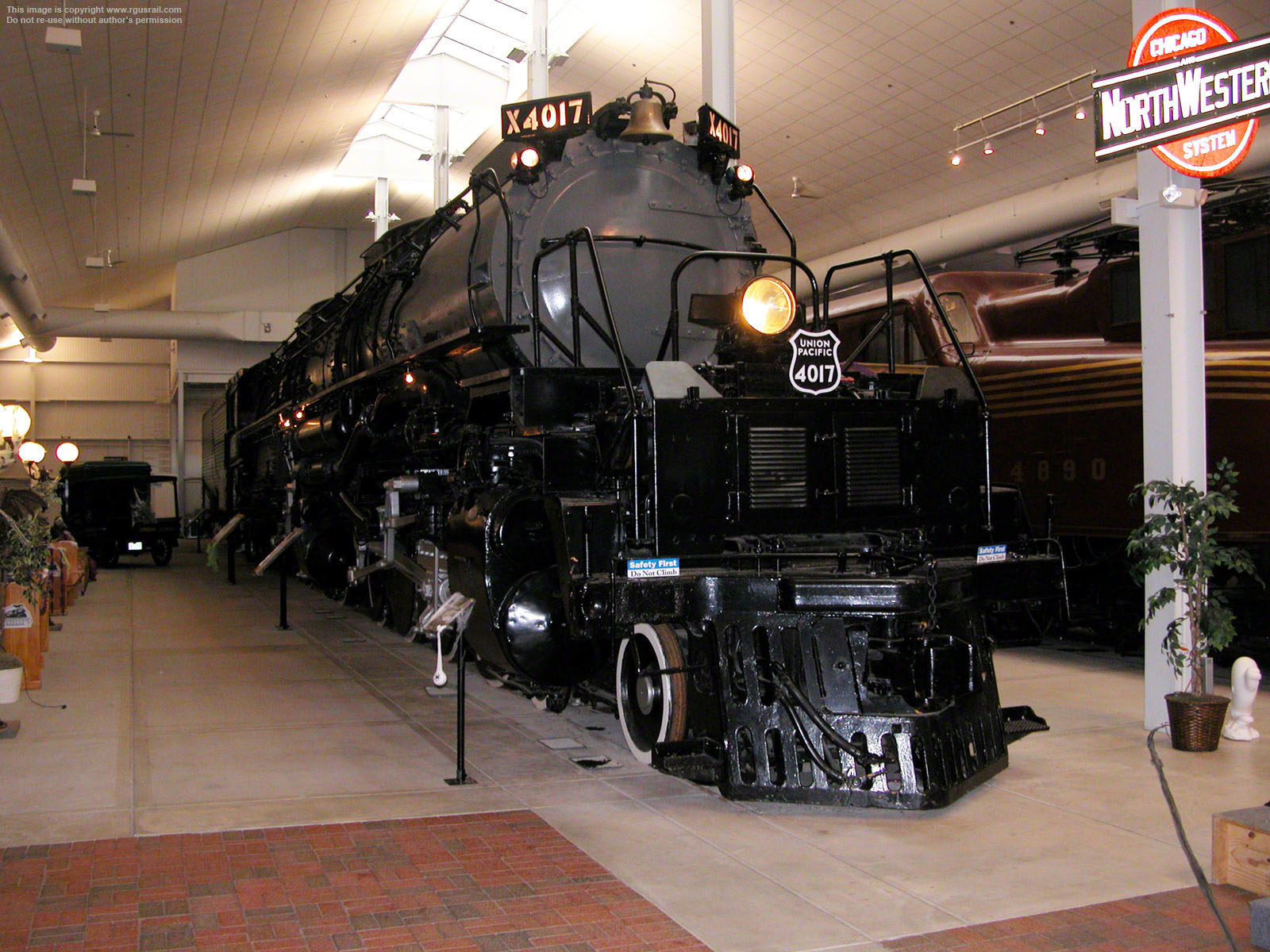
#4017 is one of eight surviving Big Boy (4-8-8-4) locomotives built for the Union Pacific by Alco. It arrived at the museum in 1961.
You can see other Big Boys on this website: #4004 is on the Cheyenne Big Boy page, #4005 on the Forney Museum of Transportation, #4006 on the National Museum of Transportation, St. Louis Yard, #4012 on the Steamtown, #4014 on Southern California RLHS page, #4018 on the Museum of the American Railroad and #4023 on the Kenefick Park pages.


Big Boys' pilots were cast separately by General Steel Castings. An opening was left for the Buckeye Steel cast coupler. In the photos above, it is shown in the open position with the coupler extended.
#4017 was one of the last Big Boys to undergo heavy repairs at Union Pacific's Cheyenne, WY, workshops in July 1959. At a contemporary value of $35 per ton, it would have realised $18,000 if sold for scrap that year.

A view under the cab.
The air brake control valve is on the upper middle right. The injector overflow pipe and spreader is in the lower middle.

The red wheel in this photo opened the hoppers to dump the contents of the ash pan.
Note the SKF roller bearings stamp on the journal box.

The boiler cladding has been removed, and this view shows the many stay bolts.
Compare this with #4004 on the Kenefick Park page of this website.

The upper part of this photo shows the Alco power reverse lever.
Also visible, the Walschaert valve gears, elliptical upper springing for the drive wheel, the multiple guide and brace and Alco designed Laird-type crosshead.

The front right hand Nathan lubricator is on the left of this photo.
Operated by a chain gear, it replaced the original rod that proved prone to fracture.

View of lubrication lines to right hand pistons and valve bushings.
The Big Boy's 32" stroke required continuous lubrication to avoid damage to the cylinders.
The UP has donated many locomotives for preservation, continues to steam Challenger #3985 and FEF-3 #844 as part of its Heritage Fleet and is the process of restoring Big Boy #4014, a testament to its commitment to preserving its historic legacy.
There are photos of many more historic and modern UP locomotives on this website. You can see a list of them by type and number on the roster page.

The lubricating reservoir for the air pumps is in
the upper right of this photo.
This was originally positioned ahead of the cooler on the pilot.

Above, a view looking out the cab window on the fireman's side.
With the cladding removed, #4017's stay bolts are clearly evident.

Above, a view from the engineer's side.
It's not clear why the cladding was removed. This is usually done to protect against damp on outdoor display.


Above, #4017's backhead. Hover your mouse over the photos to identify some of the main backhead components.
1. Fireman's Boiler Pressure Gauge
2. Fireman's Train Control Lights
3. Steam Heat Pressure Gauge
4. Feedwater Pump Pressure Gauge
5. Stoker Steam Jets Gauge
6. Injector Lever
7. Blower Steam Valve
8. Stoker Booster Valve
10. Boiler Feedwater Adjuster Valve
11. Hose Valve
12. Steam Supply to Firebox Jets
13. Right Front Ash Pan Sprinkler Valve
14. Right Rear Ash Pan Sprinkler Valve
15. Left Front Ash Pan Sprinkler Valve
16. Left Rear Ash Pan Sprinkler Valve
17. Stoker Engine Lubricator
18. Fireman's Boiler Sight Glass
19. Engineer's Boiler Sight Glass
20. Dynamo Steam Valve
21. Fire Box Door Air Valve
22. Fire Box Door Actuator
23. Fire Box Door
24. Ash Pan Sprinkler Main Valve
25. Grate Shaker Access Hatch
26. Stoker Auger Access Hatch
27. Roof Access Handle
28. Tri Gauge Cocks
29. Engineer's Boiler Pressure Gauge
30. Engineer's Train Control Lights
31. Whistle Lever
32. Throttle
33. Back Pressure Gauge
34. Brake Gauges
35. Headlight Control
36. Emergency Steam Valve
37. Front Cylinder Cocks Valve
38. Rear Cylinder Cocks Valve
39. Rail Washer
40. Train Air Brake Control
41. Locomotive Air Brake Control
42. Reverse Gear Lever
43. Cab Signal Switch
44. Bell Valve
45. Brake Stand
46. Sander Valve
47. Live Steam Injector Lever
48. Air Brake Feed Valve
49. Firebox Door Air Supply

In the photo above, the conveyor screw that fed coal from the tender to the stoker is visible. Originally, sliding doors were fitted the entire length of the tender floor, except for a small opening at the front. Firemen were expected to open the doors in succession as the coal diminished, but this arrangement proved unpopular and the doors were soon removed.
Big Boys were fitted with MB automatic stokers. These were considered the best in terms of reliability, maintenance and control. The centrally located coal jets also required little adjusting or cleaning.

The grates were manufactured by the Waugh Equipment Company.
In the view above, you can see the rods that connect the grates to shakers in the cab. Also visible in the lower half is the opening to the ash pan.

Above, the inside of the 704 sq ft firebox shows the circulators designed by Alco. The grate is 150 sq ft. The stoker firing plate is at the bottom of this photo.

The view above shows the massive tender mated to Big Boys.
They were amongst the largest ever built and were carried on a fourteen wheel (4 + 10) centipede pedestal truck initially designed for use with UP's FEF 4-8-4 locomotives.

On the left, the red Pyle-National marker lamp and recessed rear reversing light mounted at the top of the rear tender are evident.
Compare this view with the tender on UP Big Boy #4004 on the Kenefick Park page of this website.
The original tenders weighed 342,2000 lbs and had a capacity of 28 tons of coal and 25,000 gallons of water.
Once additional steel coal boards were fitted, however, visible towards the front of the upper part of the tender in the top photo, they could carry 32 tons of coal.


Displayed near #4017 is a cut away of a Timken roller bearing case for a freight car.

The Timken Roller Bearing Company was one of the first to introduce roller bearings on railroad cars.
Timken #1111, a 4-8-4 built by Alco for the company in 1930 and known as the "Timken Four Aces", was the first locomotive to use all sealed roller bearings. It ran demonstrations on fifteen US railroads and was eventually bought by the Northern Pacific in 1933.
Although it took some effort and investment in building #1111, the Timken company was able to convince locomotive buyers that roller bearings offered great improvements in performance over existing oil waste lubricated journal boxes.
By the 1940s, the new bearings were becoming standard on larger locomotives and all the Big Boys had Timken roller bearings fitted to their drive wheels.


Built in 1940, #4890 is one of one hundred and forty Pennsylvania Railroad GG1 class electric locomotives. It is 79' 6" long, weighs 468,4000 lbs and its
2-C+C-2 wheel arrangement runs on an articulated frame to negotiate tight curves. The driving wheels are 57" and the trailing truck wheels are 36".
Power was fed to the unit from
an overhead 11,000 Volt AC catenary wire by a pantograph and the voltage stepped-down through an on board transformer to feed 12 single phase 25 cycle traction motors. Each motor developed 385 hp giving a total
of 4,620 hp. GG1s could accelerate from 0 to 100 mph within 65 seconds and, at that speed, delivered 65,500 lbs tractive effort.

The GG1 was a Pennsylvania Railroad design intended to haul a consist of 12-14 passenger cars on the electrified sections of the system between New York, NY, Washington, DC, and Harrisburg, PA. The tapered hood sides and centre cab were a product of concerns for crew safety, as they provided better visibility when running in either direction. GG1s were mainly used to haul passenger trains but some were regeared for freight service.
#4890 was on display at the B&O Museum until 1995 when it was bought by the National Railroad Museum. In 2000, it received a new paint job in Pennsy's Tuscan Red with gold pin stripes when it joined UP #4017 in the museum's climate controlled indoor Lenfestey Center. You can view the inside of the cab from a raised viewing platform just visible on the right below.


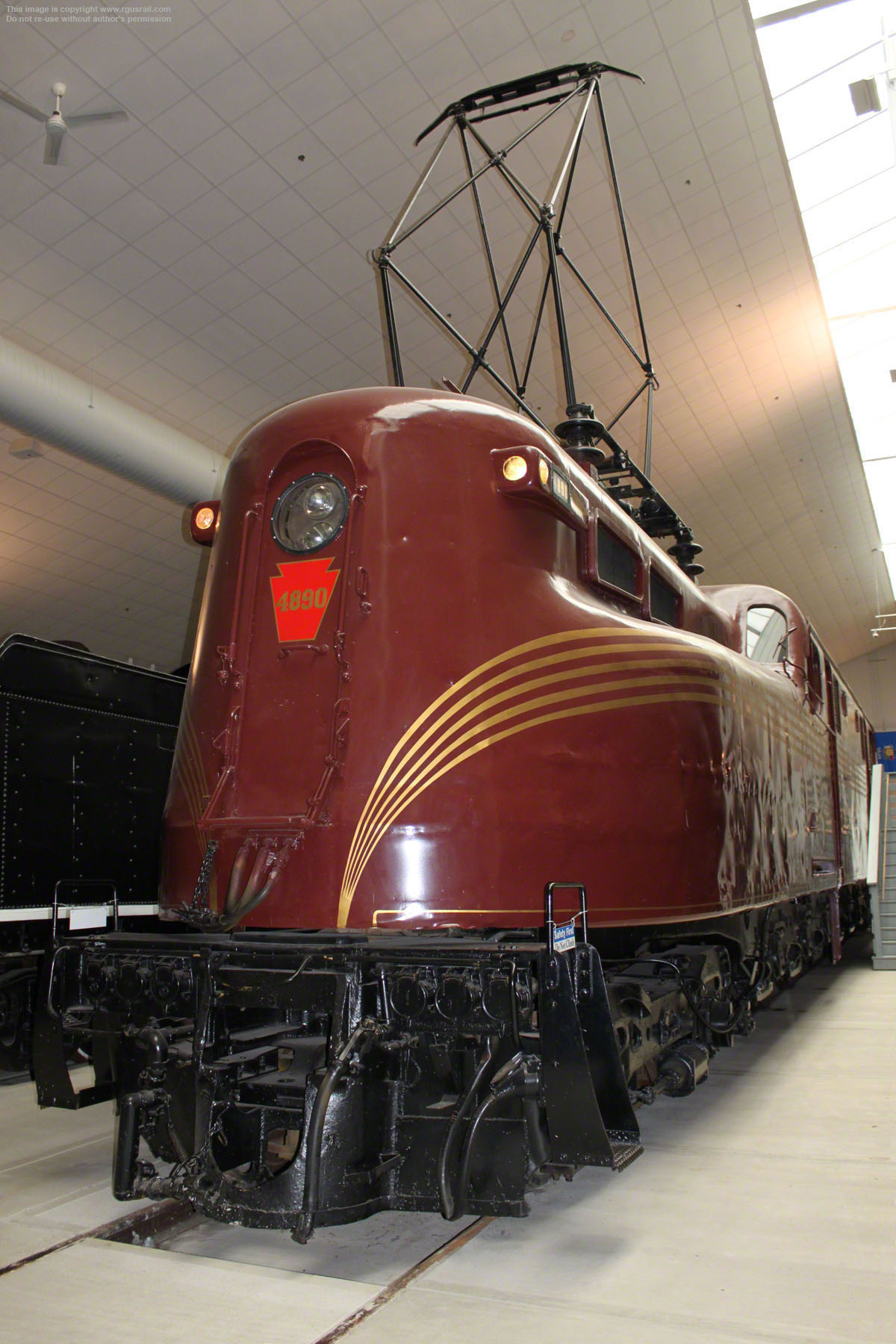
As you can see from the two views above, #4890 was one of about thirty-five GG1s that had large air intakes fitted to the sides of their hoods. This somewhat compromised the locomotive's original clean lines.
The streamlining is usually attributed to Raymond Loewy, but a recent Classic Trains Magazine article by Hampton C. Wayt ('Donald Dohner: The Man Who Designed "Rivets"', Summer 2009, pp.30-35) has argued otherwise.
Sixteen GG1s have survived.
You can see the prototype GG1, PRR #4800 "Old Rivets", on the Railroad Museum of Pennsylvania
Yard page of this website, PRR #4903 on the Museum
of the American Railroad page, PRR #4919 on the Virginia Museum of Transportation page and PRR #4935 on the Railroad Museum of Pennsylvania Train Shed page.


This is the only surviving example of one hundred and fifty Consolidation type (2-8-0) locomotives built by Baldwin in 1918 for the US Army. About fifteen hundred Consolidations were produced by Baldwin for the US Army between 1916 and 1918. They were known as "Pershings", after four-star General John Pershing, Commander of the US Expeditionary Forces in Europe.
They were intended for use in the European war theatre, although this locomotive never made it to Europe. Instead, it went to Fort Monroe, VA, as #765. It was renumbered #8341 and named "General Pershing" in 1925. In 1941, it moved to Fort Benning, GA, and then, in 1943, to Cape Blanding, FL.


Above, the four stars and name "Pershing" are stamped into the plate just above #101's headlamp.
Two years after retiring
from service with the US Army, in 1947 #8341 was shipped to Korea along with one hundred other locomotives from Europe to serve in the Korean War. There, it was renumbered #101 and was damaged by arms fire but was rebuilt in 1953 and put back into service.


The 166,400 lb locomotive has 56" drivers and 21" x 28" cylinders. A coal burner, it has a 41 sq ft grate, 128 sq ft firebox and 2,236 sq ft total heating surface, including 471 sq ft superheating. Operating at a boiler pressure of 190 psi, #101 delivered 35,610 lbs tractive effort. The tender weighs 109,000 lbs light with a capacity of 5,400 gallons of water and 9 tons of coal.
#101 ended its operating life as switcher in Seoul and was then donated to the museum by the Republic of Korea in 1959. It went on display at the museum in 1961.


The E&LS was founded in 1898 and was bought by Hanna Mining in the early 1960s. In 1978, John Larkin, a Minneapolis businessman bought the line.
It still operates 208 miles of track from Ontonagon, MI, to Green Bay, WI.
This wooden flange snow plow, #S100, was donated to the museum by the Escanaba & Lake Superior Railroad.
The plow would have been pushed by a locomotive to
remove relatively light snow from the tracks. For heavier work, a rotary snow plow would be used. The high mounted cupola
allowed good visibility for the plow crew.


On this display, the plow's wings are latched back to the side. When extended, they allowed snow to be cleared along the track side.
Note the absence of a front light, which would have been required for night work.
The E&LS still rosters plows like this, although they are painted in the railroad's current orange, black and gold livery.


This 0-4-0T (Tank) locomotive was built
for stock by Alco in 1923 and then sold to the W. F. Carey Company as #5. It was acquired by the Pullman Car & Manufacturing Company in 1934 along with the Carey Company. Renumbered #29, it switched in the yards of the company town of Pullman, IL, fourteen miles south of Chicago until the late 1950s. It was sold to the Purdey Company, a scrap dealer in Chicago, IL, in the late 1950s or early 1960s.
In 1961, #29 was purchased by the Jennie Fuller Estate of Green Bay, WI, and the following year was donated to the museum.


#29 weighs 79,000 lbs, and has 19" x 22" cylinders and 40" drivers. Operating at a boiler pressure of 190 psi, it delivered tractive effort of 17,400 lbs.
The locomotive was actually a propane burner. Although a very clean and efficient fuel, very few propane burning steam locomotives were ever built.


From 1962, with a plate bearing "Brillion Pioneer" attached to its foot boards, #29 hauled trains for the museum's tourist "Wisconsin & Yesterday Railroad". Unfortunately, complaints from locals along the route forced it into retirement, and the only evidence of its life as an excursion engine I have seen is a postcard of it hauling a passenger excursion train over a trestle bridge in Wisconsin.
#29 has not been relettered and is displayed with restored Anhapee & Western Railroad bay window caboose #33.


In 1947-48, the US began a relief effort to war-torn France and Italy, donating more than seven hundred box cars of goods to an “American Friendship Train”. In gratitude, a group of French citizens organised a private effort to thank the people of the US for their assistance. The result was the forty-nine box car “Merci Train”. The cars were called “40 et 8” (40 and 8) cars because the French military rated them to carry forty soldiers or eight horses.
You can see other "40 et 8" cars on the Ogden Union Station page of this website, McCormick-Stillman Railroad Park, Kentucky Railroad Museum, B&O Railroad Museum Roundhouse and Nevada State Railroad Museum pages.


Above, AT&SF Speeder #174591. Note the metal "grab" frame mounted to the vehicle to allow lifting onto and off the rails.


Following WWII, with greater car ownership, growth of the nation's interstate highway system and air services, railway passenger numbers began to decline. In response, railroads sought ways to attract
passengers back, including introducing stylish trains that combined speed and added luxury. One such effort was General Motors' "Aerotrain", unveiled in 1955.
The trainset is essentially a combination of GM bus bodies re-styled and adapted to run on rails and hauled by a diesel engine. The GM "style" is evident in the windshield design, smooth front end lines with recessed headlights, and the fin-like wrap-around just above the pilot.

Above, a side shot that includes part of the two car trainset.


Inside the Victor McCormack Train Pavilion.

The first railroad to test one of the new trains in February 1956 was the PRR, but the lightweight coaches, single-axle trucks and a suspension system designed for buses, made for a very uncomfortable ride at high speed. The Pennsy was not convinced and returned the train to GM after a year of use.
GM took the trains on a tour of the country in an effort to drum up interest, but the same problems arose and no-one was willing to buy.
Finally, in 1957, they
were sold to the Rock Island for commuter services in Chicago, IL, where lower speeds applied but, after only nine years, in 1966 both trains were retired.


#506 is the first of ten E1 Class Santa Fe type (2-10-2) locomotives allocated to the Duluth Missabe & Northern by the USRA in 1919 (#506-#515). Built by Alco, they followed the introduction of the first six 2-10-2s built for the railroad by the Baldwin Locomotive Works in Philadelphia, PA, in 1916. E #502, one of that first order, is on the National Museum of Transportation, St. Louis Yard page of this website. Growing demands because of WWI necessitated the purchase of the ten additional Santa Fes. The locomotives joined the Duluth Missabe & Iron Range roster when the DM&N was absorbed by that railroad in in 1938.
The E1s had a larger tender with a capacity for 10,000 gallons of water rather than 9,000. Like the E, the tender on the E1 also came with a "dog house" for the brakeman, visible in the photo on the right above. As part of an upgrade to the DM&N Santa Fes in the late 1920s, additional sand boxes were fitted on the pilot. All but two of this class (#512 & #514) eventually had Nicholson thermic syphons.


The E1s cost $56,795 each. With an
engine wheelbase of 40' 6" and driver wheelbase of 21', they weigh 352,000
lbs, 274,000 lbs on their 57" drivers. The
grate is 76.3 sq ft and the firebox 475 sq
ft. Total heating surface was 5,727 sq ft, including 218.9 sq ft of superheating
and, operating at a boiler pressure of 200 psi, they delivered 69.575 lbs of tractive effort.
Right, the 1920s upgrade included installing a coal pusher.

Above, the E-1 engines
were equipped with
Southern valve gear. The driving wheels are slightly smaller than the E class,
57" on the E1 versus 60" on the E. The cylinders are
27" x 32".
The tender weighs 227,360 lbs light and has a capacity of 10,000 gallons of water and 16 tons of coal.

Above, #506's backhead is in very good condition, if a little dusty.


The E1s had a long life and were amongst the last steam locomotives retired by the DM&IR, starting in 1959.


#506 was in service until 1962 and was donated to the museum the same year.


The Sumter & Choctaw was owned by the Allison Lumber Company in
Bellamy, AL, serving the two namesake counties in western Alabama. Two Baldwin steam locomotives, one of which was #102, operated on the line.
#102 was a coal burner. It weighs 128,000 lbs, 98,000 lbs on its 44" drivers. With 17" x 24" cylinders and operating at a boiler pressure of 180 psi, it delivered 24,100 lbs tractive effort.
#102 was donated to the museum in 1964. In 1988, the museum sent the locomotive to the Green Bay & Western Norwood roundhouse, where it spent nearly eighteen months being rebuilt with a diesel engine from an old center cab switcher fitted to the tender so that it can haul trains, although not in steam. The other Sumter & Choctaw Baldwin, #103, is preserved at the Railroad Museum of New England in Tomaston, CT.


Baldwin built this Mikado type (2-8-2) locomotive in 1924 for the Sumter & Choctaw Railroad.


#102 usually has the privilege of hauling the museum's Polar Express train at Christmas.


Tucked away in the gloom of the Victor McCormick Train Pavilion is Chesapeake & Ohio K-4 class #2736, a Berkshire (2-8-4) type locomotive, although this wheel arrangement was known as a "Kanawha" on the C&O after the river that cut through the railroad's heartland in West Virginia.
Built by Alco in 1944, #2736 was one of the first forty K-4s delivered to the C&O (#2700-#2739).


With a total heating surface of 6,705 sq ft (including 1,932 sq ft superheating), #2736 operated at a boiler pressure of 245 psi delivering 69,368 lbs tractive effort.
Twelve K-4s have survived. You can see #2705 on the B&O Museum Yard & Car Shop page of this website, #2707 on the Illinois Railway Museum Yard, #2716 on the Kentucky Railway Museum, #2727 on the National Museum of Transportation, St. Louis Train Shed and #2736 on the Hoosier Valley Railroad Museum pages. #2700, #2732, #2755, #2756, #2760 and #2776 each have their own page.


Eventually, the C&O rostered a total of ninety of these locomotives.
K-4s operated over most of the C&O system, but had a short life. The first was retired in 1950, possibly because of a collision, but the rest were not far behind.


Ten more were then ordered from Lima in 1945 (#2740-#2749) and ten in 1947 (#2750-#2759), as well as another thirty from Alco the same year (#2760-#2789).
All the K-4s had been retired by 1957 and the majority scrapped by 1961.


The FM H-10-44 is a 240,000 lb switcher built by Fairbanks-Morse in Beloit, MI, from 1944 to 1950. One hundred and ninety-five were built for US railroads, and #767 was one of the first, outshopped in 1944. The locomotive's 2-cycle 38D8 1/8 6 cylinder opposed piston diesel engine delivered 1,000 hp powering a Westinghouse WE481B generator to drive four Westinghouse - WE362B traction motors. It had a top speed of 60 mph and produced tractive effort of 40,440 lbs.
Fairbanks Morse had developed a diesel engine used on much of the US Navy's WWII submarine fleet. With two pistons in each cylinder, it generated nearly twice as much power from the same number of cylinders as other engines. Taking advantage of post-war railroad dieselisation, the company introduced what was then the most powerful engine available in a diesel. However, the radical design made the locomotives relatively difficult to maintain.
The first FM H-10-44, MILW #760, is on the Illinois Railway Museum Yard page of this website. Designed by Raymond Loewy with a slanted nose, sloping hood and protruding roof visor on the rear of the cab, this styling was carried through to the FM H-12-44 until 1952, when it was simplified to reduce costs. BMH FM H-12-44 #1860 with the rear roof visor is on the North Carolina Transportation Museum page of this website, and SWPX FM H-12-44 #115 without the visor is on the Museum of the American Railroad page.
Hallet Dock Co. FM H-10-44 #HD-11 is on the Lake Superior Railroad Museum page.


Stored on a flatbed car in the Victor McCormick Train Pavilion when I last visited the museum, are the parts of the only narrow gauge locomotive in the collection. It is a 2-truck Shay built by Lima in 1917 and is one of thirteen Shays rostered over the years by the Pardee & Curtin Lumber Company of Webster County, WV.
#12 was sold to the Ely Thomas Lumber Company in Fenwick, WV, in 1947 and renumbered #5. In 1955, it was purchased by the railfans Harold
Allen and Casimir Samborski and placed in storage in Ann Arbor, MI. It was finally purchased by George Banta Jr., and donated to the museum in 1972.
#12 is a 36" gauge coal burner. Mounted on the engineer's side, its three vertical 10" x 10" cylinders power a drive shaft geared to each of the locomotive's 29" drivers. Weighing 72,000 lbs, it operated at a boiler pressure of 180 psi and delivered tractive effort of 14,310 lbs.
Two thousand, seven hundred and sixty-eight Shay locomotives were built by Lima from 1878 to 1945 in four classes, ranging in size from 6 to 160 tons. You can see other Shays on the Cass Scenic Rail Road page of this website, the Travel Town, Northwestern Railroad Museum, North Carolina Museum of Transportation and B&O Museum Roundhouse pages.


#5017 is one of twenty-five Texas type (2-10-4) locomotives built in 1944 by Baldwin. These AT&SF 5011 class locomotives were the last steam locomotives delivered to the railroad.
The first AT&SF Texas type, #5000, was built by Baldwin in 1930. It has been beautifully restored by the Railroad Artifact Preservation Society and is on display next to Queen's Garden in downtown Amarillo, TX. You can see photos of it on the ATSF #5000 page of this website.


The next nine AT&SF 2-10-4s were built by Baldwin in 1938, classed 5001.

You can see the first of this class delivered to the AT&SF, #5011, on the National Museum of Transportation, St. Louis Train Sheds page of this website, as well as another on the ATSF #5030 page.
They were one of the largest non-articulated locomotives ever built. At 74", the driving wheels were also the largest ever applied to a Texas type, and the 310 psi boiler pressure one of the highest.

Oil burners, like the 5001s the 5011s developed 108,961 lbs tractive effort.
Below, #5017 lines up with Soo Line #2718 (centre) and Lake Superior & Ishpeming #24 (left) in the museum's Victor McCormack Train Pavilion.


#5017 has a 121.7 sq ft grate, 494 sq ft firebox and total heating surface of 8,577 sq ft, including 2,640 sq ft superheating. The tender weighs 462,700 lbs light with a capacity for 21,000 gallons of water and 7,000 gallons of oil.
#5017 worked on the AT&SF Pecos Division between Clovis and Belen, NM, but travelled as far afield as Texas, Oklahoma and Colorado. It ran up a total of 750,000 miles in its fifteen year life. Retired in 1959, it was donated to the museum that year.


This is one of six H-23 class Pacific type
(4-6-2) locomotives built in 1923 by Alco for the Minneapolis, St. Paul & Sault Ste. Marie Railroad, also known as the Soo Line.
The six H-23s were the last Pacifics ordered by the Soo Line and, although relatively light compared to other railroads' Pacifics, they were the heaviest rostered by the Soo.

In 1939, #2718's tender was replaced with the one to which it is now coupled.
The change was to increase coal and water capacity and, thereby, the locomotive's operating range.


#2718 weighs 281,080 lbs. It has a 52.75 sq ft grate area, 207 sq ft firebox and 4,219 sq ft total heating surface, including 840 sq ft superheating. With 25" x 26" cylinders, it operated at a boiler pressure of 200 psi, delivering tractive effort of 36,833 lbs. With their 75" drivers, the H-23s, were nevertheless designed for passenger service, reaching speeds of 80 mph on the railroad's level Chicago-Minneapolis/St Paul line.
The Soo Line was started in 1883 by a consortium of flour mill owners in Minneapolis to connect its two namesake cities and avoid sending shipments through Chicago, IL. It was never a major passenger carrier as its line between Chicago, IL, and Minneapolis/St Paul, MN, was much longer than its competitors, the Milwaukee Road, Chicago & North Western and the Chicago, Burlington & Quincy.
#2718 was in service for twenty-five years until 1958, when the Soo Line donated it to the museum. The only other surviving H-23, SOO #2719, is based at the Lake Superior Railroad Museum in Duluth, WI. That locomotive is still operational, and runs excursions along the
Lake Superior shore line from Duluth to Two Harbors.


Right, #24 is on the left, SOO #2718 is in the centre and ATSF #5017 is on the right.
Consolidation type (2-8-0) locomotive #24 was built by Alco in 1910 as #40 for the Marquette & Southeastern Railway, which operated a sixty mile line between Big Bay and Lawson, MI.


In 1911, the Marquette & Southeastern merged with the Munising Railway, a short line between Munising and Princeton, MI.


The Munising, Marquette & South Eastern Railroad merged with the Lake Superior & Ishpeming Railroad in 1923. The LS&I then renumbered the locomotive #24, and later modernised it with a wider firebox in 1931. Weighing 189,360 lbs, #24 has 22" x 28" cylinders and 57" drivers. A coal burner with a 50 sq ft grate and total heating surface of 2,600 sq ft, including 430 sq ft superheating, it operated at a boiler pressure of 200 psi, delivering tractive effort of 42,000 lbs.
Two other LSI SC4 locomotives have survived. You can see one of them on the LSI #19 page of this website and the other, #22, on the Mid-Continent Railway Museum page.


#24 was donated to the museum by the LS&I in 1962.


#D-538 is an early diesel electric built by the Electro Motive Corporation, later EMD.

EMC built one hundred and seventy-five Winton engined diesel-electrics from 1935 to 1939. The S series had 600 hp engines. The N series had 900 hp engines.
Twenty-seven NW1s were built from 1937 to 1939 with a Winton 201-A 12 cylinder prime mover powering a Westinghouse 480 four generator to drive GE 287D traction motors. With a top speed of 50 mph, they delivered 43,000 lbs continuous tractive effort at 11 mph.
#D-538 was bought by the Minneapolis & St. Louis Railway in 1938. Sold to the Marinette, Tomahawk & Western in 1957, it continued in service on that railroad until 1973, when it was donated to the museum.


This centre cab switcher was built by General Electric for the St. Paul Union Depot in 1941. It switched passenger cars at the St. Paul, MN, mainline passenger station and is powered by two Caterpillar D17000 V8 180 hp engines producing 360 hp in total to four traction motors, one on each axle.
Three hundred and eighty-five of these locomotives were produced by GE from 1940 to 1956. They were mainly bought by US and Canadian railroads, but some went to South America, Saudi Arabia, India and even Australia. Designed for industrial and light switching duties, they often replaced steam switchers in the US, as their 44 ton weight exempted them from having a two-person crew under agreements made with the railroad unions on new diesel power.


Many of these little switchers have survived. You can see more on the Savannah Roundhouse Museum, Ogden Union Station and Southeastern Railroad Museum pages of this website.


#715 was one of twenty-two GP30s built for the Soo Line by EMD in 1963. Along with seventeen other SOO GP30s, it later joined the Wisconsin Central roster.
Nine hundred and forty-six GP30s were built from 1961 to 1963 for US railroads, and two for Canadian, all with 567D3 16 cylinder prime movers powering a GM D22 generator to drive four GM D57 traction motors. Their characteristic hump-and-cab profile incorporated air intakes for the central air system.
You can see ATSF GP30 #2441, built in 1962 and rebuilt in 1984, operating in a classic Santa Fe blue and yellow livery on the Caliente Horseshoe Curve page of this website.


#315 is the only Alco C-430 switcher bought by the Green Bay & Western. It was delivered in 1968. After suffering a broken crankshaft in 1986, it was retired. In 1987, the GB&W donated it to the museum.
The C-430 is 63' 1" long and weighs 272,000 lbs. It is equipped with an Alco built 4 cycle Model 251E V16 prime mover powering a GE GTA9 generator to drive four GE 752 traction motors, one on each axle. It delivered 57,200 lbs continuous tractive effort at 8 mph with a top speed of 70 mph.
#315 was the last of the C-430 production run. It was outshopped in February 1968 and, soon after, Alco ceased production of domestic diesel-electric locomotives entirely.

The C-430 is part of Alco's "Century" series, which included six and eight axle units. The
C-430 was the last of the four axles units. The preceding models were the C-415, C-420, C-424 and C-425.
Only sixteen of the
C-430s were built between 1966 and 1968, all for US railroads. The New York Central purchased ten, the Reading Line two, and the last three were Alco demonstrators.
There are other four axle Century series units on this website: MCRR C-415 #701 is on the Railroad Museum of Pennsylvania Yard page and both DL C-420 #414 and DL C-425 #2423 are on the Steamtown Yard page.


Wisconsin Central Railway Wrecking Crane
W-1 is coupled with a Soo Line crane idler car. Built by the Industrial Works, Bay City, MI, in May 1903, the crane was steam powered and had a lifting capacity of 80 tons.
The Industrial Works started out in 1873, primarily repairing equipment and supplying saws, engines and boilers for the many local sawmills and shipbuilders. The firm built its first crane for the Chicago & Western Illinois Railroad in 1883 and went on to become a major producer of cranes.
There is another Industrial Works steam powered crane on the Nevada Northern Railroad Museum page of this website.


Burlington Northern Jordan Spreader #973172 was out in the yard last time I visited the museum.


It removed snow, spread gravel and trimmed embankments of brush along the sides of track.


#403 is one of four Alco S-2 switchers bought by the Fairport, Painesville & Eastern Railroad in northeastern Ohio in 1947. Sold to the
Georgia Pacific Paper Company, it was renumbered from #103 to #63-180 and appears to go through various changes at the museum: it sported the Howard Paper Company livery when I last visited.
The S-2 had an Alco 4-cycle Model 539 6L prime mover, GE GT553 generator and four GE 731 traction motors.
The S-2 is almost identical to Alco's S-4, except it has Alcos Blunt trucks while the S-4 has AAR type A switcher trucks. The S-4 also has a GT 563 generator and GE 731D traction
motors.


Alco built one thousand, three hundred and sixty-three S-2s between 1940 and 1950 for US railroads and twenty-three for Mexican. Alco's Canadian subsidiary, Montreal Locomotive Works, built another one hundred and thirteen for Canadian railroads.


USA #8651 is one of an order of thirty RSD-1 switchers delivered to the US Army by Alco in 1945. A total of one hundred and forty-four RSD-1s were built for the US Army from 1942 to 1946. A further six were built in 1946 for Ferrocarriles Nacionales de México.

The first thirteen RSD-1s were built as
RS-1 units but returned to Alco and rebuilt
as RSD-1s (#8000-#8012) at the Army's request in 1942. They were classed E1645 and you can see the first RS-1 unit
converted to an RSD-1, TXIX #8000, on the Museum of the American Railroad page of this website.
The first twenty-one production RSD-1s were then built later that year (#8013-8033) and a further twenty-three in early 1943. These were also classed E1645. The remaining one hundred units were built between 1943 and 1946 (#8600-#8699) and classed E1646. The last six units were built 1946 for the Ferrocarriles Nacionales de México and were classed E1641.
The RSD-1 is 54' 11" long and weighs 204,000 lbs. With an Alco 1,000 hp V12 4-cycle Model 539T-6L prime mover powering a GE GT553C generator to drive four GE 731 traction motors, two on each of its six axle trucks, the units delivered 34,000 lbs continuous tractive effort at 8 mph and had a top speed of 60 mph.
ARR RSD-1 #1034 is on the Railroad Museum of Pennsylvania Train Yard page of this website.


This is one of sixteen EMD SD24 units delivered to the Chicago, Burlington & Quincy in 1959 (#500-#515).
The SD24s could be ordered with a low or high short hood, and the CB&Q units were fitted with high short hoods. Originally numbered #510, this unit was renumbered #6250 when the CB&Q merged into Burlington Northern in 1970. In a succession of sales, it became Maryland Midland #6250, Fox River Valley #2402 and, finally, Wisconsin Central #2402.
The SD24 is 60' 8" long and weighs 390,000 lbs. Its 2,400 hp 567D3 16 cylinder prime mover powered a GM D22 generator to drive six GM D47 traction motors. With a top speed of 65 mph, it developed 72,300 lbs continuous tractive effort at 9.3 mph.
The SD24 was not particularly successful. Only one hundred and seventy-nine were built from 1958 to 1963, all for US railroads. Forty-five cabless B units were also built for the Union Pacific. As they aged, they were prone to electrical problems and their turbo charged engines were maintenance intensive, making them less attractive as secondary power as newer motive power became available.


The only other SD24 to survive is CBQ #504, later Burlington Northern #6244, which has been restored to operating condition. You can see photos of it on the Illinois Railway Museum Yard page of this website.


Originally Bangor & Aroostook Railroad #552, this EMD BL2 was later renumbered #52. It was eventually sold to the Janesville & Southeastern, where it retained number #52.


Fifty-eight BL2s were built between 1948 and 1949 after BL1 Demonstrator #499, outshopped in 1948. The major difference was that the BL1 had an air-actuated throttle and could not multiple-unit, while the BL2, had a standard electrically-actuated throttle.
The BL2 is 54' long and weighs 230,000 lbs. Its 1,500 hp EMD 567B prime mover drove a GM D12 generator to power four GM D27B traction motors, one on each axle. It had a top speed of 65 mph and delivered 40,000 lbs continuous tractive effort at 9.3 mph.
The BL stood for "branch line", meaning these locomotives were intended for lines with light traffic or limits on axle loadings. Something of a hybrid, the BL2 was used to haul freight and, occasionally, passenger trains as well as performing switching duties.
When I last visited, #52 was parked outside with Bangor & Aroostook #56 (right).


#556 is one of seven BL2s bought by the Bangor & Aroostook in 1949 (#550-#556), which included #552. #556 was later renumbered #56.
You can see Western Maryland BL2 #81, on the B&O Museum Yard and Car Shop page of this website.


The BL2 seems to polarise opinion amongst rail fans. While some consider them rather ugly, I find their snub nose, chunky profile and swept sides quite attractive.


Above and right, some photos of an Alco S-6 switcher hauling a train on the track running around the perimeter of the museum grounds.
This diesel-electric was built by Alco for the Southern Pacific as #1036 in 1955. It was subsequently renumbered #1203. However, the museum had painted it in the Green Bay Route livery and renumbered it #106 when I visited in September 2009.
One hundred and twenty-six S-6s were produced between 1955 and 1960, ninety-six for US railroads and thirty-three for Mexican. The largest number, seventy, were delivered to the Southern Pacific between 1955 and 1956. The S-6 is 45' 5" long and weighs 230,000 lbs. A development of the earlier 800 hp S-5, it has a 900 hp Alco 251A four stroke prime mover, which powers a GE GT553 generator to drive four GE GT533 traction motors, one on each axle. With a top speed of 60 mph, it delivers 46,000 lbs continuous tractive effort at 5 mph..


Related Links:
National Railroad Museum Website
Big Boy Information Page
Information on the Aerotrain
Missabe Railroad Historical Society
Chesapeake & Ohio Historical Society
Milwaukee Road Historical Association
ATSF Rail Fan Site
Soo Line Fan Site
Unofficial Lake Superior & Ishpeming Railroad Site
Eddie's Green Bay & Western Page
Unofficial Bangor and Aroostook Railroad Page
Green Bay Route Website
Send a comment or query, or request permission to re-use an image.