


The Lake Superior Railroad Museum is on W Michigan St in downtown Duluth, MN. It has an interesting collection
of historic steam, diesel and electric locomotives that largely operated in the US Mid-West, including one of three surviving DM&IR Yellowstone locomotives
(2-8-8-4). There are also many other pieces of equipment, including snow plows and two wrecking cranes, as well as other railroad related displays.
The museum works in partnership with the North Shore Scenic Railroad, which provides a variety of local train excursions. During Summer, several trains leave Union Depot daily along Lake Superior, into the North Woods or up to Two Harbors. The tours are narrated so that you get an understanding of the people, history and geography of this fascinating part of the country (you can see photos of my September 2008 trip from Duluth to Two Harbors on Soo Line #2719 on the North Shore Scenic Railroad page of this website).
I have been to the museum on a number of occasions,
and the photos on this page are from various different visits.



The Lake Superior Railroad Museum houses its collection in what was once the train shed of the old Duluth Union Depot, as well as in the adjacent marshalling yard to the south of the depot.
Built in 1892 at a cost of $615,000, it replaced an earlier wood-frame depot built in 1870. Designed by the Boston firm of Peabody, Stearns and Furber, the depot building is in the French Norman architectural style. This is sometimes referred to as the "Chateauesque" style because its characteristic round bays with conical roofs resemble French chateaux.
The building was once a bustling hub for the city, with as many as five thousand people passing through and over fifty trains dispatched every day for seven railroads, the Duluth & Iron Range, the Duluth, Missabe & Iron Range, the Duluth, South Shore & Atlantic, the Duluth Superior & Western, the Great Northern, Northern Pacific and the Saint Paul & Duluth. The last train left in 1969.
In 1973, work started on restoring the Depot. It is now the St. Louis County Heritage and Arts Center, housing the Duluth Arts Institute, Duluth Children's Museum, Duluth Playhouse, Duluth-Superior Symphony Orchestra and the St. Louis County Historical Society, as well as the Lake Superior Railroad Museum.



Perhaps the most impressive piece in the museum's collection is Duluth, Missabe & Iron Range M3 #227, one of three surviving DM&IR Yellowstone type (2-8-8-4) locomotives. You can see another M3 on the DMIR #225 page of this website, as well as DMIR M4 #229 on the Two Harbors Depot Museum page.
#227 was restored by the DM&IR for the museum and is in really excellent condition. Because there is no natural light in the engine room, however, and the artificial lighting is quite low, it can be challenging to get good photos.


The Western Pacific M-137s delivered a massive 137,174 lbs tractive effort. They worked on the Feather River Canyon route, running 65-74
car Pacific Fruit Express trains up a ruling grade of 1% at speeds of
18-25 mph over one hundred and seventeen miles from Oroville to Portola, CA, but what the Missabe Road had in mind was an entirely new locomotive, far bigger than anything that had previously operated on the road, indeed, what was to be one of the largest locomotives ever built in the US.
The design included lengthening the back engine frame and fitting a larger, vestibuled cab to protect crews against the harsh northern cold, which increased the engine's weight and required a four-wheel trailing truck in place of the M-137's two-wheel truck.

A second order for ten more Yellowstones from Baldwin followed in 1943 (#228-#237).
Although identical in design to the M3s, the new, M4 Class were 4,700 lbs heavier because carbon steel was used in place of alloys as a result of war restrictions. They were completed late in 1943 after the DM&IR's ore traffic had subsided, so some were initially leased to the Denver & Rio Grande Western in the Winter season when much of the DM&IR system was inoperable because of the ice and heavy snow.

Above, #227 stands alongside MILW EF-1 #10200 on the left.
In the late 1930s, although tonnage had dropped considerably as a result of economic recession, the DM&IR saw a need for new power to meet the demands of transporting what were certain to be much greater volumes of ore as a result of impending war in Europe. The railroad had not purchased any new locomotives in nearly twenty years but had in mind a locomotive that could handle 115 car, 8,750 ton trains on the Iron Range Division's 0.62% grades without stalling.
The ten oil-burning Western Pacific M-137 class
2-8-8-2s (#251-#260) built by the Baldwin Locomotive Works in Philadelphia, PA, in 1931 was the basis for the design.


Both the forward and rear engine frames were of cast-steel with integral cylinders.
Roller bearings were installed on all drivers and axles, including the tender, and these were the only "pedestal" or "centipede" 4 + 10 wheeled tenders fitted to Yellowstone type locomotives in the US, a feature derived from the Union Pacific's Big Boys then nearing completion in the Alco works.
The DM&IR considered the first eight Yellowstones built by Baldwin at a cost of $246,570 each and designated Class M3 (#220-#227) a success, but their arrival in 1941 coincided with growing industrial actvity associated with WWII. It was time for more road power.

The tender weighs 438,000 lbs light with a 25,000 gallon water and 26 ton coal capacity.
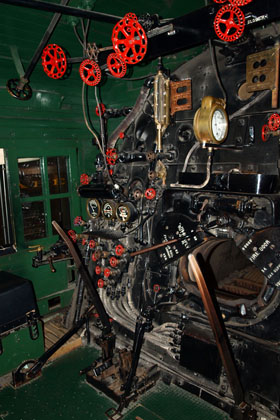
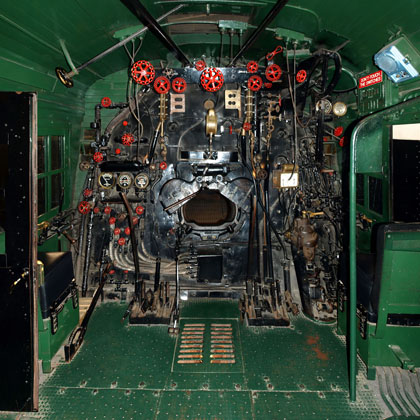
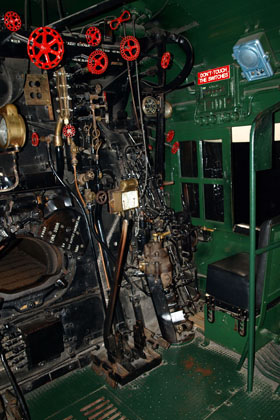
Above, the backhead of #227 possesses an intriguing, if what appears to be a fearsomely complicated, set of piping, gauges, handles, taps, levers and gears.
The cab is over eleven feet across and ten feet deep, and was
enclosed to protect the crew from the harsh Minnesota winter
weather.
Except for #237, which was badly damaged in a wreck on lease to the D&RGW in 1958 and scrapped, DM&IR's Yellowstones operated for about twenty years.
Dieselisation started on the Missabe Road in 1953 and, other than three preserved locomotives, all the 2-8-8-4s were retired between 1962 and 1963 and sold for scrap.
Hover your mouse over the photos to identify some of the main backhead components.
1. Injector Control
2. Feedwater Heater Control
3. Booster Control
4. Steam Heat Control
5. Water Gauge Control
6. Main Turret Control
7. Flue Blower Control
8. Radio Dynamo Control
9. Injector Control
10. Cylinder Cock Control
11. Dynamo Control
12. Passenger Car Heat Control
13. Fireman's Boiler Water Sight Glass
14. Highest Point of Crown Sheet
15. Boiler Pressure Gauge
16. Engineer's Boiler Water Sight Glass
17. Tri Gauge Cocks
18. Throttle
19. Back Pressure Gauge
20. Light Controls
21. Feedwater Pump Pressure Gauge
22. Steam Heat Gauge
23. Stoker Steam Jets Gauge
24. Fire Door Actuator
25. Brake Gauges
26. Reverse Lever
27. Firebox Jet Valves
28. Locomotive Air Brake Control
29. Train Air Brake Control
30. Grate Shakers
31. Firebox Doors
32. Firebox Foot Pedal
33. Stoker Auger Access Door

Above, a view inside the 750 sq ft firebox. Note to the two thermic siphons supporting the firebrick arch, which contributed 194 sq ft of heating surface. The combustion chamber added another 177 sq ft. The M3 operated at a boiler pressure of 240 psi.
The DM&IR Yellowstones did not have particularly large grates: at 125 sq ft they were roughly 30% smaller than the Northern Pacific Yellowstones. However, burning of superior bituminous coal shipped from the east and a larger total evaporative area, 9,550 sq ft compared to 10,892 sq ft, more than compensated.
Although lighter at 560,257 sq ft, the DM&IR Yellowstones were heavier on their drivers and had greater tractive force than either the UP 4-8-8-4 Big Boys or the C&O 2-6-6-6 Alleghenies. You can review a summary of arguments for and against the largest/most powerful steam locomotive in the US on the B&O Railroad Museum Yard page of this website.

There are two models of Duluth, Missabe & Iron Range Yellowstone (2-8-8-4) M3 #225 on display in the museum.


Above, this model #225 is on loan from the Ralph W. Andres Trust.
The engine is 17' in length, weighs 28,000
lbs, is propane gas fired, has a tractive effort of 566 lbs and took thirty-one years to complete!


The model above of #225 in a black boiler jacket was built by Frank Saville of Barrington, IL.
It is 10' 8" long, weighs 800 lbs and took six thousand, eight hundred hours to construct between 1968 and 1974.
The original DMIR M3 #225 has been preserved and is on open air display at Proctor, MN. You can see photos of it on the DMIR #225 page of this website.



In 1890, the "William Crooks" passed to the Great Northern Railway with another transfer of the road.
It was saved from scrapping by James J. Hill, President of the GN, in 1897, and later appeared at the 1927 Fair of the Iron Horse in Maryland.

#1 was built in 1861 for the Minnesota & Pacific Railroad by the New Jersey Locomotive & Machine Works. The M&P was almost immediately absorbed into the St Paul & Pacific, and #1 was named "William Crooks" after the Chief Mechanical Engineer of that road.
It was the first locomotive to operate in Minnesota, starting work in 1862 hauling passenger trains between St. Paul and St. Anthony. It joined the Saint Paul, Minneapolis & Manitoba Railway in June 1879 with transfer of the SP&P to that road.

The locomotive also appeared at the 1939 New York World's Fair.
An American type (4-4-0) locomotive, the "William Crooks" was built as a wood burner but was later converted to burn coal.
With an engine wheelbase of 19' 11" and driver wheelbase of 7', #1 is
50' 8¾" long. It weighs 55,400 lbs, 35,950 lbs on its 63" drivers. With Stephenson valve gear and 12" x 22" cylinders, it has a 12.5 sq ft grate and 65.4 sq ft firebox. Total heating surface is 498 sq ft and, operating at a boiler pressure of 110 psi, it delivered 4,700 lbs tractive effort.


The locomotive's cylinders, rods and bearings
were completely rebuilt at the Great Northern Railroad's Dale Street Shops in St. Paul, MN, in 1947-48 by machinist George A. Halvorsen (his
last job before retirement). It then steamed for the very last time, appearing in the "Wheels A-
Rolling" pageant at the Chicago Railroad Fair in 1948.
The "William Crooks" went on display at the Saint Paul Union Depot from 1954 to 1962 when it was donated to the Minnesota Historical Society by the Great Northern.


Above, the tender weighs 46,800 light with a 2,500 water and 5 ton coal capacity. #1 was moved to the Lake Superior Railroad Museum in 1975.


Northern Pacific #1 Minnetonka, was built by Smith & Porter in Pittsburgh, PA, in 1870 It was the first locomotive purchased by the Northern Pacific and cost $6,000.
It helped build the east end of the NP system from Carlton to Brainerd, MN, then transferred to the west end from Kaloma to Tacoma, WA. In 1886, #1 was sold to the Ainsworth & Simpson Lumber Company, where the small fuel tender was added. In 1889 it went to the Port Blakely Mill Company in Montesano, WA, and then to Polson Brothers Logging of Hoquiam, WA, in 1895, where it was known as "Old Betsy".


It remained in service for Polson Brothers until 1928 when it was abandoned in nearby woods.
Five years later, after a lengthy search, the Northern Pacific found the locomotive in the woods near Hoquiam and traded Baldwin built 2-8-0 #51 for it. It was moved to St Paul, MN, for reconditioning and subsequently steamed at the 1933-34 Chicago World's Fair, 1939-40 New York World's Fair and 1948-49 Chicago Railroad Fair.
A wood burning 0-4-0T (Tank) locomotive
weighing 28,270 lbs with 44" drivers and 10" x 16" cylinders, #1 is 17½' long. It operated at a boiler pressure of 125 psi delivering 3,330 lbs tractive effort.


For some time, #1 was displayed outside BNSF's Fort Worth headquarters and it is still the property of BNSF on loan to the museum.


Henry Kirke Porter formed a partnership with John Y. Smith in 1866 to form the Smith & Porter Company, setting up a small machine shop in Pittsburgh, PA, to repair and build industrial equipment. They received an order for their first locomotive the following year from the New Castle Railroad & Mining Company, and built forty-three locomotives together, including the Minnetonka shown earlier on this page.
The partnership ended in 1871 and two further partnerships followed until Porter continued on his own in 1878. The company specialised in building locomotives for small industrial railroads and became the largest US producer of industrial locomotives, building almost eight thousand of them up until 1950. Davenport bought the H. K. Porter locomotive builders in 1950 and produced Porter designs as well as its own until closing in 1956.


Minnesota Steel #7, an 0-4-0T (Tank) locomotive, was built by H. K. Porter in Pittsburgh, PA, in 1915 for the United States Steel Company and spent its entire life switching coal, ore and coke cars at the US Steel Morgan Park plant just south of Duluth, MN.
At 76,000 lbs, it is quite heavy for a four wheel locomotive, but it was designed that way to move heavy loads in restricted clearances around the open hearth. It was designed to be operated by one man.


A coal burner with 44" drivers and 10" x 16" cylinders, #7 operated at a boiler pressure of 125 psi, delivering 3,330 lbs tractive effort.


Lake Shore Museum of Transportation #1 was built in 1931 by the Mack Truck Company of Allentown, PA, for Fegles Construction Company of Minneapolis, MN.
It was later owned by the Northern Pump Company, also of Minneapolis.


The Mack Company was formed in 1893. It began making rail cars and locomotives in 1905. Although it has passed through a number of owners over the years, it still operates as a subsidiary of Renault Trucks.
After retirement, #1 was donated to the museum by the Hyman-Michaels Company of Duluth, MN, and was then completely rebuilt by the Reserve Mining Company at its Babbitt, MN, shops. It is one of the oldest surviving diesel locomotives in the world, but remains fully operational and is used for switching at the museum when required. It's blunt looking, but nevertheless a nifty little bug!


This 60 ton steeple cab electric locomotive was built by General Electric in 1928 for service at Hanna's Wabigon Mine in Buhl, MN. #307 also worked on the company's Mesabi Chief Washing Plant haulage line near Keewatin, MN.
The Hanna Company began as Rhodes & Company mining coal in Ohio in the 1840s. It expanded into iron mining around Lake Superior in the 1860s and changed its name to Hanna Mining in 1885. In the 1980s, it diversified into plastics and polymers while progressively divesting its mining operations. It is now part of PolyOne Corporation.
#307 took power via a pantograph from an offset overhead line, which provided room for transferring ore into cars by shovel loaders. The locomotive also sported a cord run from a large front mounted disk that permitted it to travel further into the mine than the overhead line.
#307 was the last electric unit to operate on the Mesabi Range. It was donated to the museum by the Hanna Mining Company in 1974. You can see another Hanna Mining electric unit on the DMIR #347 page of this website.



Electrical components were supplied by General Electric. Drawing on direct current of up to 3,000 volts, the 576,000 lb EF-1s could deliver 3,340 continuous hp, although their top speed as-built was just 35 mph (higher speeds placed too much strain on traction motor armatures).
In 1919, with the arrival of a newer generation of passenger power, the EP-1 locomotives were converted to EF-1 freight locomotives and renumbered #10230-#10241. In this role, they continued in service into the 1970s. #10200 retired in the mid 1970s.

This is the first of forty-two electric units bought to operate on the Milwaukee Road's six hundred and sixty miles of newly electrified line in Montana, Idaho and Washington State. Thirty were assigned to freight service classified as EF-1 (#10200-#10229). The other twelve were assigned to passenger service as class EP-1 (#10100-#10111) and had higher-speed gearing.
The locomotive consists of two half units numbered as one, with 'A' and 'B' suffixes, coupled back to back using couplers and a ball and socket joint.
When it was delivered in 1915, #10200 was the most powerful electric locomotive in the world.

#10200 was donated to the museum in 1977 by the Milwaukee Road.



Built for the Duluth, Missabe & Northern in 1906, this C3 class Consolidation type (2-8-0) locomotive was originally numbered #332. It weighs 204,800 lbs, 182,300 lbs on its 56" drivers with an engine wheelbase of 24' and driver wheelbase of 15' 6". A coal burner, with 22" x 28" cylinders, a 48.2 sq ft grate, 196 sq ft firebox and total heating surface of 2,598 sq ft, including 430 sq ft superheating, it operated at a boiler pressure of 190 psi delivering 42,750 lbs tractive effort.
Twelve C3s had been delivered to the DM&N in 1905, #332 was one of six more delivered in 1906, and a further fourteen were delivered in 1907. They hauled ore on the DM&N's line out of Mountain Iron, MN, on the Mesabi Range to docks at Superior, WI, and Duluth, MN, and were incorporated into the Duluth Missabe & Iron Range roster in 1937.
#332 was sold to the Duluth & Northeastern in 1955. Renumbered #28, it hauled freight until 1964. After dieselisation, it ran specials for the D&NE and, on 8th August 1965, it hauled the last passenger train to use the Duluth depot and last operated in September 1972. The D&NE repainted #28 in 1973, then shipped it via Burlington Northern to the museum, arriving on 13th July 1974. The locomotive was restored by the Cloquet Terminal shop in Cloquet, MN, and the museum and returned to steam in 2017.



This steam operated wrecking crane was built for the Northern Pacific Railroad by the Industrial Works at Bay City, MI, in 1913. It is a relatively small crane, with a lifting capacity of 75 tons at a 16' radius, and is one of the few surviving steam operated wrecking cranes in the US. You can see another Industrial Works-built steam operated crane, Nevada Northern Wrecking Crane A, on the Northern Nevada Railroad Museum page of this website and Spokane Portland & Seattle Railway X-5 on the Northwest Railroad Museum page.
The Industrial Works was established in 1873, built its first crane for the Chicago & Western Illinois Railroad in 1883 and went on to become a major producer of cranes as Industrial Brownhoist. You can see other Industrial Brownhoist cranes on the Ogden Union Station page, the Gold Coast Railroad Museum page, the Pennsylvania Railroad Museum Yard page, the B&O Museum Yard & Car Shop page and the Virginia Museum of Transportation page.
#38 was donated to the museum by the scrap operator, Hyman-Michaels Company, and restoration was carried out by the Duluth, Winnipeg & Pacific Railroad at its Virginia, MN, work shop.


Built in 1907 by the Russell Car and Snow Plow Company in Ridgeway, PA, this wedge snow plow saw service on the Northern Pacific system into the 1960s. The Hyman-Michaels Co., donated it to the museum, and it was restored by Lake Superior Transportation Club members.
In operation, #19 was propelled by two or three locomotives to push small to moderate snow drifts off rail tracks to the side of the right of way. To clear heavy snow, the locomotives would back up and ram the plow into the snow as fast and as hard as possible. However, the impact at 50-60 mph could derail the plow, so a special crew accompanied it to help rerail it should that be necessary.
The plow is also fitted with a flanger blade
between the wheels to scrape snow from between the tracks that could not be cleared by the front wedge. The blade could be raised and lowered to prevent it snagging switches and track cross
overs.
You can see other wedge snow plows on the National Railroad Museum page of this website and the Railroad Museum of Pennsylvania Train Shed page.


You can also see a wedge snow plow mounted to a flat car on the Colorado Railroad Museum page.


Built by the Cooke Locomotive Works in 1887 for the Northern Pacific, this is the oldest surviving steam powered rotary snow plow in the US.
#2 started work in the Cascades, but moved east to Minnesota when more powerful plows arrived.


Above two views looking along the engine boiler inside the housing.

The rotary at the
front was operated by the steam engine inside the car, but the plow could not move under its own power. It had to be pushed by three or four locomotives.
With this assistance, it could clear snow drifts as high as 15'.


Snow was sucked into the rotary blades and shot to the side of the track from a chute behind the headlight. There is also a flanger blade between the wheels to scrape ice and snow from between the tracks.
#2 was bought from the Steam Preservation Society of Cadillac, MN, and restored by members of the Lake Superior Transportation Club.
You can see other Cooke/Alco snow plow on Steamtown page of this website, the Colorado Railroad Museum page, the Cumbres & Toltec Scenic Railroad page and the Mid-Continent Railway Museum page.


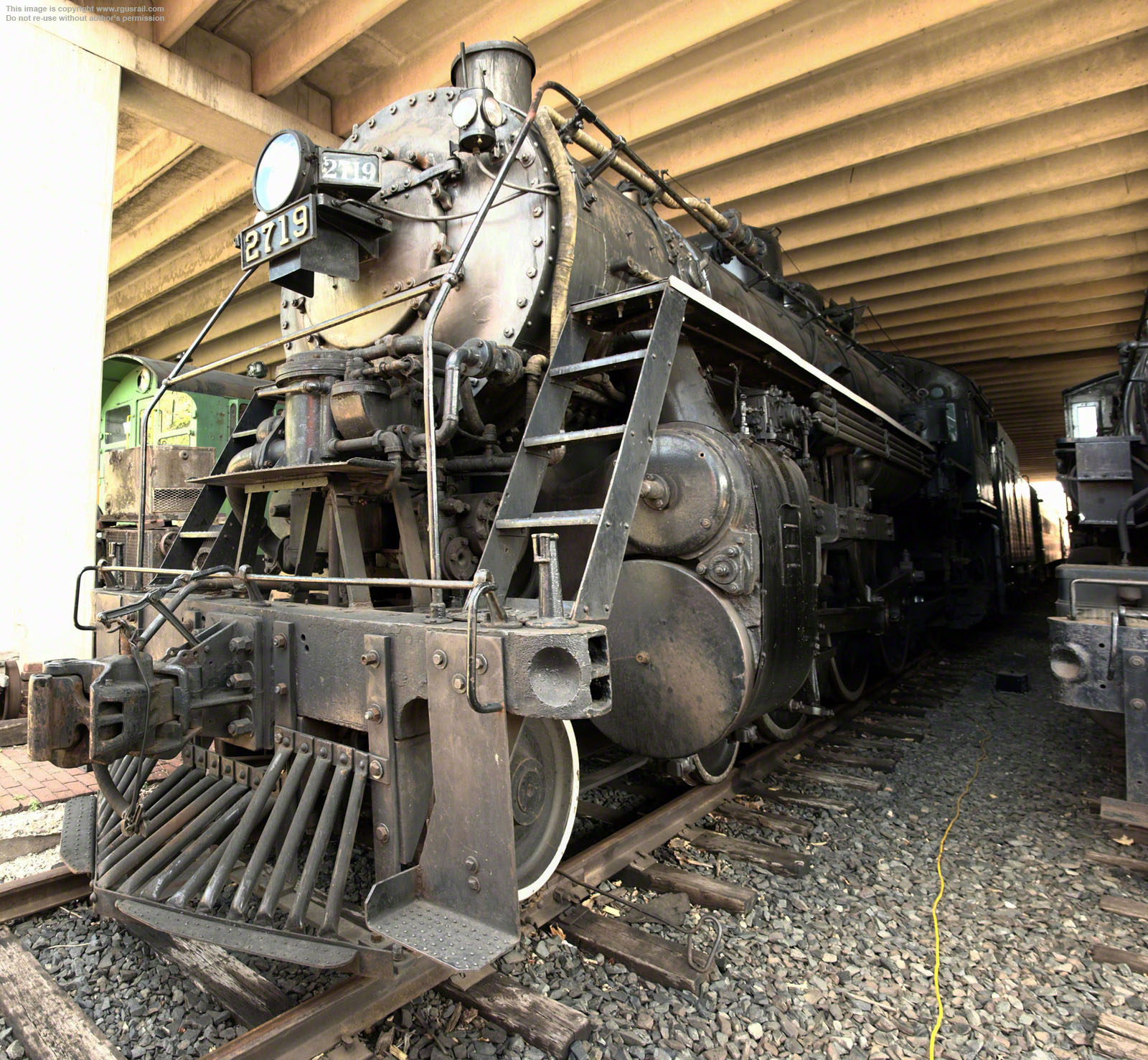
#2719 is one of six H-23 Class Pacific type locomotives (4-6-2) built in 1923 by Alco for the Minneapolis, St Paul & Sault Ste Marie Railroad or Soo Line.
It was in regular service until the mid-1950s, when it was put into storage, but was then brought out of retirement to haul the last steam train on Soo Line tracks on 21st June 1959, a round-trip railfan excursion between Minneapolis, MN, and Ladysmith, WI. It was donated to the City of Eau Claire, WI, the following year and went on display in Carson Park.
Thirty-six years later, in May 1996, restoration work was started by the Locomotive and Tower Preservation Fund, Ltd., which purchased #2719 that year and, after just over two years, an inaugural steam run was held on 19th September 1998. In June 2000, #2719 was moved to the Wisconsin Great Northern Railroad in Spooner, where it operated summer excursions until 2003. During the off season, it was stored at the Altoona, WI, roundhouse but, with the roundhouse levelled in
June 2004, the locomotive sat outside exposed to the elements until the end of 2006, when it was moved to the Lake Superior Railroad Museum. The museum leases #2719 from the Locomotive and Tower Preservation Fund and operates it through its affiliate, the North Shore Scenic Railroad.
I joined a return excursion from Duluth to Two Harbors on 12th September 2008 and you can see photos of that trip on the North Shore Scenic Railroad page of this website. You can also see photos of the only other surviving H-23, #2718, on the National Railroad Museum page.

Above, #2719 winters alongside DMN #14 in the train shed.
With 75" drivers, the locomotive was designed for fast passenger service. It has an engine wheelbase of 71' 1", weighs 281,080 lbs and has a 52¾ sq ft grate area, 207 sq ft firebox and 4,219 sq ft total heating surface, including 840 sq ft superheating. With 25" x 26" cylinders, it operated at a boiler pressure of 200 psi, delivering 36,833 lbs tractive effort.
The tender weighs 215,000 lbs light, and has a capacity of 12,000 gallons of water and 17½ tons of coal.

Duluth & Northern Minnesota #14 is a Mikado type (2-8-2) locomotive built in 1913 by the Baldwin Locomotive Works in Philadelphia, PA. The D&NM, chartered in 1898, was the common carrier for the Alger-Smith logging company.
With an engine wheelbase of 28' 5" and driver wheelbase of 14', #14 weighs 178,000 lbs, 137,000 lbs on its 51" drivers. It has 20" x 28" cylinders, a 41.3 sq ft grate, 153 sq ft firebox and total heating surface of 3,299 sq ft. Designed to haul freight, it operated at a boiler pressure of 200 psi delivering 37,333 lbs tractive effort.


For some years, the D&NM's one hundred mile line was the only land transport link along Lake Superior north of Duluth.
The D&NM also ran limited passenger services, and #14 may have hauled some of these in its short life with the railroad.
In 1919, as Alger-Smith's logging activity wound down, #14 was sold to the Lake Superior & Ishpeming. Forty years later, it was sold on to the Inland Lime & Stone Company at Gulliver, WI.


In 1974, #14 was transferred to the Duluth, Missabe & Iron Range. The DM&IR donated the locomotive to the museum in 1981.



Built in 1907 by Alco's Brooks Works in Dunkirk, NY, for the Northern Pacific, this T Class Prairie type (2-6-2) locomotive was designed for light freight service.
The first Prairie locomotives were built by the Chicago, Burlington & Quincy in 1900 and that railroad continued to build and purchase many of the type through to 1912. The Northern Pacific was familiar with the CB&Q Prairies and apparently impressed by their ability to haul fast freight as well as to work branch lines.
The railroad took delivery of its first twenty 2-6-2s in 1906 (#2300-#2319) and, by the following year, had amassed one hundred and fifty of them (#2300-#2449). They were assigned initially to the company's eastern divisions but, by 1908, were running on all the divisions except
Seattle.

Weighing 209,500 lbs, 152,000 lbs on 63" drivers, #2435 has Stephenson valve gear and 21" x 28" cylinders. It has an engine wheelbase of 28' 11" and driver wheelbase of 11'. With a 43.5 sq ft grate, 235 sq ft firebox and total heating surface of 2,340 sq ft, it operated at a boiler pressure of 200 psi, delivering 35,000 lbs tractive effort. Over the years, several different tenders were used on the T class.
With the advent of faster and larger locomotives, #2435 was transferred to switching and transfer duties. Retired in 1954, it was donated to the City of Duluth and went on display at the city zoo. It was donated to the museum by the City of Duluth in 1978.



This crane was built by Bucyrus in 1915.
Founded in the city of Bucyrus, OH, in 1880, the company was an early producer of steam shovels. In 1927, it merged with the Erie Steam Shovel Company to form Bucyrus-Erie. It is now a major, NASDAQ listed company marketing mining equipment, drag lines, trucks and excavators.


The Northern Pacific Railroad bought this steam-powered 165 ton lifting capacity crane secondhand from a shipyard in 1930 and numbered it #44. It was self-propelled when constructed but, at some point, part of its drive was removed and it was renumbered #161.
The crane was modernised with a diesel engine in 1960, and joined the Burlington Northern roster in 1970 when the Northern Pacific was merged into the newly formed company. In its last years, it was called the "Staples Wrecker" because it was based in Staples, MN.
The Burlington Northern donated #161 to the museum in 1985. It is displayed alongside United States Steel-Duluth Works Ladle Car #6 (lower two photos).
Built in 1915, this car was used to carry molten slag from within the Duluth steel mill to the nearby slag dump. The large air cylinder visible in the right hand view of the car actuated dumping of the giant ladle.
It is one of the last pieces of equipment from what was once US Steel's huge steel-making operation in Duluth, which ceased operations in 1987.



#4211 is one of two hundred and nine F9
diesel-electric locomotives built between 1953
and 1960 by EMD, ninety-nine A units, and one hundred and ten cabless B units. A further
forty-six B units were built for Canadian railroads by EMD's subsidiary, GMD of London, Ontario in Canada.
The 23,000 lb F9 A units have Winton 567C 16 cylinder prime movers and GM D12D generators powering four GM D37 traction motors. Starting tractive effort is 56,500 lbs at 25%. Continuous tractive effort is 40,000 lbs at 9.3 mph.


Originally numbered #101, #4211 was purchased brand new by the Erie Mining Company in 1956.

It spent its entire life working for the company before being donated to the museum in 2002.


Lower photo above, Erie Mining #4222, an F9 B unit. It has the same equipment as the A unit but, at 228,000 lbs, It is slightly lighter.
You can see other F9 units on the Illinois Railway Museum Yard page of this website, the Colorado Railroad Museum page and the Union Pacific
Cheyenne Roundhouse page.



Three hundred and twenty-four FP7s were built by EMD from 1949 to 1953, the majority for US railroads, as well as fifty-seven for Canadian railroads by GMD of London, ON. A number have survived. You can see other FP7s on the North Carolina Transportation Museum page of this website and the Steamtown Yard page.
#7001 was later bought by the Soo Line, along with two cabless F7B units. As #2500, the unit regularly hauled The Laker passenger train between Duluth, MN, and Chicago, IL. It was donated to the museum in 1986 by the Soo Line.
This 1,500 hp diesel electric was built at EMD's La Grange, IL, plant as FP7 #7001 demonstrator in 1949 (the "FP" indicates it a dual purpose freight and passenger unit). The FP7 was basically an F7A unit extended by 4' to provide water capacity for a steam generator to heat passenger trains.
Like the F7, the FP7 had a Winton 567B 16
cylinder prime mover and GM D12D main
generator powering four GM D27 traction motors delivering 64,000 lbs starting tractive effort at 25% and 40,000 lbs continuous tractive effort at 9.3
mph. The unit is 54' long and weighs 258,000 lbs. It had a top speed of 65 mph. #2500 occasionally pulls excursions on the North Shore Scenic Railroad.


The exterior was repainted and mechanical restoration was completed in 1995.



This is one of four hundred and sixty-nine RS-1 diesel electrics built by Alco-GE from 1941 to 1953, and then by Alco from 1953 to 1960.
The RS-1 had the longest production run of any diesel locomotive for the North American market, and the carbody design pioneered the road switcher type. Most switchers since then have followed this basic design.
The first thirteen production RS-1s were requisitioned by the US Army in 1942 and remanufactured into 6 axle RSD-1s for use on the Trans Iranian Railroad to supply the Soviet Union during WWII.
You can see TXIX RSD-1 #8000 on the Museum of the American Railroad page of this website, USA RSD-1 #8651 on the National Railroad Museum page and ARR RSD-1 #1034 on the Railroad Museum of Pennsylvania Yard page.
#101 is the only known survivor from the Duluth, South Shore & Atlantic, which served a large part of the Upper Peninsula of Michigan and the Lake Superior shoreline of Wisconsin. It had a long life (1885-1960), much of it as a subsidiary of the Canadian Pacific. In 1961, the CPR combined it with the Wisconsin Central and Soo Line, renaming the whole operation the Soo Line.



#192 was purchased by the Lake Superior Railroad Museum in 1996
#192 is one of ten 900 hp NW5 diesel electric locomotives bought by the Great Northern from EMD between 1946 and 1947. Only thirteen NW5s were ever produced: a further two for the Union Belt of Detroit and one for Southern Railway.
All ten GN NW5s survived the Burlington Northern Railroad merger, and most continued in service until 1982. #192 was then sold to the Colorado & Eastern, passed to the Kyle Railroad and on to Iowa Southern.
Like EMD's NW3 unit, the NW5 was basically an EMD NW2 switcher with a 12 cylinder EMD 567 diesel engine and main generator set on a stretched frame with standard EMD Blomberg B design road trucks. With a GM D7 main generator powering four GM D37 traction motors, one on each axle, it delivered starting traction of 52,300 lbs at 25% and continuous tractive effort of 31,000 lbs at 11 mph. It had a top speed of 65 mph.
Large, road-sized fuel and water tanks were fitted between the trucks under the frame, and NW5s were also equipped with a steam generator to heat passenger cars fitted in the sloping hood behind the cab visible in the two lower photos on the left.


#400 is the first SD45 production model built by EMD in 1965. It was delivered to Great Northern's Minneapolis Junction Roundhouse in St. Paul, MN in May 1966 and was christened "Hustle Muscle".

In 1970, #400 became Burlington Northern #6430 but, at the request of railfans and employees, it kept its "Hustle Muscle" nickname.
In 1986, the locomotive was retired and donated to the Great Northern Railway Historical Society. Three years later, it was repainted to its original GN #400 livery at the BNSF shops in Grand Forks, ND, and moved to the museum.
One thousand, two hundred and sixty of these 368,000 lb,
65' 9½" long, 6 axle, 3,600 hp diesel-electric units were built for US railroads by EMD between 1965 and 1971. They are powered by an EMD 645E3 twenty cylinder prime mover with an AR10 main generator powering six D77 traction motors. Starting tractive effort is 92,000 at 25% and continuous tractive effort is 82,100 lbs at 11 mph.
Still owned by the Great Northern Railway Historical Society, #400 is now based at the Jackson Street Roundhouse in St Paul, MN. You can see WC SD45 #7495 next on this page, WCSD45 #7525 on the Illinois Railway Museum Yard page, NW SD45 #1776 on the Virginia Museum of Transportation page and SP SD45 #7475 on the Ogden Union Station page.



#7495 is one of thirty SD45s built for the Northern Pacific from 1966 to 1968.
It was delivered as Northern Pacific #3617 in 1967.
Renumbered #6417 when the Northern Pacific was incorporated into Burlington Northern in 1970, it was sold to Gulf & Mississippi as #6417 in 1986, and then to Wisconsin Central as #6417 in 1987. It was later renumbered #6495 and then rebuilt as #7495. For technical details, see the previous entry on this page for GN EMD SD45 #400.
It was donated to the museum in 2007 by Canadian National Railways, which had purchased the Wisconsin Central in 2001.



When I last visited, #403 appeared to be undergoing restoration.
Built by the short lived Baldwin-Lima-Hamilton Corporation in 1956, this is one of four S12 switchers built for the Erie Mining Company, and it was the last locomotive to leave Baldwin's Eddystone, PA, plant before it closed. Built as Erie Mining #403, it cost just under $115,000.
The Erie Mining Company was formed in 1940 to establish the commercial feasibility of Taconite mining in Iron Mountain, MN. Construction of a pellet plant at Hoyt Lake and a 1,200' ore dock and related buildings at Taconite Harbor was begun in 1954 and completed in 1957. The railroad's seventy-two mile line ran from Hoyt Lake to Taconite Harbor on Lake Superior.
Four hundred and fifty-two S-12s were built from 1951 to 1956, all for US railroads. Powered by a 6 cylinder 606A diesel engine prime mover, they delivered 1,200 hp. You can see one of the first two demonstrator units, Baldwin S-12 #1200, on the Railroad Museum of Pennsylvania Yard page of this website.



This four axle, H-10-44 switcher was built by Fairbanks-Morse for the Minnesota Western as #51
in 1946. It was sold to the Minneapolis Northfield & Southern as #11 and then to the Hallett Dock Co., in 1976, which later donated it to the museum. One hundred and ninety-five H-10-44s were built between 1944 and 1950.
Weighing 240,000 lbs and 48' 10" long, they had a 1,000 hp, 6 cylinder opposed piston engine prime mover and Westinghouse WE481B main generator powering four Westinghouse WE362B traction motors.
The Raymond Loewy designed carbody had a slanted nose, sloping hood and a protruding roof visor on the rear of the cab. This styling was carried through to the
H-10-44's successor, the H-12-44, until 1952 when the exterior design was "Spartanized" to reduce production costs.
You can see the first FM H-10-44, MILW #760, on the Illinois Railway Museum Yard page of this website, and MILW FM H-10-44 #767 is on the National Railroad Museum page.



#900 is the first of seven HH-1000 switchers built by Alco for the Oliver Iron Mining Co., in 1940, and is believed to be the first diesel-electric locomotive used on the Mesabi Range. It was donated to the Museum in 1973 by Marine Iron and Shipbuilding of Duluth, who had used the engine since its retirement as a temporary electrical generator. It is still in operating condition.
The "HH" in the earlier series (HH-300, HH-600, HH-660 and HH-900) was originally an abbreviation of "High Hood", but came to be used as an official designation of the hp output. Built from 1931 to 1940, these were Alco's first diesel switchers to enter series production. One hundred and seventy-seven HH series units were produced, all for US railroads. The thirty-four HH-1000s weigh 230,000 lbs and are 54' 5¾" long. Their 4-cycle 539T 6L prime movers powered a GE GT552A generator to drive four GE287D traction motors, producing 28,000 lbs continuous tractive effort at 8 mph. They had a top speed of 60 mph.


Above, SD18 #193 is marshalling passenger cars to haul a North Shore Scenic Railroad excursion. Built in 1960, this was the last of nineteen SD18 diesel-electric locomotives purchased by the DM&IR from EMD (#175-#193). DM&IR SD-M #316, which started out as an SD18, is shown later on this page. It was reclassified when it had its nose chopped down by the DM&IR in 1970.
One hundred and fourteen SD18s were built from 1960 to 1963, including sixty for export. Weighing 390,000 lbs and 60' 8" long, they have a 567D1 16 cylinder prime mover and GM D22 main generate powering six GM D47 traction motors.
They deliver starting tractive effort of 97,500 lbs at 25% and continuous tractive effort of 67,500 lbs at 9.3 mph.


Above, standing idle on a winter morning. #193 was donated to the museum in 1998 by the DM&IR.


#316 started life as EMD SD18 #186. This 6-axle, 1,800 hp diesel-electric locomotive was built by EMD for the DM&IR in 1960.


One hundred and fourteen SD18s were built from 1960 to 1963, nineteen for the DM&IR, thirty-five for other US railroads and sixty for export. They weigh 390,000 lbs and have a 567D1 16 cylinder prime mover and GM D22 main generator powering six GM D47 traction motors delivering starting tractive effort of 97,500 lbs at 25% and continuous tractive effort of 67,500 lbs at 9.3 mph.
In 1970, the DM&IR chopped #186's nose down and reclassified it as an SD-M. In 1990, it was renumbered #316 and was donated to the museum in 2008.


When we last visited, #316 was heading the North Shore Scenic Railroad Two Harbors Train.


Above, SOO #700 bringing the consist in for the Lester River Excursion.
#700 is a GP30 road switcher built in March 1963 by EMD, part of a $4 million order for twenty-two of the model by the Soo Line. All rode on traded-in Alco ARR type B trucks using GE 752 traction motors instead of the standard Blomberg Bs.
#700 was later sold to the Wisconsin Central Railroad. Retired in 2001, it was donated to the museum by the Wisconsin Central Division of the Canadian National Railway. In 2005, the museum repainted the engine and started using it on the North Shore Scenic Railroad.


Nine hundred and eight GP30s were built between 1961 and 1963, all for US railroads.


Conceived to head off competition from GE's U25B, at 2,500 hp then the highest hp four axle diesel-electric in the US, the GP30 updated elements of the GP20 but managed to get an extra 250 hp out of the 2,000 hp 567 series engine. Powered by a V16 EMD 567D3 prime mover, the GP30 could deliver starting tractive effort of 60,500 lbs at 25% and 50,000 lbs continuous tractive effort at 9.3 mph and had a top speed of 65 mph.
Although it lost a little to the GE and Alco competition, the solidity and reliability of the GP30, helped by railroad mechanical departments' familiarity with EMD products, successfully countered the GE threat and maintained EMD's dominance in the market.


Forty GP30 B units were built for the Union Pacific and and two additional cab units were built by GMD in London, ON, for the Canadian Pacific.


Note the bulge on the upper car body, part of the sealed, pressurised car body ventilation system.
Related Links:
Lake Superior Railroad Museum Website
Missabe Railroad Historical Society
Northern Pacific Railway Historical Society
Milwaukee Road Historical Association
Soo Line Fan Site
A Duluth, South Shore & Atlantic Railway Page
Great Northern Railway Historical Society
Friends of the Burlington Northern Railroad
Send a comment or query, or request permission to re-use an image.