


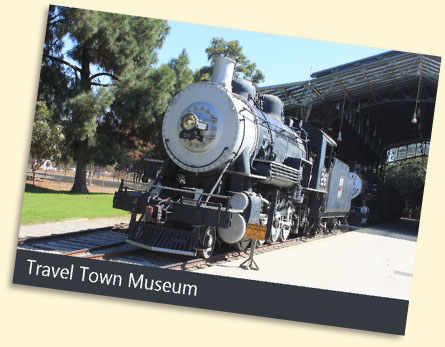
Travel Town is part of the Los Angeles Department of Recreation and Parks. It is located at 5200 Zoo Drive, Los Angeles, CA, in Griffith Park.
Travel Town started out as a possible addition to the existing miniature train ride already at the location in the late 1940s. It was a fortuitous time to be scouting unwanted steam locomotives, as all the major railroads were moving to diesel power. The collection has some interesting locomotives, mainly from railroads that operated in the western US from the 1880s to about 1930. The museum was formally dedicated on 14 December 1952.
I have visited a couple of times and the photos on this page are from both visits. There is plenty of parking right next to the museum and there is no entrance fee. However, this is another museum with a no-camera-tripods policy although, because the collection is largely housed outdoors, that shouldn’t be much of a problem. The museum can also get quite crowded, so get there early to get unimpeded shots of the equipment.


This Consolidation (2-8-0) type locomotive was the first of forty-five built for the AT&SF in 1899 for the AT&SF by the Baldwin Locomotive Works in Philadelphia, PA. Originally numbered #891, it was renumbered #644 in 1900. In 1910, it was loaned to the Pecos & Northern Texas Railway, but returned to the AT&SF after only one year.
It worked on Santa Fe's Northern, Southern, Panhandle, Plains and Gulf Divisions and was in active service when donated to Travel Town in 1953. Some engines from this class were rebuilt as 0-8-0 switchers in the early 1930s.


#664 was superheated by the AT&SF some time in the 1920s. The grate reduced slightly to 29 sq ft and the firebox to 156 sq ft. Total heating surface reduced to 1,749 sq ft including 308 sq ft superheating. Boiler pressure remained at 180 psi. Tractive effort increased to 33,145 lbs.
As with most conversions to a superheating, the exchange of 109 boiler tubes for 21 flues for the superheater elements resulted in a smaller combined heating surface, but the hotter, drier steam produced more power for the relatively small weight gain.


#664 was the first locomotive built by Baldwin with a cast steel frame.
As built the locomotive weighed 156,130 lbs, 139,530 lbs on its 57” drivers. The engine wheelbase is 23’ 3” and the driver wheelbase
15’ 2”. The engine is equipped with Stephenson valve gear and has 21" x 28" cylinders. With a 29.23 sq ft grate and 165 sq ft firebox, including 22 sq ft of arch tubes and 233 boiler tubes, total heating surface was 1,852 sq ft. Operating at a boiler pressure of 180 psi, it delivered 31,000 lbs tractive effort.




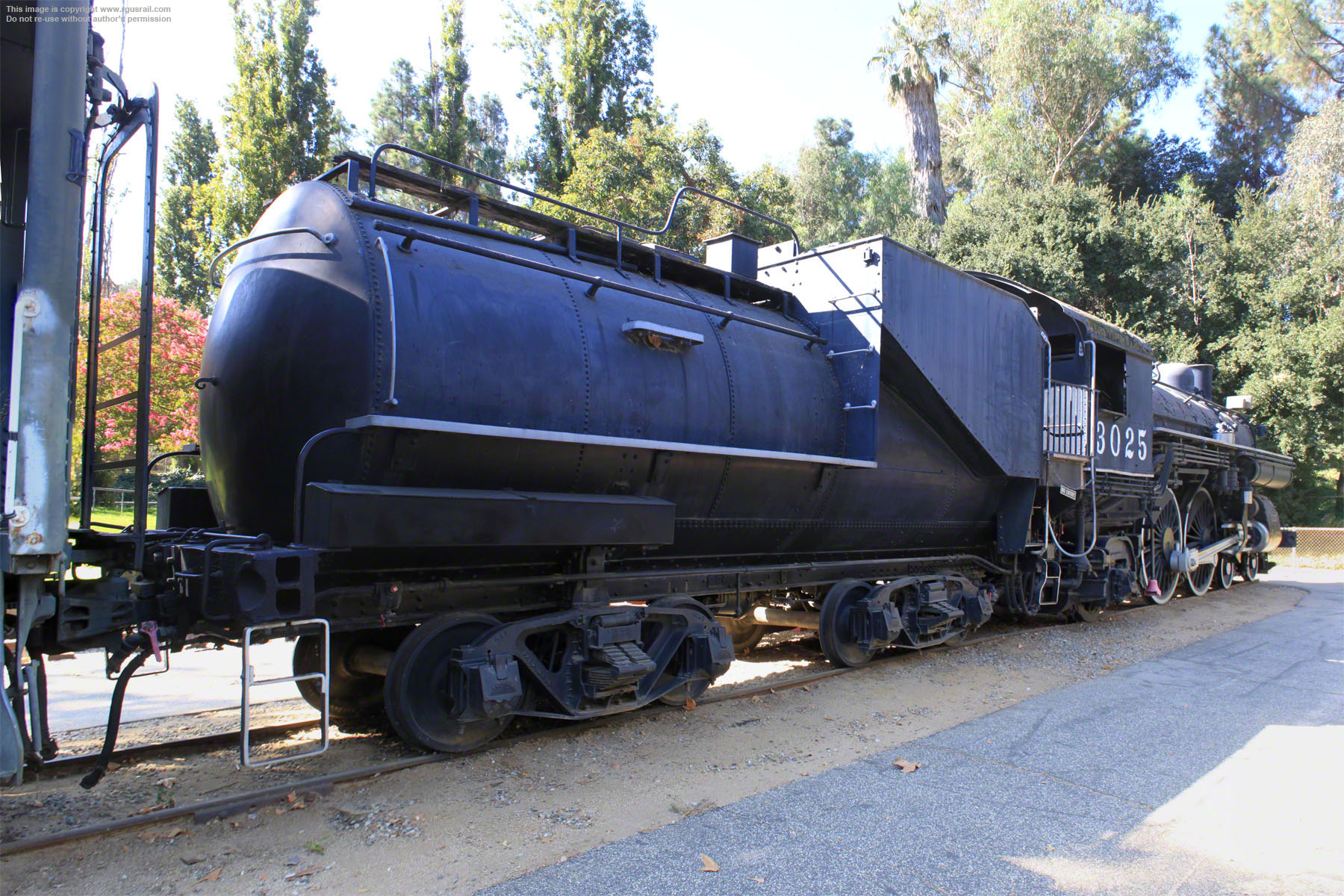
#3025 is an Atlantic type (4-4-2) locomotive, the first of thirteen built for the Southern Pacific by Alco from 1904 to 1908. It has very large drivers (at 81” nearly the tallest ever built) for speed, and probably hauled several name passenger services in California, including the Daylight, Starlight and Lark. It could reach 100 mph.
#3025 is the only survivor of fifty one Atlantics built for the SP and its subsidiary, the Texas & New Orleans. It was donated to the museum by the SP in 1952 and was the first standard gauge locomotive to go on display at Travel Town.


As built #3025 weighed 196,000 lbs, 105,000 on its drivers. It has a 27’ 7” engine wheelbase and, with only four drivers, just a 7’ driver wheelbase. It is equipped with Stephenson inside valve gear and has 20" x 28" cylinders. With a 49.5 sq ft grate and 174 sq ftt firebox, total heating surface was 2,649 sq ft. Operating at a boiler pressure of 200 psi, it delivered 23,506 lbs tractive effort.
The A-3s were superheated by the SP in the 1920s. Other than the heating surface, all dimensions of the locomotives were unchanged. Total heating surface dropped to 2,195 sq ft, including 435 sq ft superheating. Engine weight rose to 199,560 lbs and 107,000 lbs on the drivers.
Almost all the A-3s also received feedwater heaters or cast trailing trucks with starting booster engines.


Santa Maria Valley Railroad Company #1000 is a Mikado (2-8-2) type locomotive built by Alco in 1920 as #4 for the Hetch Hetchy Railroad. This 68 mile railroad was built by the City of San Francisco to develop the O'Shaughnessy Dam on the Tuolumne River in Hetch Hetchy Valley, Yosemite, CA.
In 1930, #4 was sold to the Newaukum Valley Railroad, a line owned and operated by the Carlisle Lumber Company in Washington State running between Napavine to Onalaska. There, it was re-numbered #1000.


In 1944, #1000 was sold to the Santa Maria Valley Railroad, a 10½ mile shortline serving oil refineries in Santa Maria, CA, as well as hauling produce to the Southern Pacific's mainline at Guadalupe, CA. The Santa Maria Valley Railroad donated #1000 to the museum in 1953 as it dieselised.
#1000 weighs 194,000 lbs, 149,000 lbs on its 48” drivers. It is equipped with Walschaert valve gear and has 20" x 28" cylinders. Operating at a boiler pressure of 180 psi, it delivered 35,700 lbs tractive effort.


#26 is a Consolidation type (2-8-0) oil burning locomotive, one of forty-five built by Alco at a cost of $15,331 in 1910 to haul freight on the Western Pacific.
As built, the C-43s weighed 203,000 lbs, 184,000 lbs on their 57” drivers. The engine wheelbase was 24’ 4” and the driver wheelbase 15’ 8”.
Equipped with Walschaert valve gear they had 22" x 30" cylinders. With a 33.6 sq ft grate and 218 sq ft firebox, total heating surface was 3,070 sq ft. Operating at a boiler pressure of 200 psi, they delivered 43,305 lbs tractive effort.

The C-43s were superheated by the WP. The engine weight rose to 207,000 lbs, 83,915 on the drivers. The relatively small grate and firebox remained unchanged. Total heating surface, however, dropped to 2,292 sq ft including 733 sq ft superheating. Boiler pressure also dropped to 190 psi and tractive effort to 41,140 lbs The tender weighed 155,000 lbs fully loaded, holding 3,000 of oil and 8,000 gallons of water.
The C-43s served the WP through WWII and retired in the late 1940s and early 1950s. #26 was donated to the museum in 1954.





Mogul (2-6-0) type locomotive #7 was built in 1902 by Alco. It was one of four delivered to the Minnesota Land & Construction Co. Sold to C. H. Sharp Construction C., in 1909, the two-wheel trailing truck was added to make it a Prairie (2-6-2) type. #7 worked on building the Santa Fe Railway System through Kansas, Texas, Oklahoma, New Mexico, Arizona and California.
During WWI, #7 worked at Camp Kearney, San Diego, CA. During WWII, it worked at various ordnance depots, including Fort Wingate, NM, and the Navajo Ordnance Plant at Flagstaff, AZ.


#7 was an oil burner weighing 133,600 lbs, 102,500 on its 56" drivers with 19” x 26” cylinders. It operated
at a boiler pressure of 195 psi delivering 27,900 lbs tractive effort.
It was donated to the museum by Sharp & Fellows in 1954.



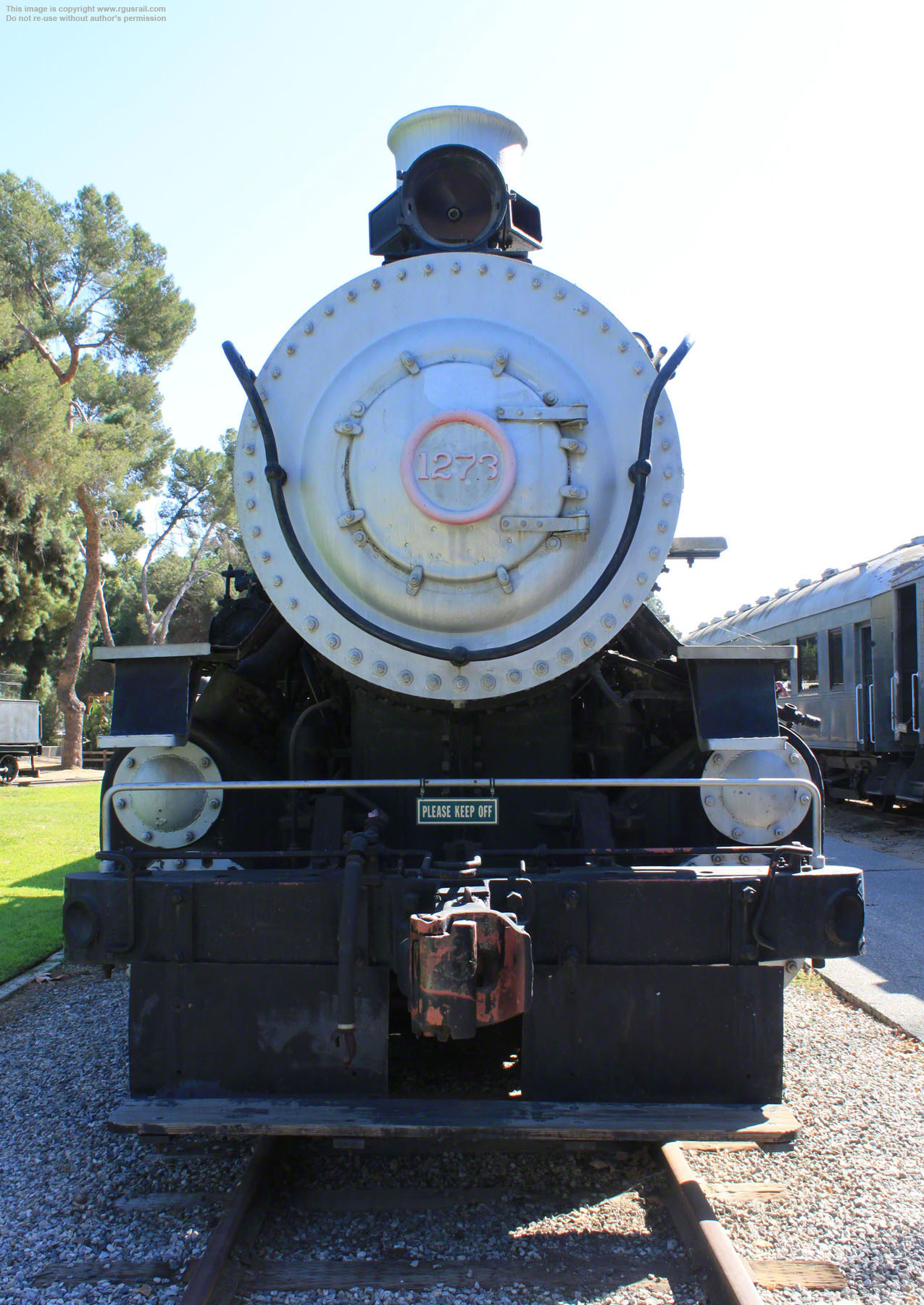


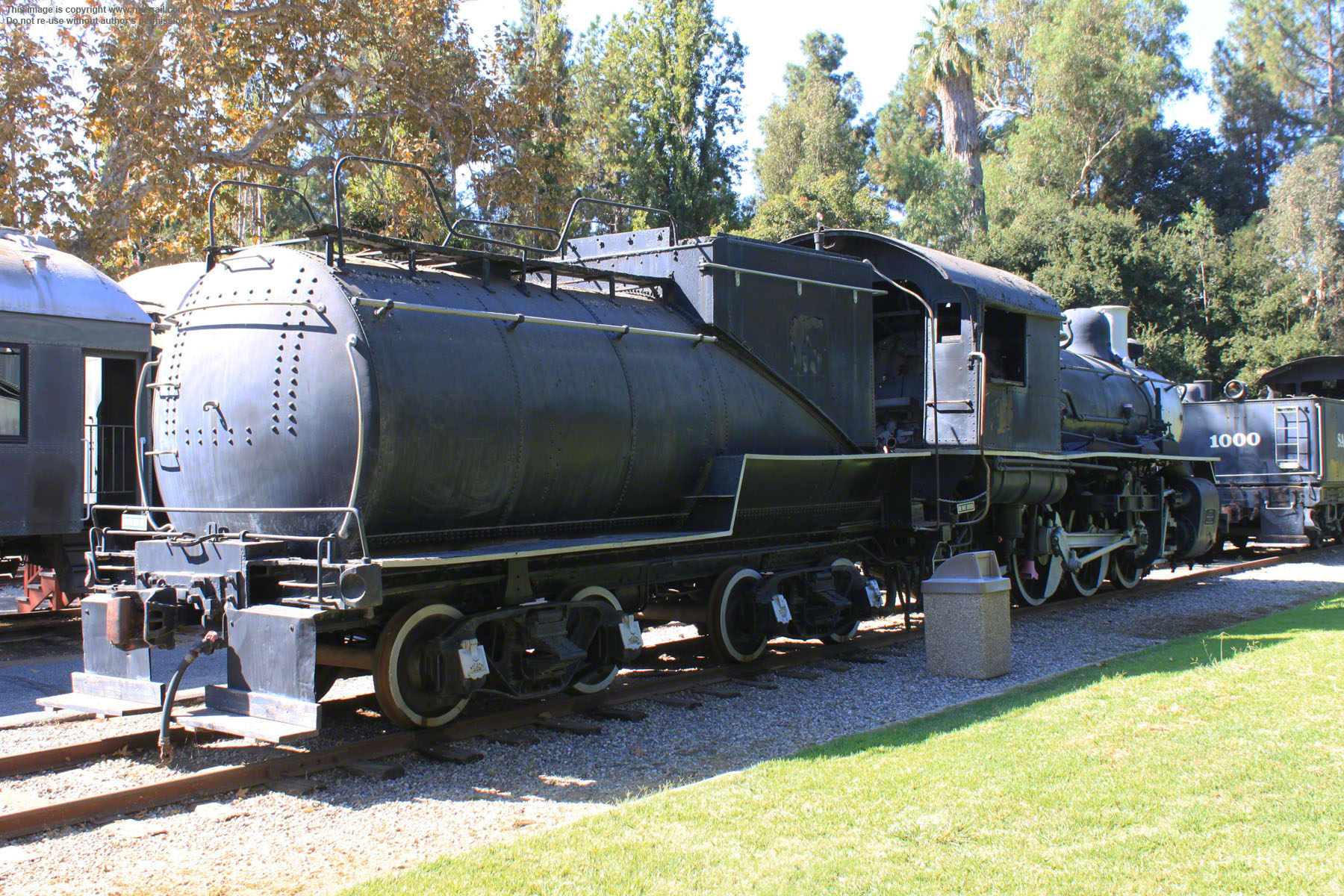


#1273 is one of thirty-two 0-6-0 switchers built by the Southern Pacific at its Sacramento shops. Six more were built at the Los Angeles shops. Built in 1921, #1273 worked in the Sacramento yards for most of its life logging over 1,500,000 miles in 35 years service. Retired in 1956, it was donated to the museum by the SP in 1957.
It was an oil burner, weighing 153,000 lbs and, operating at a boiler pressure of 200 psi, it delivered 31,020 lbs tractive effort. Equipped with Walschaert valve gear, it has 51” drivers and 20" x 26" cylinders.


#4439 is one of forty-five oil burning S-5 class
0-6-0 switchers built for the Union Pacific by the Baldwin Locomotive Works in 1918. During its early career, it worked in Cheyenne, WY. Later, it served on the Los Angeles Harbor Belt line until its operation was ended on the order of the Air Pollution Control Board in 1957.
#4439 weighs 156,000 lbs. Equipped with Walschaert valve gear, it has 21” x 26” cylinders and 51” drivers. Operating at a boiler pressure of 180 psi, it delivered 24,680 lbs tractive effort. The Union Pacific donated it to the museum in 1957.



This 3-truck Shay was built by the Lima Locomotive Works for the Little River Redwood Company Railroad in Crannell, CA, in 1922 as #4.
It was sold to the Camino, Placerville & Lake Tahoe Railroad in 1935 where it was renumbered #2.
The CPLT ran 8 miles from Camino in the Sierra Nevada Mountains east of Sacramento to a connection with the Placerville Branch of the Southern Pacific at Placerville, CA. It was primarily a lumber-hauling line owned by the Michigan-California Lumber Company.
A coal burner, #2 weighs 166,500 lbs. It operated at a boiler pressure of 200 psi, and produced a tractive effort of 30,350 lbs. The drivers are 36” and the cylinders 12” x 15”. The bunker has a capacity of 5 tons of coal, the tender 3,000 gallons of water.





#2 was built by the Heisler Locomotive Works, Erie, PA, in 1918 for the Hetch Hetchy Railroad
Like Santa Maria
Valley Railroad Company #1000, it worked on the O'Shaughnessy Dam on the Tuolumne River in Hetch Hetchy Valley.

Heislers are readily identified by their cylinders set at a 45° angle to the central drive rod. #2 has two 17” x 15” cylinders. An oil burning 3-truck Heisler, it weighs 150,000 lbs. It operated at a boiler pressure of 200 psi delivering 30,000 lbs tractive effort. The drivers are 38”.
#2 may have actually worked tender to tender on the Hetch Hetchy with Santa Maria Valley #1000, then Hetch Hecthy #4. In 1923, #2 was sold to Standard Lumber Co., which later became Pickering Lumber. It was donated to the museum in 1957.





Destined for the scrap yard, #31 was identified as a candidate for the museum’s collection and was donated by the Los Angeles Harbor Authority in 1953.
Right, #32 is another (0-4-0T) saddle tank built for the City of Los Angeles by Alco to work on the Port of San Pedro harbour development. Delivered in 1914, it was an oil burner, weighing 38,000 lbs. Operating at a boiler pressure of 165 psi it delivered 8,230 lbs tractive effort. It has 33” drivers and 11" x 16" cylinders. It too was donated to the museum in 1953.
#31 is an (0-4-0T) saddle tank locomotive built in 1921 for the City of Los Angeles by the
Davenport Locomotive Works of Davenport, IA. It was purchased to work on the ongoing development of the Los Angeles Port of San Pedro, mainly on the island of Catalina hauling rock from the quarry to the shore, but also on the main land
#31 was an oil burner, weighing 42,000 lbs and operating at a boiler pressure of 192 psi delivering 11,080 lbs tractive effort. It has 28½” drivers and 11" x 16" cylinders.


#1 was built by the Norris Locomotive Works in Lancaster, PA, in 1862 for the first railroad to bear the name "Western Pacific".
This was organised in 1862 to connect the Central Pacific in Sacramento with San Jose, CA.
#1 is an American (4-4-0) type locomotive and
was one of ten bought by the Western Pacific lettered "A" to "J". #1 was originally lettered "G". In 1867, the Western Pacific ran out of money and halted work until absorbed by the Central Pacific in 1870. #1 was then renumbered #31. It was sold to the Stockton, Terminal and Eastern Railroad in 1914.
#1 is an oil burner weighing 62,100 lb, 37,200 lbs on its 63" drivers. It has 16” x 22” cylinders. Operating at a boiler pressure of 135 psi it delivered 10,260 lbs tractive effort.


#1544 was built in the North Shore Railroad's Tiburon shops in Sausalito, CA, in 1902. It
weighs 50 tons. It has 33" drivers and could produce 500 hp. The sloped ends on either side of the cab were taken from steam locomotive tenders, one end filled with water and the other with sand for ballast.
PE used #1544 as a work locomotive and switcher at various locations in the Los Angeles area. It last worked at PE's Torrance repair shops, south of Los Angeles, until retired in 1952. It was donated to the museum in 1953.



#1 is a 42 ton, 300 hp diesel-electric switcher, one of three built by the Electro-Motive Division of General Motors in 1942 for the United States Navy. Only eleven of these locomotives were built between 1940 and 1943.
#1 worked at the US Navy Torpedo Station on Goat Island, RI, and the North Island Naval Air Station in San Diego, CA. In 1962, it moved to the McDonnell-Douglas Aircraft Corporation's Naval Weapons Industrial Reserve Plant at Torrance, CA, where it worked until 1988, when McDonnel-Douglas donated it to the museum.



This 0-6-0ST (Saddle Tank) locomotive was built by Alco in 1925 for the Reliance Rock Co., in Azusa, CA. The company was consolidated into the Consolidated Rock Products Co., in 1929. #1 worked on the 3 mile standard gauge railroad connecting the quarry to a connection with the SP until it was retired in 1955 at the order of the Smog Control Board and replaced by a diesel. It was donated to Travel Town in 1958.
#1 weighs 124,000 lbs. An oil burner with 17” x 24” cylinders, it operated at a boiler pressure of 180 psi delivering 24,100 lbs tractive effort.