


For me, the Baltimore & Ohio Railroad Museum, at 901 W. Pratt St, Baltimore, MD, has one of the finest collections of motive power in the US, and one of the most attractive display spaces.
The museum is open all year (weather permitting!) Monday-Saturday 10.00am-4.00pm and Sunday 11.00am-4.00pm, except Easter Sunday, Memorial Day, Independence Day, Labor Day, Thanksgiving, Christmas Eve, Christmas Day, New Years Eve and New Years Day
There is so much in the collection that
I have two pages devoted to the museum on this website. This page covers the roundhouse. The next page covers the B&O Museum Yard and Car Shop.


Below, the taller, three block part of the 1851 building has been adapted as the museum entrance.
The first depot built in 1829 also had a stable for horses. It was named in honour of James Maccubbin Carroll, through whose Mount Clare estate the newly formed railroad was built west. Carroll had inherited the land from his barrister father Charles Caroll, and either donated or sold the right of way to the company as did other landowners along the route.
The building on the right in the photo above is the 1851 Mount Clare depot. It replaced the earlier depot constructed in 1829.
From about 1830, the B&O also began building locomotives at Mt. Clare, freight and passenger cars, and other railroad equipment. In 1850, an iron works was added, and the first iron railroad bridges, designed by Wendel Bollman, were built there in the 1850s.


Left, a view of the roundhouse from Pratt St.
Designed by the head architect for the B&O, Ephraim Francis Baldwin, to service the railroad's passenger cars, it was the largest circular industrial building in the world when completed in 1884. It stands 125' high and covers more than an acre.
The B&O was one of the oldest railroads in the US. Chartered in 1827, construction began on 4th July 1828, when Charles Carroll of Carollton (a distant relation of James Maccubbin Carroll) did the official groundbreaking and laid the "First Stone".


The stone, pictured above, was a gift of the Stone Cutters of Baltimore, and is now on display just inside the museum entrance.
Right and below, two photographs show a replica of the freight agent's room set up inside the old depot building.
Until this building opened, passengers would purchase tickets at a small wooden ticket booth located at the corner of Pratt St and Parkin St. When the B&O extended its rails east into the city in 1831, the depot served the western suburbs


When steam arrived on the B&O in 1832, the city prohibited the smoky, dirty locomotives from the city streets. Trains were then uncoupled at Mount Clare and pulled downtown by horses.
Then, when the railroad constructed a large, Italianate passenger depot at the junction of Howard and Camden Streets in 1857, Mt Clare became a freight-only depot.
At about this time, the first roundhouse, as well as an engine house and car shops were built. By then, the shops were employing about a thousand workers.
After the Civil War, the B&O built a foundry, blacksmith shop, additional car shops and an office building. In 1882, it added a bridge fabrication shop, and Baldwin's roundhouse followed in 1884. Between 1900 and 1920, a large locomotive shop, sawmill, machine shop, grain elevator and a tender shop were added. By this time, over 3,000 employees worked in the complex. The B&O built its last steam locomotive at Mt. Clare in 1948. As it dieselised, there was less need for the shops, and the B&O abandoned use of the roundhouse in 1953.
For much of its life, the B&O had collected locomotives and other artefacts for public relations purposes. The collection was stored in various sites until centralised in the Mt. Clare Shops in 1953. It was maintained by the Chesapeake & Ohio when it acquired ownership of the B&O in 1963 and by the successor companies, the Chessie System and CSX. In 1990, CSX deeded the property and collection to the newly formed museum organisation, which has continued to expand its role and the collection.

Above, a 1920s view from a nearby grain elevator looking over the roof of the roundhouse. The image is from Volume II of Edward Hungerford's The Story of the Baltimore & Ohio Railroad 1827-1927, published in 1928 (you can browse this work or download searchable pdf versions from the books and manuals page of this website).
As well as the roundhouse itself, the Passenger Car Works building on the far left has survived. It now holds several pieces of historic motive power, which you can see on the B&O Museum Yard and Car Shop page of this website.

Above, a photo from 1971. The expanse of buildings middle centre in the top photo, including the locomotive erecting shop, sawmill, machine shop and tender shop, burned down in 1962. The grain elevator on the lower left and, top left to top center, the blacksmith shop, brass foundry and iron foundry were all demolished during the 1970s.


Above, the remains of the "Stourbridge Lion" are on loan to the museum from the Smithsonian in Washington, DC, and are displayed just past the ticket office.
The "Stourbridge Lion" was built in England for the Delaware & Hudson Canal Company by Foster, Rastrick & Co., of Stourbridge. It was the first steam locomotive to be exported from the UK, and was also the first steam locomotive to operate in the US. It was assembled at the West Point Foundry, NY, in 1829 and tested under steam in August that year, but it had a brief operational life. With designing and building of locomotive in the US improving, it was soon rendered obsolete.

In 1834, the D&H tried to sell the "Lion" with three other UK built engines, to the Pennsylvania Canal Commission, which had just completed its railroad over the Alleghenies (you can see the remains of that railroad on the Allegheny Portage page of this website) but without success.
Components were then melted down to manufacture other parts and products and, by 1845, all that remained of the original locomotive was the boiler. This was displayed at the 1883 Railway Exposition in Chicago, IL, where souvenir hunters then made off with whatever removable parts remained. The boiler was finally acquired by the Smithsonian in 1890.
You can see a replica of the engine on the Stourbridge Lion page of this website.


Above, a model of the locomotive displayed in front of the exhibit shows how the "Stourbridge Lion" looked when in service.

Below, a 2" to one foot scale model of EMD E8 #950. The cutaway on one side lets you see the internal layout and pushing buttons on the information panel illuminates key components. It was built by General Motors in 1949. Later presented to the Smithsonian, it is on loan to the museum. #950 is a fictional number, as none of the four EMD E8 prototypes (#5600A, #952 & #810-#811) bore that number.
Four hundred and forty six E8 A units were built for US railroads and three for Canadian from 1949 to 1953, and forty-six B units from 1949 to 1954, all for US railroads. Fifty-eight survived and a number still operate on short line and heritage railroads. SOU #6900 is on the North Carolina Transportation Museum page of this website, SOU #6901 on the Southeastern Railroad Museum page, PRR E8 #5794 liveried as FEC #1594 on the Gold Coast Railroad Museum and NYC E8 #4085 on the NYC Museum page.




Above, a composite picture intended to capture the grand interior scale of the roundhouse. It is a truly impressive piece of engineering, and has been beautifully restored following a catastrophic roof collapse that occurred in 2003.
On 16th February that year, a record-breaking snowfall caused one half of the roof to collapse, spilling tons of snow and debris onto the collection and damaging several historic locomotives. The museum had to close but, after twenty-two months of work, it reopened on 13th November
2004.

Click on this link to see a full, 360° flash panorama of the roundhouse interior:


The line was officially opened two days later on 24th May 1830, inaugurating the first regular railroad passenger service in
the US.
Initially, three round trips were run daily from Mt. Clare to Ellicott's Mills. A fourth was added on 5th July 1830.


The first trains on US railroads were pulled by horses and, until the 1880s, the Mt. Clare depot included functioning stables for the horses used to pull cars through the city.
Above, a replica of "Pioneer", one of the first
horse drawn passenger car to operate in the country, built at the Mt. Clare workshops in 1892. It was displayed at the 1893 World’s Columbian Exposition in Chicago, IL, the 1927 Fair of the Iron Horse, the 1933-34 Chicago World's Fair, 1939-40 New York World's Fair and 1948-49 Chicago Railroad Fair. The original was built by Richard Imlay and carried the B&O company directors on their trip from Mt. Clare to Ellicott's Mills on 22nd May 1830. The run from Mt. Clare was thirteen miles and took about 1½ hours to complete.

Above, the level of comfort was somewhat rudimentary.


This replica of the 0-4-0 "Tom Thumb" was built at the Mt. Clare workshops in 1927 for the Fair of the Iron Horse.
The original was built in 1830 by inventor and businessman Peter Cooper as a demonstrator locomotive. On 28th August 1830, it carried the B&O directors in a passenger car to Ellicott's Mills, to their amazement, travelling at the then impressive speed of 10-14 miles per hour. It was later dubbed "Tom Thumb" because of its small size and weight of less than a ton.


Above, the Director's Car is a 1926 replica of the one that travelled on the original demonstration run of the "Tom Thumb".
"Tom Thumb" was the first successful US steam locomotive, although it only hauled passengers until March 1831 and never went into regular service. It was salvaged for parts in 1834.
Nor was Peter Cooper recognised for his accomplishment until 1875, when he described and sketched a drawing of the locomotive. In 1892, a wooden model was built by Major Pangborn, who also made models of many other early locomotives. It was this model and Cooper's description that formed the basis for the replica which steamed at the 1927 Fair of the Iron Horse. It also appeared at the 1933-34 Chicago World's Fair, 1939-40 New York World's Fair and 1948-49 Chicago Railroad Fair.


Above, the 5" x 27" vertical cylinder that drives the wheels on one of the axles.
The replica weighs 10,000 lbs, 5,800 lbs
on its drivers. Operating at a boiler pressure of 90 psi, it delivers 820 lbs tractive effort.


The main limitation on development of this type of engine was the vertical boiler, which constrained overall size and power. They were soon replaced by horizontal boilered rod locomotives and most had been dropped from the B&O roster by the 1840s, although a few continued in service as yard switchers as late as the 1890s.
In all these photos, the walking beams, or so called grasshopper "legs" and gears of this type of locomotive are clearly evident. It was the first commercially successful and practical American built locomotive.
The original "Atlantic" #2 was an 0-4-0 built in 1832 by Phineas Davis and Israel Gartner of York, PA, after winning the competition to design a suitable locomotive for the line. It was scrapped in 1835.
This "Atlantic" is actually the "Andrew Jackson" #7, built at the Mt. Clare shops in 1836 by Ross Winans and George Gillingham, and adapted in 1892 to resemble "Atlantic" #2 for the 1893 Columbian Exposition in Chicago, IL. It appeared at the Fair of the Iron Horse in 1927.

With its vertical driving rods, the "Atlantic" is another example of the "grasshopper" type. Andrew Jackson, the first sitting president to use a railroad, rode behind the original "Atlantic" in 1833.
By 1838, the B&O owned fourteen grasshoppers, as well as two Ross Winans designed derivatives called "crabs", all built at the company's Mount Clare shops. Although it retained an upright boiler, the distinctive features of the "crab" were its horizontal drivers, slide rods and cylinders.


It also appeared at the 1939-40 New York World's fair and the 1948-49 Chicago Railroad Fair.

The original "Atlantic" weighed 6½ tons and had 35" drivers and 10" x 20" cylinders. It delivered 4,245 lbs tractive effort.


The rebuilt "Atlantic" weighs 13½ tons with 36" drivers and 12½" x 22" cylinders. A coal burner operating at a boiler pressure of 75 psi, it produced 6,915 lbs tractive effort.

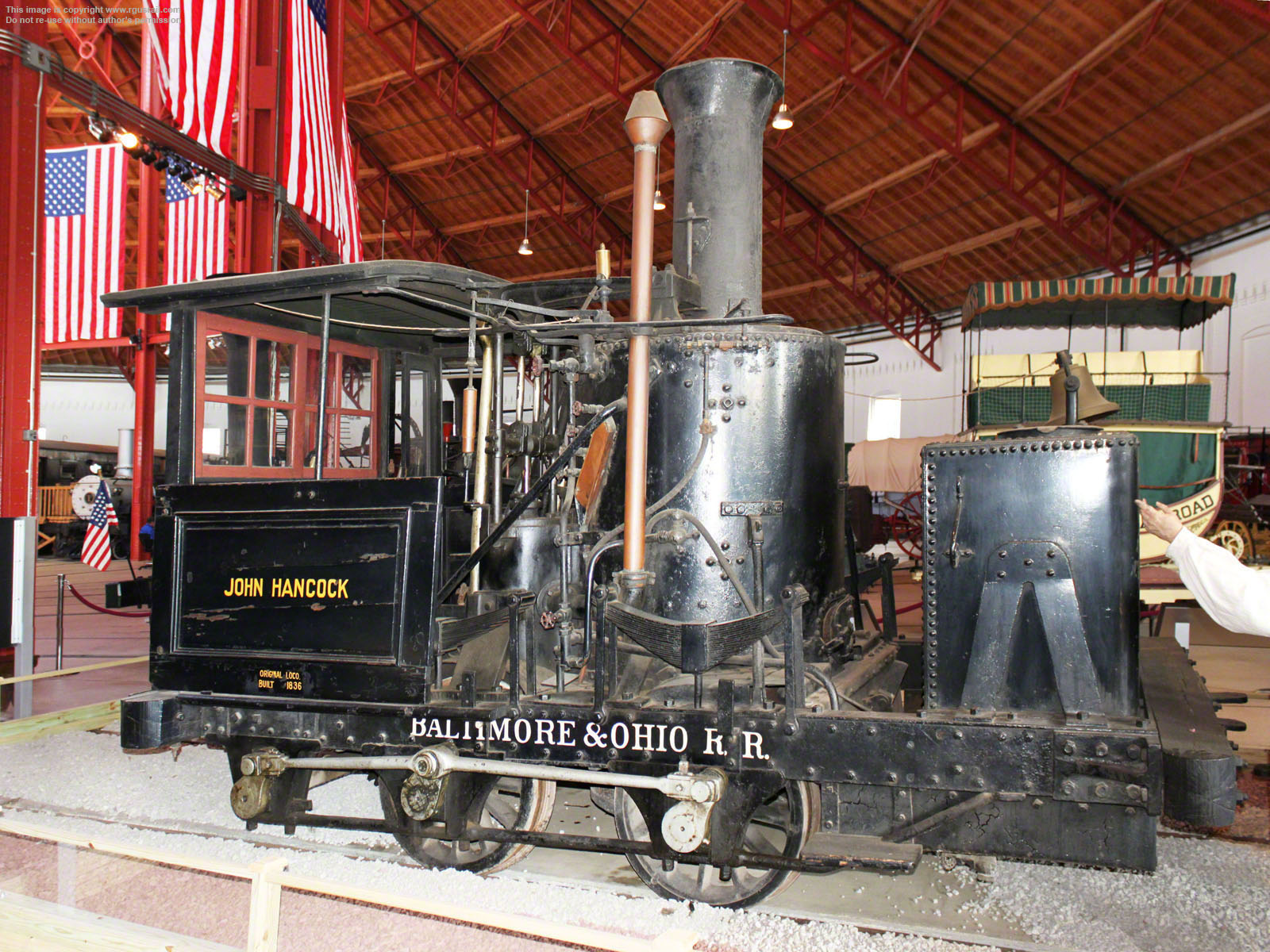

The 0-4-0 "John Hancock", built by George Gillingham and Ross Winans in 1836, is an improved grasshopper type locomotive, with dual-powered axles. It was also the first B&O locomotive built with a cab, so weighs twice the original "Atlantic" (29,000 lbs).
In 1851, it was numbered #8 when the B&O stopped naming locomotives and then, in 1884, #3, as the third oldest B&O locomotive in existence. It worked at Mt. Clare until 1892 when it was retired and rebuilt for display at the 1893 World's Columbian Exposition in Chicago, IL. At that time, #3 was incorrectly named the "Thomas Jefferson", which had been the original #3 "Grasshopper" locomotive.


The engine was also displayed at the 1927 Fair of the Iron Horse, the 1933-34 Chicago World's Fair and the 1939-40 New York World's Fair.


A coal burner, the “John Hancock” was originally built with 12½" x 24" cylinders, but these were rebuilt to 12” x 22” cylinders in 1892.
It has 35” drivers and operated at a boiler pressure of just 75 psi delivering 5,094 lbs tractive effort.

It appeared again at the 1948-49 Chicago Railroad Fair, as did the so-called "Bride's Coach" to which it is coupled above.


This replica of the 4-2-0 "Lafayette" was built at the Mt. Clare workshops in 1927 for the Fair of the Iron Horse where it was displayed as the "William Galloway". William Galloway had driven the first, horse-drawn train from Mt. Clare to Elllicott's Mills in 1830. He later became an engineer on the B&O and apparently worked in that capacity for over fifty years.
The Fair of the Iron Horse marked the 100th anniversary of the chartering of the B&O by the states of Virginia and Maryland, and featured twenty-six locomotives, twelve from the B&O, including the "Atlantic", the "William Mason", the "Memnon" and "J. C. Davis", all shown on this page. You can find out more about the Fair on the Fair of the Iron Horse page of this website.

Having reached Harpers Ferry, WV, by 1837, the B&O needed more powerful engines.
Then President of the B&O, Louis McLane, looked to Norris Locomotive Works in Philadelphia, PA, to supply them.


The "William Galloway" then appeared at the 1933-34 Chicago World's Fair and the 1939-40 New York World's Fair.
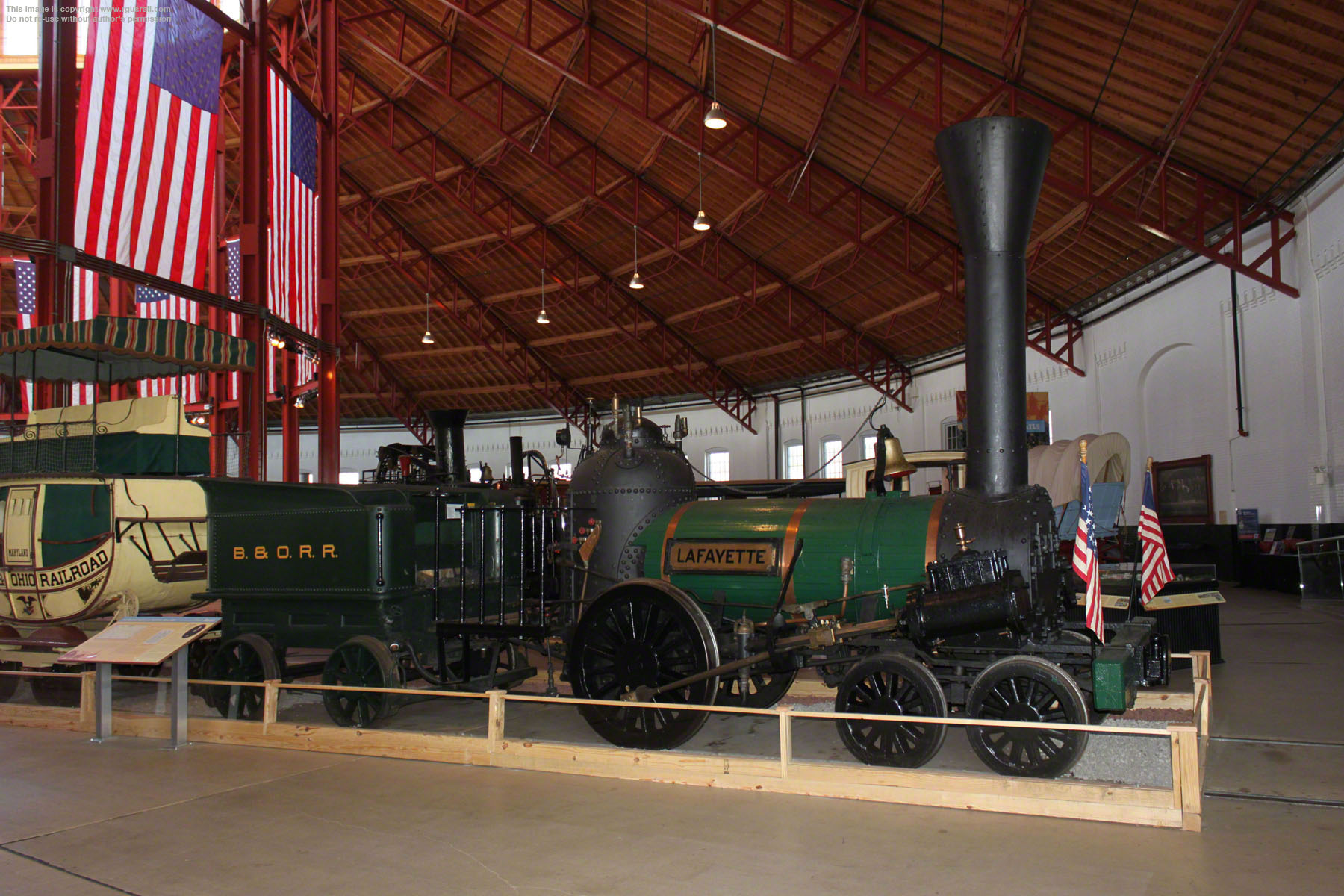


The replica engine also appeared at the 1948-49 Chicago Railroad Fair, by which time it had been renamed the "Lafayette".

Still operational, the replica weighs 29,200 lbs, has 9" x 18" cylinders and 42" drivers (the original had 48"). Operating at a boiler pressure of 90 psi, it delivers 2,323 lbs tractive effort.
It last steamed at the Railfest held at the museum in 2013.


Built by Norris in 1837, the original "Lafayette" was one of the first locomotives ordered by the railroad from an external builder, the first horizontal boilered locomotive built for the B&O, the first commercially produced with a swivelling four wheel pilot truck and may have been the first standardised production model. Another innovation was the positioning of the cylinders at the side of the smokebox. This horizontal boilered locomotive was more powerful and fuel efficient than B&O's vertical boilered ones.
The "Lafayette" is an example of what were quickly nicknamed "one armed billies" probably after the builder, William Norris, but also possibly because of their characteristic single connecting rod from the piston to the drivers.

Above, two views of the "Lafayette's" upright firebox.

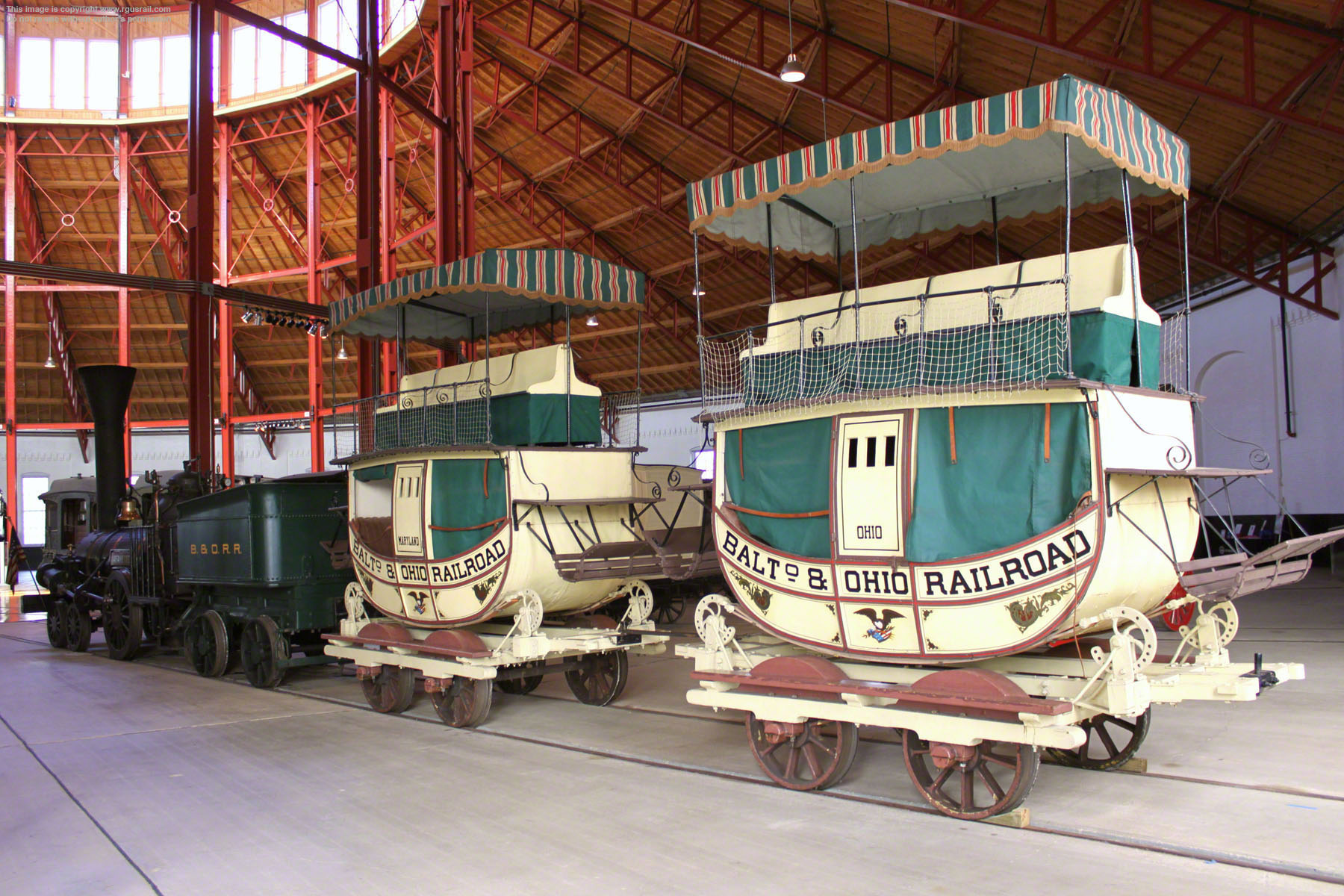
Above, two photos of the beautifully detailed replica passenger cars attached to the
"Lafayette". These are typical of early examples of the originals, which were simply stage coach bodies applied to wheeled frames. However, their separate leather springing would provide a smoother ride on the often rough rail track of the time. Note the ratchets at each end of the truck to allow the tension to be tightened on the straps as they stretch with use.
As was the case with contemporary stage coach travel, the lower compartments would have been reserved for passengers paying a higher fare than those who occupied the more open upper decks. Passengers would also have sat on the benches at the front and rear.

Above, in 1937, the "Lafayette" briefly appeared in the Western Wells Fargo, directed by Frank Lloyd and starring Joel McCrea, Bob Burns and Frances Dee. It was lettered for the Tonawanda Railroad pulling a two car passenger train into Batavia in western New York State (actually a location somewhere in California).
The Tonawanda was chartered in 1832 to connect Rochester to Buffalo, NY, and reached Batavia in 1837. It was absorbed into the New York Central in 1853.

Above, the "Lafayette" put in an appearance in the "Wheels-a-Rolling'" pageant at the 1948-49 Chicago Railroad Fair.

Above, in 1997, "Lafayette" and the two replica passenger cars appeared in Amistad, directed by Steven Spielberg and starring Morgan Freeman, Nigel Hawthorne, Anthony Hopkins, Djimon Hounsou and Matthew McConaughey. The film was based on the mutiny in 1839 of newly captured Mende slaves who took control of the Spanish ship "La Amistad" off the coast of Cuba, and the international legal battle that followed their capture by a US revenue cutter.
Below, a temporary cab was built for the "Lafayette" when it appeared as the "Yonah" in Walt Disney's 1956 film The Great Locomotive Chase directed by Francis D. Lyon and starring Fess Parker, Jeffrey Hunter and John Lupton.
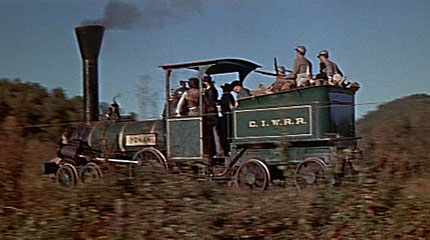
You can see two of the original locomotives that took part in this historic event on the Southern Museum and Great Locomotive Chase page of this website.


#600 was one of the more seriously damaged locomotives in the roof collapse. The cab was flattened. Only the front wall was left, but most of the cab appliances and controls may be salvageable. Damage to the boiler top fittings included denting of the bell. The bell stand and yoke were also broken into pieces, and the whistle body and stem were bent. A number of gouges, dents and scrapes were sustained by the boiler jacket.
Fortunately, the tender sustained only minor buckling and scratching.
On 17th February 2003, a heavy snow storm caused the roundhouse roof to collapse, and the museum's collection inside suffered serious damage.
Twelve historic locomotives were badly damaged, some of the items were damaged beyond repair.

#600 was built in 1875 at the Baltimore & Ohio Railroad's Mount Clare works under the supervision of then Master of Machinery, John C. Davis. Designed to haul mail and passenger express trains over B&O's Keyser, WV, to Grafton, WV, division, it was the first Mogul type (2-6-0) passenger locomotive rostered by the railroad and weighs 90,400 lbs, 76,550 lbs on its 60" drivers. It has an engine wheelbase of 22' 12¾" and driver wheelbase of 15' 1" with 19" x 26" cylinders and Stephenson valve gear. With a 23.7 sq ft grate, a 122 sq ft firebox and total heating surface of 1,272 sq ft, it operated at a boiler pressure of 130 psi delivering 17,286 lbs tractive effort. Its tender weighs 63,000 lbs light, with a capacity of 3,000 gallons of water and 4 tons of coal.
#600 won first place at the US Centennial Exhibition in Philadelphia, PA, in 1876, where it was displayed as the then heaviest locomotive in the world. In 1884, it was renumbered #918 but, in 1893, returned to its original number and was named "J. C. Davis". Retired in 1926, it appeared at the Fair of the Iron Horse the following year.


The "A J Cromwell" #545 was another of the locomotives badly damaged by the 2003 roof collapse. Above, when I visited in 2010, both the #545 and #600 were in a glassed off area. #545 is on the left, #600 on the right.
The left rear part of the cab, rear doors and windows were badly damaged and the entire roof needed to be replaced, although most of the cab appliances and controls were salvageable. The left side suffered the most serious damage with deformation to the boiler jacketing, handrail and stanchions, and running boards.


#545 is a Consolidation type (2-8-0) locomotive, designed for durability rather than speed. It spent its entire operating life hauling freight.
Above, restoration of #545 was completed and the engine returned to display inside the roundhouse in 2012.
Built as an E-6 Class locomotive at the Baltimore & Ohio Railroad's Mt. Clare shops, #545 was designed by Andrew J. Cromwell, the B&O's Supervisor of Motive Power. It was originally equipped with 20" x 26" cylinders but was later converted to a Class E-8 and fitted with 21" x 26" cylinders. With a 55" diameter wagon top boiler, it weighs 134,200 lbs, 121,200 lbs on its 50" drivers, and has a 29 sq ft grate, 186 sq ft firebox and total heating surface of 1,740 sq ft. Operating at a boiler pressure of 165 psi, it delivered 36,162 lbs tractive effort. #545 was retired in 1926 and appeared at the Fair of the Iron Horse the following year when it was renamed “A. J. Cromwell”. It then went into storage in the Hall of Transportation located on the Fair’s site in Halethorpe, MD. In August 1935, a major storm caused the roof of the building to collapse.


#545 is the sole remaining B&O locomotive of this type and the oldest piece in the museum's collection equipped with air brakes. In 1956, it appeared in the The Swan, an MGM movie starring Grace Kelly.


“Memnon” was also badly damaged when the Roundhouse roof collapsed in 2003 and had to undergo extensive restoration.
Below, compare its simple backhead with C&O H-8 #1604 on the B&O Museum Yard & Car Shop page of this website.
In 1842, the B&O had reached Cumberland, MD, and needed locomotives to haul coal trains from the mines there, something the lighter weight grasshoppers and one armed billies could not easily do.
In 1844, the railroad had begun rostering Mount Clare built 0-8-0 type locomotives, as that
wheel arrangement produced maximum tractive effort by evenly distributing all of the engine’s weight on its drivers. In 1848, the B&O the ordered six additional 0-8-0s from external manufacturers.


“Memnon” was one of two built under sub-contract to Baldwin by the Newcastle Manufacturing Company in Newcastle, DE.
“Memnon” was rebuilt in 1853 and then served in the Civil War hauling troops and supplies
for the Union. Since then, it has been known as the “Old War Horse”.With 17” x 22” cylinders and 43" drivers, “Memnon” has “blind” (flangeless) centre drivers, which were installed to ease curve-handling. Operating at a boiler pressure of 65 psi it” delivered tractive effort of 8,580 lbs.
Renumbered #13 in 1884 and retired from service in 1892, it was rebuilt for display at the the 1893 World's Columbian Exposition in Chicago, IL, when it returned to #57. It last steamed at the B&O's 1927 Fair of the Iron Horse and is one of the oldest surviving freight locomotives in the US.

"Memnon" was returned to display in February 2008.


This American type (4-4-0) locomotive was built by the Mason Machine Works in Taunton, MA, in 1856 as #25, one of two ordered by the B&O from the works. The 4-4-0 was one of the most popular locomotive designs on US railroads during the mid 19th Century.
Renumbered #55 in 1882, It returned to #25 in 1892 and was displayed at the Chicago's World Fair the following year. It then appeared at the St. Louis Exposition in 1904 and was named "William Mason" in 1927 when it appeared at the Fair of the Iron Horse.


#25 later appeared at the 1933-34 Chicago World's Fair, the 1939-40 New York World's Fair and the 1948-49 Chicago Railroad Fair.
William Mason wanted to improve the symmetry of the American locomotive, and his designs produced from 1853 until his death in 1883 had far less of the ornamentation more typical of the day. The Mason Machine Works turned out over seven hundred and fifty steam locomotives until it ceased production in 1889. Producing textile machinery then became the company's core business until its decline in the 1920s. It finally went out of business in 1944.
The "William Mason" is the oldest operating steam locomotive in the
US and has had a long career, appearing in many movies, including The Swan (1956) with Grace Kelley and Alec Guinness, as the "General" in Disney's The Great Locomotive Chase (1956) and in the Civil War drama Raintree County (1957). More recently, it was rebuilt as the "Wanderer" at the Strasburg Railroad in Strasburg, PA, for the 1999 Warner Brothers remake of the movie The Wild, Wild West starring Will Smith and Kevin Kline and also featured in Tuck Everlasting (2002) and Gods and Generals (2003).

With an engine wheelbase of 20' 9" and
driver wheelbase of 7', #25 weighs 56,000 lbs, 40,500 lbs on its 60" drivers. It has Stephenson valve gear, 16" x 22" cylinders, a 15 sq ft grate, 86.5 sq ft firebox and a total heating surface of 784 sq ft. Operating at a boiler pressure of 100 psi it delivers 6,225 lbs tractive effort.
Below, #25’s cab is a little more comfortable than the "Memnon", although it would probably not have been pleasant with a tail wind in a Northeastern winter!


#25 was the first B&O locomotive to have a Stephenson link motion valve gear and a round smoke box set on a cylinder saddle.


Above, from the top, the "William Mason" as it appeared in The Great Locomotive Chase, Raintree County, Wild Wild West and Gods and Generals.


The "Pioneer" was built in 1851 by the Union Works in South Boston, MA, and bought by the Cumberland Valley Rail Road.
The CVRR was chartered in 1831 and built a line from Carlisle to Harrisburg, PA, in 1837. It began operating over Franklin Railroad trackage to Hagerstown, MD, in 1841, took over the Franklin in 1865 and, by 1889, had reached Winchester, MD.
Daniel Tyler was hired to supervise the line's rebuilding in 1850, and took on Alba Smith as Superintendent of the Machinery Shop. It was Smith, who was Superintendent until 1856, who introduced light weight "single-wheel" locomotives like the "Pioneer".

From 1901, "Pioneer" appeared
at many exhibitions, including the 1904 Louisiana Purchase Exposition in St. Louis, the Fair of the Iron Horse in 1927, the 1933 Chicago World's Fair and the 1948-49 Chicago Railroad Fair. In 1961, the Pennsylvania Railroad , which had taken over the CVRR in 1919, donated "Pioneer" to the Smithsonian.
Below, a glimpse inside the cab.
A 2-2-2 type, "Pioneer" has no separate tender, so it is officially a tank engine. A
wood burner weighing 25,000 lbs, it is built of wrought iron and cast iron, with copper boiler tubes, and has 54" drivers and 8½" x 14" cylinders. It hauled 1-3 car passenger trains between Harrisburg and Hagerstown.
During the Civil War, the
CVRR provided an important supply line carrying Union materiel and troops to southern Pennsylvania, western Maryland and northern Virginia. In 1862, Confederate troops raided Chambersburg, PA, burning the engine house in which the "Pioneer" and several other locomotives were stored.
Some of the locomotives were destroyed but the "Pioneer" escaped major damage. It continued to operate over the railroad until it was finally retired in 1901.

In 2010, the B&O Railroad Museum began restoring "Pioneer" to how it appeared at the end of its operational life in 1901. The work was completed in 2011.
The locomotive was part of "The War Came by Train" Civil War exhibition on one of my visits.


#147 is a Ten Wheeler (4-6-0) type locomotive built at B&O's Mt. Clare shops in 1863 to meet increased demand arising from the Civil War.
The B&O had built its first 4-6-0 in 1853 to tackle the heavy grades in the Appalachian Mountains of what was then Virginia, now West Virginia.
West Virginia broke away from Virginia after the 1861 Wheeling Convention during the Civil War. Seceding from the Confederate States, the new state was admitted to the Union on 20th June 1863.
#147 was one of eleven Ten Wheeler locomotives designed by B&O Master of Machinery, Thatcher Perkins. After the Civil War, it continued in passenger and freight service, and was renumbered #282 in 1884. It was preserved by the railroad in 1892, when it was renumbered to represent another Ten Wheeler built in 1863, #117.
The railroad gave it the name "Thatcher Perkins" for the 1927 Fair of the Iron Horse to honour its designer. It also appeared at the 1933-34 Chicago World's fair, 1939-40 New York World's Fair and the 1948-49 Chicago Railroad Fair.


Above, #147's tender weighs 63,000 lbs light and has a capacity for 3,000 gallons of water and 4 tons of coal.
Above, note the design of the manually operated fire doors.
The locomotive weighs
90,700 lbs. Built with
18" x 26" cylinders (now 19" x 26") and 60" drivers (now 58"), the engine's first driver was originally flangeless but is now flanged.
#147 also originally had a long combustion chamber with an ash hopper underneath. However, the hopper leaked and the combustion chamber was soon removed.
The engine has a 19.39 sq ft grate, 113.63 sq ft firebox and total heating surface of 1,020 sq ft. Operating at a boiler pressure of just 75 psi, it delivered 10,317 lbs tractive effort (now 10,350 lbs).


This 4-6-0 (Ten Wheeler) type locomotive is a true camel: its cab is mounted on top of the boiler, rather than straddling it.
The latter configuration, such as CNJ P-6s #592 shown later on this page, is properly known as a camelback or "Mother Hubbard".


The "Ross Winans" was built in 1869 at the
B&O Mt. Clare shops as #305 and was renumbered #187 in 1884. It was retired in 1892 and displayed at the 1893 World's Columbian Exhibition in Chicago as #129 and then renumbered as #217 in 1927 for the Fair of the Iron Horse. It also appeared at the 1933-34 Chicago World's Fair and the 1939-40 New York World's Fair
The first camels were 0-8-0 types designed for the B&O by Ross Winans, in honour of whom the locomotive was named in 1927. Winans was an independent locomotive builder whose works were situated next to the Mt. Clare shops. He built one hundred and nineteen 0-8-0 camels for the railroad from 1848 to 1857.
In 1853, Samuel J. Hayes, Master Mechanic for the B&O, designed the first 4-6-0 camel, which was built at Mt. Clare. The 4-6-0 improved on the earlier 0-6-0 and 0-8-0 B&O camels by adding a four wheel leading truck, which improved running stability, and these locomotives continued in production into the 1870s.
#305 weighs 77,100 lbs and has 50" drivers and
19" x 22" cylinders. With a 17.2 sq ft grate, 73 sq ft firebox and total heating surface of 881 sq ft, it operated at a boiler pressure of 65 psi and delivered tractive effort of 8,775 lbs.


#305's tender weighs 129,100 lbs light and has a capacity for 2,000 gallons of water and 3½ tons of coal.
For many years, camels were a trademark of the B&O on both passenger and freight trains. Although odd looking, they had larger fireboxes and greater weight on the drivers than standard designs, which produced more traction. But, it was hot and uncomfortable for the engineer perched atop the boiler, and communication between him and the fireman was difficult because of the position of the deck. The engineer was also directly over the side rods while the locomotive was in motion, not an ideal place to be if any of the running gear come loose or broke! In fact, because of such safety concerns, the Interstate Commerce Commission banned further camel and camelback production in 1927, although some remained in operation well into the 1950s.
You can see another surviving B&O camel, #173, on the National Museum of Transportation, St. Louis Train Sheds page of this website.


The Maryland "40 et 8" Car is in the museum.
In 1947, the US began a relief effort to war-torn France and Italy. States donated box cars of goods, food and clothes to an "American Friendship Train". The French responded with a forty-nine box car "Merci Train" (Thank You Train) two years later, one for each state at the time, and one to be shared between the District of Columbia, Alaska and Hawaii. The cars, called "40 et 8" (40 and 8) cars because the French military rated them to carry forty soldiers or eight horses, contained artwork, antiques and books.


You can see the Nevada and Kentucky "40 et 8" cars on the Nevada State Railroad Museum and Kentucky Railway Museum pages of this website.

The Utah "40 et 8" car is also on the Union Station Ogden page and the Arizona "40 et 8" is on the McCormick-Stillman Railroad Park page.


This derrick crane was built in the B&O Mt. Clare workshops in 1878. Although hand operated, it could lift 10 tons and worked on track maintenance and train wreck removal. It could be anchored to the rails for greater stability.
#D-2 helped clear the 17th August 1887 train wreck in Washington, DC. That day, the B&O's Cincinnati, Chicago and St. Louis Express entered the city running late. The engineer had been trying to make up time when he found his brakes had failed.The locomotive derailed on a curve at Terracotta travelling at 60 mph.


In the resulting mayhem, several buildings were destroyed, the engineer was killed and many passengers were injured.
The wreck was one of five major railroad accidents in the US in 1887.
On 5th August, a B&O mixed freight fell from the Mount Savage Bridge a few miles west of Cumberland, MD, after the bridge collapsed. The engine and several cars were thrown into the swollen stream, and both the engineer and fireman were killed. On the night of 10th August, more than eighty people died when a Toledo, Peoria & Western train bound for Niagara Falls crossed a trestle just east of Chatsworth, IL, weakened earlier in the day by fire. The first engine crossed but a second engine crashed into the side of the hill, each following passenger car telescoping into the next. The accident became known as the "Great Chatsworth Train Wreck".


This 120,000 lb, 6 cylinder, 300 hp locomotive was the first commercially successful diesel-electric to operate in the US. Built in 1925, it was a joint
effort of Alco, GE and Ingersoll Rand. Alco issued orders, and built and shipped the car bodies to GE at its Erie, PA, works. Ingersoll-Rand produced the engines in Phillipsburg, NJ, and shipped them to GE, which delivered completed units back to Ingersoll-Rand.
#1000 switched at Central of New Jersey's New York Yard. In 1928, it replaced CNJ's 0-4-0 tank engine at the railroad's Bronx Terminal yard.


The change was necessary because of the city's new smoke ordinances, although the 0-4-0T was used off and on as a standby engine.
Including #1000, twenty-six of these units were produced from 1925 to 1930 in both 60 ton and 100 ton versions. The 32' 6", 60 ton units like CNJ #1000 had a tractive effort of 37,200 lbs and a top speed of 30 mph.
#1000 was retired in 1957. As well as CNJ #1000,
six examples of AGEIR units have survived. You can see Ingersoll Rand #90 on the Henry Ford Museum page of this website and DLW #3001/IR #91 on the Illinois Railway Museum Train Shed page. BO #1/195/8000 is in the collection of the National Museum of Transportation, St. Louis. The North Alabama Railroad Museum in Huntsville, AL, has Union Carbide #3/11 and the Western Pacific Railroad Museum in Portola, CA, has Foley Brothers #110-1.


When I last visited, #1000 was in the train shed.


The Fells Point Terminal warehouse district east of Baltimore's inner harbour was served by street trackage with overhead electrified wires that tapped into the nearby street car line.
#10 weighs 100,000 lbs and developed 48,000 lbs tractive effort. It replaced a smaller 5 ton electric switcher #4, also purchased by the B&O from GE
in 1895, and one of the earliest electric
locomotives ever built. Baltimore & Ohio #1 hauled the first train pulled by an electric locomotive through the Baltimore & Ohio Belt Line on 27th June 1895.


This electric switcher was built by General Electric for the B&O in 1909 to work at the railroad's Fells Point terminal in Baltimore.

#1 has been scrapped, but you can see a photo of
it on the Fair of the Iron Horse page of this
website.


#10 had a long life, working at Fells Point until it was retired when the electric street car service was abandoned there in 1954.


Better remembered today for its geared steam locomotives, Heisler built twenty-eight fireless rod and one fireless geared locomotive from 1934 until its plant closed in 1941.
#43 is 21' 4" long and weighs 70,000 lbs when filled with 380 cu ft of water (66,800 lbs empty). It has 31" drivers and 19" x 17" cylinders. To operate, it was charged with 400°F superheated water from PEPCO's plant boilers.
When fully charged, 80-85% of the boiler was filled with hot water and the remainder with steam. As steam was drawn off and used in the cylinders, pressure in the boiler would drop and some of the hot water would flash into steam, vaporising from the hot water that remained liquid.
When fully charged, #43 operated at 250 psi. However, the continuing vaporisation caused the water temperature to reduce until it dropped below a level at which it would vaporise at sufficient pressure to be used in the cylinders.
#43 alone could run for thirty miles fully charged, but just 3.1 miles when hauling four fully loaded 40 ton coal hoppers.
Fireless locomotives had a number of advantages. They required little preparation to use, with no firing up period. They were easy to operate, with no complex controls or boiler to fire. Because they had no firebox, flues or smokebox, high maintenance items on traditional steam locomotives, they were easy to maintain. And there was no smoke or cinders, an important factor if operating inside a building or near flammable materials.
The Potomac Electric Power Company donated this 0-4-0F (the "F" stands for fireless) to the Smithsonian in 1979. In 2009, the Smithsonian donated it to the B&O Museum.
Built by Heisler Locomotive Works of Eire, PA, in 1938, it worked its entire life for PEPCO, first at the Buzzard Point Power Station in Washington DC, and then at the Potomac River Power Station in Alexandria, VA. It was retired in 1978 because it lacked the power to handle the 70-100 ton coal hoppers coming into use at that time.


There are other fireless locomotives on the North Carolina Transportation Museum page of this website and the Virginia Museum of Transportation page.
You can also see more on the National Museum of Transportation, St. Louis Yard page, Illinois Railway Museum Train Shed page and the Savannah Roundhouse Railroad Museum page
The largest fireless locomotive ever built, beautifully restored Pennsylvania Power & Light #4094-D, is on the Railroad Museum of Pennsylvania Train Shed page.


This 3-truck Shay was originally built for the G. W. Huntley Lumber Company of Neola, WV, in 1905 by the Lima Locomotive Works. It was sold that year to the Flint, Erving & Stoner Lumber Company of Thornwood, WV, and owned successively by the North Fork Lumber Company of Nottingham, WV, and then the Greenbrier, Cheat & Elk River Railroad at Cass, WV.
Like the other Cass locomotives, ownership passed through West Virginia Pulp & Paper, the Mower Lumber Co., and then to Midwest Raleigh Railroad when Mower Lumber went bankrupt, before being sold to the State of West Virginia in 1962 to operate on the Cass Scenic Railroad.
Below, when viewed from the front end, Shay locomotives have a "lop sided" look.
This results from the boiler being offset to accommodate the side-mounted cylinders.

#1 was acquired by the museum from the Cass Scenic Railroad. in 1980 after swapping Western Maryland Shay #6, which had been in the museum's collection since 1953. You can see #6 in operation, as well other Shay locomotives, on the Cass Scenic Rail Road page of this website.
You can also see Shays on the Travel Town page of this website, the Snoqualmie page, the North Carolina Museum of Transportation page and the Pennsylvania Railroad Museum Train Shed page.


Above, the 12" x 15" vertically side mounted cylinders. With 36" drivers, operating at 200 psi, #1 delivered 33,000 lbs tractive effort.

Above, a model of the Ely-Thomas Lumber Company #2 2-truck Shay displayed in front of Greenbrier, Cheat & Elk #1.


Shay locomotives were geared on the right side of the engine. Power was then transmitted from the cylinder rods by a drive shaft running the length of the three trucks. The shaft has a universal joint and square sliding slip joints to accommodate the trucks' swivelling motion. Drive was transferred to the wheels by bevel gears.
Shays developed great power and could handle comparatively tight curves and grades, but their small drivers meant they could not operate at very high speeds.
Another problem with Shays in operation was that, because of their outside drive shaft, truck rotation on tightly curved track placed quite significant stress on the drive shaft. This made curve handling difficult, particularly with heavy loads, and led to Shays being termed "rail spreaders" and "flange hounds".
You can see more Shays on the Mid-Continent Railway Museum, National Railroad Museum, Steamtown and Colorado Railroad Museum pages of this website.


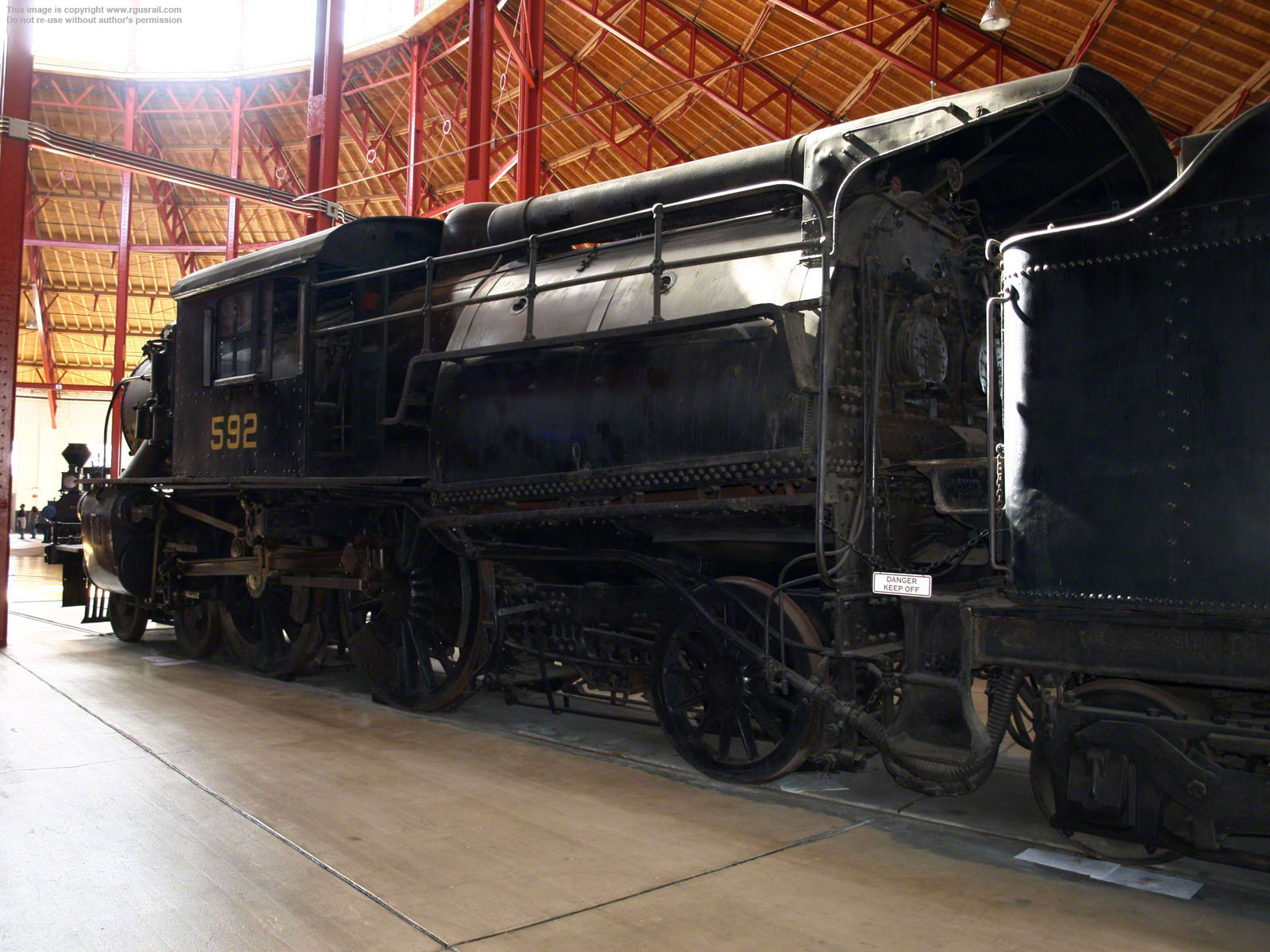
#592 was one of 6 P-6s class Atlantic (4-4-2) type locomotives (#590-#595) built for the Central of New Jersey by Alco between 1901 and 1902.

Although often referred to as a camel, #592 is actually a camelback or "Mother Hubbard". Compare #592, for example, with a true camel, B&O A #305 shown earlier on this page, with its cab perched atop the boiler. #592's cab, by contrast, straddles the boiler with its firebox supported by a trailing truck.
Designed for fast passenger service, #592 was built with 85" drivers, but these were reduced to 79" in 1917. When built, the engine weighed 191,000 lbs but, in 1917, the P-6 locomotives were rebuilt with superheating and larger cylinders, which increased the engine weight to 215,700 lbs.


The P-6 engines also had their cylinders increased from 20½" x 26" to 22" x 26". The rebuilt P-6s Class had an 81.63 sq ft grate (down from the P-6 82 sq ft) and 173.9 sq ft firebox (down from the P-6 174 sq ft), and twenty-four flues and superheater elements replaced one hundred and fifty-five tubes in the rebuilt boiler.
Total heating surface was now 1,648 sq ft, including 460 sq ft superheating (down from the P-6 2,967 sq ft). Operating at a boiler pressure of 210 psi, the
P-6 delivered tractive effort of 22,945 lbs. Although the boiler pressure was unchanged, tractive effort increased to 28,433 lbs for the rebuilt P-6s. The tenders were also increased from 124,000 lbs light to 153,800 lbs to hold 7,500 gallons of water and 13 tons of coal.


Above, two views inside the left side of the cab. A narrow running board along the side of the boiler connects to where the fireman stokes the fire.


Above, two views inside the engineer's side of the cab. Like the fireman's side, it is extremely cramped and must have been uncomfortably hot in summer.
The P-6s was very successful, and #592 was often used on the Philadelphia-Atlantic City express route, as well as occasionally hauling the B&O's Royal Blue Line. The CNJ held onto the six locomotives until almost the end of steam: they were still operating in 1946. Destined for the scrap heap in 1949, #592 was spared. It was then the only surviving Atlantic type camelback in the country, and CNJ donated it to the museum in 1954.


Above, the deck plate from which the fireman worked. The firebox is a "Wootten" type, patented in 1877 by then General Manager of the Reading Railroad, John Wootten, to burn anthracite coal.
Anthracite was an extremely hard coal found only in Pennsylvania, but it was burned extensively, particularly for heating homes, because of its higher quality. The coal was screened to remove fine material and to size it before shipping, but unused coal formed almost 20% of production, and initially had no commercial use.
The Wootten firebox, however, was ideal for burning this waste, variously known as buckwheat, rice or culm depending on its size. The large grate allowed it to be spread thinly and to burn with a moderate draft. In turn, anthracite was ideal for passenger trains as it burned with a high heat and very little smoke.
The trailing truck, which permitted the firebox to be mounted behind the driving wheels on #592 had not been developed when Wootten was working so, in his design, the huge firebox was placed above the drivers. The cab then had to be placed astride the boiler as the very wide firebox would have severely limited visibility if a rear end cab had been utilised.

Above, because of the wide firebox and very large grate, two firedoors were fitted.
Firing through these in such an exposed, narrow space straddling the deck while just a few feet above the rails, must have been challenging when #592 was running at its top speed of 90 mph!
The cab also placed the engineer directly over the whirling side rods while the locomotive was in motion, again, not an ideal position to be in at 90 mph should any of the running gear come loose or break.
In fact, because of such safety concerns, and public pressure, production of this type of locomotive ended in the 1920s.


The name "Clinchfield" came from the Virginia coal region which was serviced by the railroad's line from Dante, VA, to Elkhorn City, KY, where it connected with the Chesapeake & Ohio Railroad. Like many Blue Ridge Mountain railroads, it invested in large, articulated steam locomotives during the 1940s, although these were all scrapped in the 1950s.
In 1955, the town of Erwin, TN, bought #1 intending to put the locomotive on display, but this never materialised, and #1 sat behind the Clinchfield shops at Erwin rusting.


Clinchfield #1, also known as "Old Number One", was built as #423 in 1882 by the Columbus, Chicago & Indiana Central in Logansport, IN.
In 1899, the locomotive was renumbered #543 and, the following year, was sold to the Ohio River & Charleston Railway where it was renumbered #5. The OR&CR was bought by the South & Western in 1905 and then changed its name to the Carolina, Clinchfield & Ohio Railway in 1906.
Seven years later, #5 was sold to Black Mountain Railway in Burnsville, NC, where it was renumbered #1. It ran there until 1955, when it was sold back to the Clinchfield.


#1 is a coal burner. Operating at a boiler pressure of 125 psi, it delivered tractive effort of 15,100 lbs.

Above, a view of #1's backhead.
In 1968, the locomotive was
completely overhauled at Clinchfield's shops. Sporting brass trimmed domes and air pump, and a graphite
smokebox and smoke stack, it made its first trip on 23rd November that year from Erwin to Kingsport, TN, and back. It was the first steam locomotive to operate over the Clinchfield line in fourteen years.
#1 was retired in 1979, having completed nearly one hundred years of service. It was then donated to the museum, and is one of only two Clinchfield locomotives to survive.
A Ten Wheeler type (4-6-0) locomotive built for freight service, #1 has that characteristically Southern long leg between the rear and second drivers (see the photo above left). It weighs 83,100 lbs, and has 50" drivers and
18" x 22" cylinders.


I don't usually include many photographs of rolling stock, but this car built by the B&O to gauge internal tunnel clearances took my fancy. In operation, it was attached to a caboose.
Early clearance cars were quite simple. Upright wooden or light steel profiles of the individual railroad's loading gauge were mounted on railroad cars and towed along a route.


Later clearance cars, like CE-15 above, were fitted with physical feelers.
The metal fingers were then extended, the car was pushed through a tunnel and the resulting displacement showed the minimum clearance of the tunnel. The feelers were also sometimes connected to measuring instruments inside the car.
Clearance cars were generally only owned by larger railroads like the B&O.
More recently, lasers have been used to check clearances. They have usually been mounted on Hi-Rail trucks, road vehicles with supplemental rail wheels that are used on most modern railroads for track and right-of-way inspections.
Related Links:
Baltimore & Ohio Railroad Museum Website
Baltimore and Ohio Historical Society
Send a comment or query, or request permission to re-use an image.
Below left, Herbert Harwood Jr., provides a detailed history of the B&O in Impossible Challenge II, published by Barnard Roberts & Co., in 1994 (click on the cover to search for this book on Bookfinder.com). Impossible Challenge II is an updated, edition of Impossible Challenge I, published in 1979.


Above right, John Stover's History of the Baltimore and Ohio Railroad was published by Purdue University Press in 1987 (click on the cover to search for this book on Bookfinder.com).


You can download a (word searchable) PDF version of J. Snowden Bell's Early Motive Power of the Baltimore and Ohio Railroad, published in 1912, from the books and manuals page of this website.