


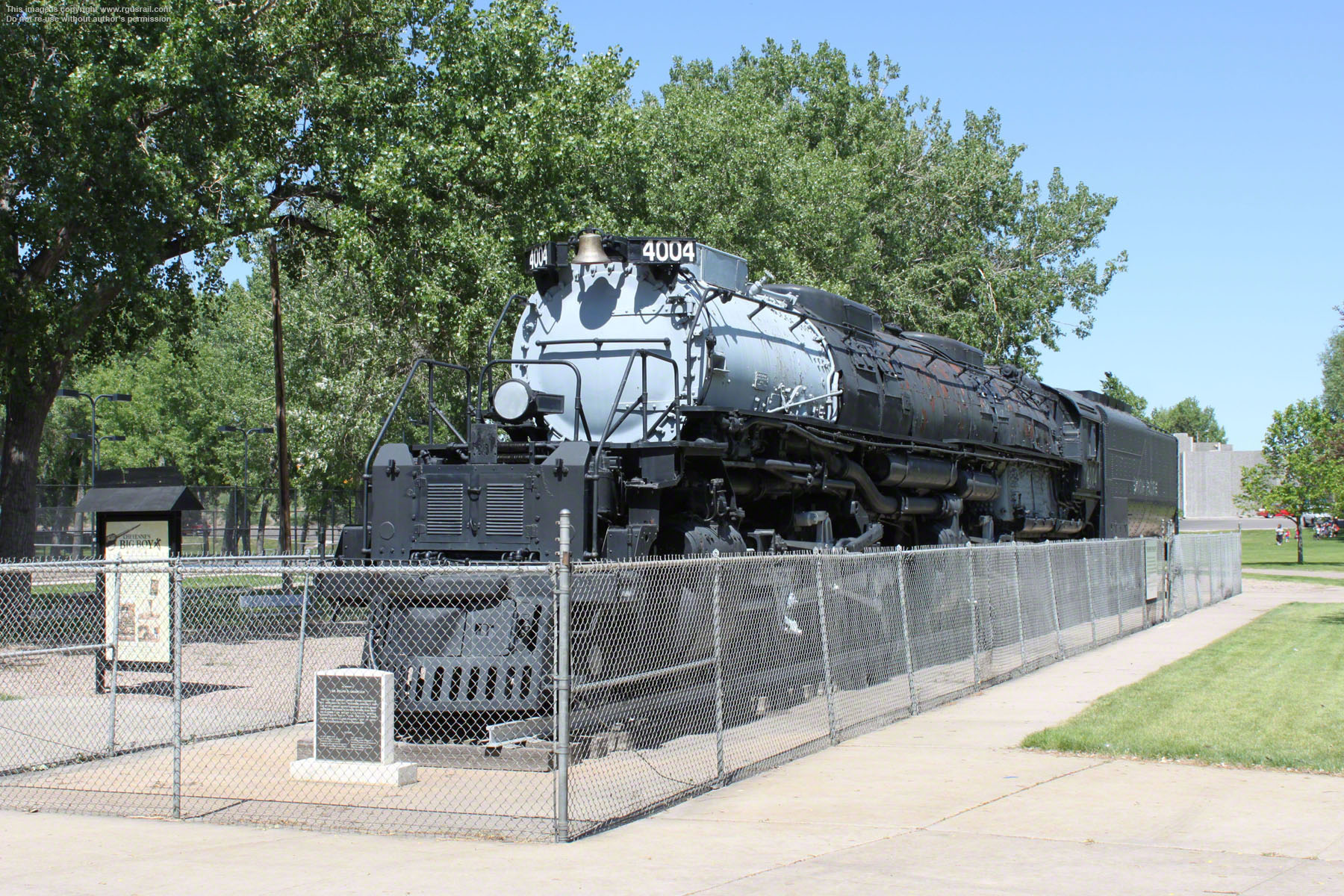
Union Pacific's 4-8-8-4 Big Boy #4004 is on display in Holliday Park, Cheyenne, WY, at 17th and Morrie Avenues.
It is one of eight surviving Big Boys,
twenty-five of which were built by Alco to a design by UP's Department of Research and Mechanical Standards. The first twenty "Class 1" Big Boys were delivered in 1941 (#4000-#4019), and five more (#4020-#4024), designated "Class 2", in 1944.
All twenty-five were 132' 10" from front coupler to rear tender coupler, and the engine alone was 85' 10" long. They were designed to work heavy grades, particularly the Ogden-Wahsatch district, but also on Sherman Hill just west of Cheyenne.

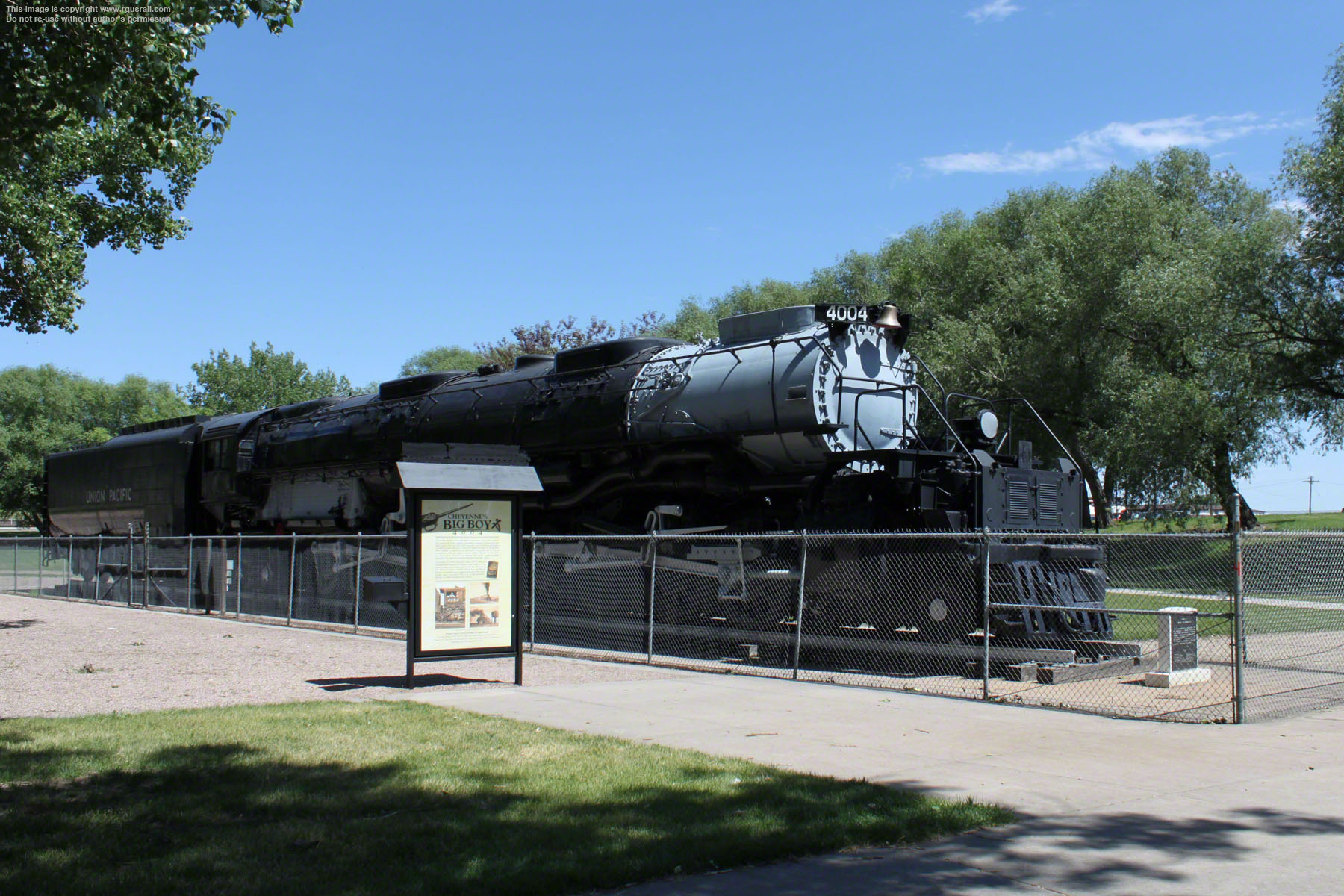
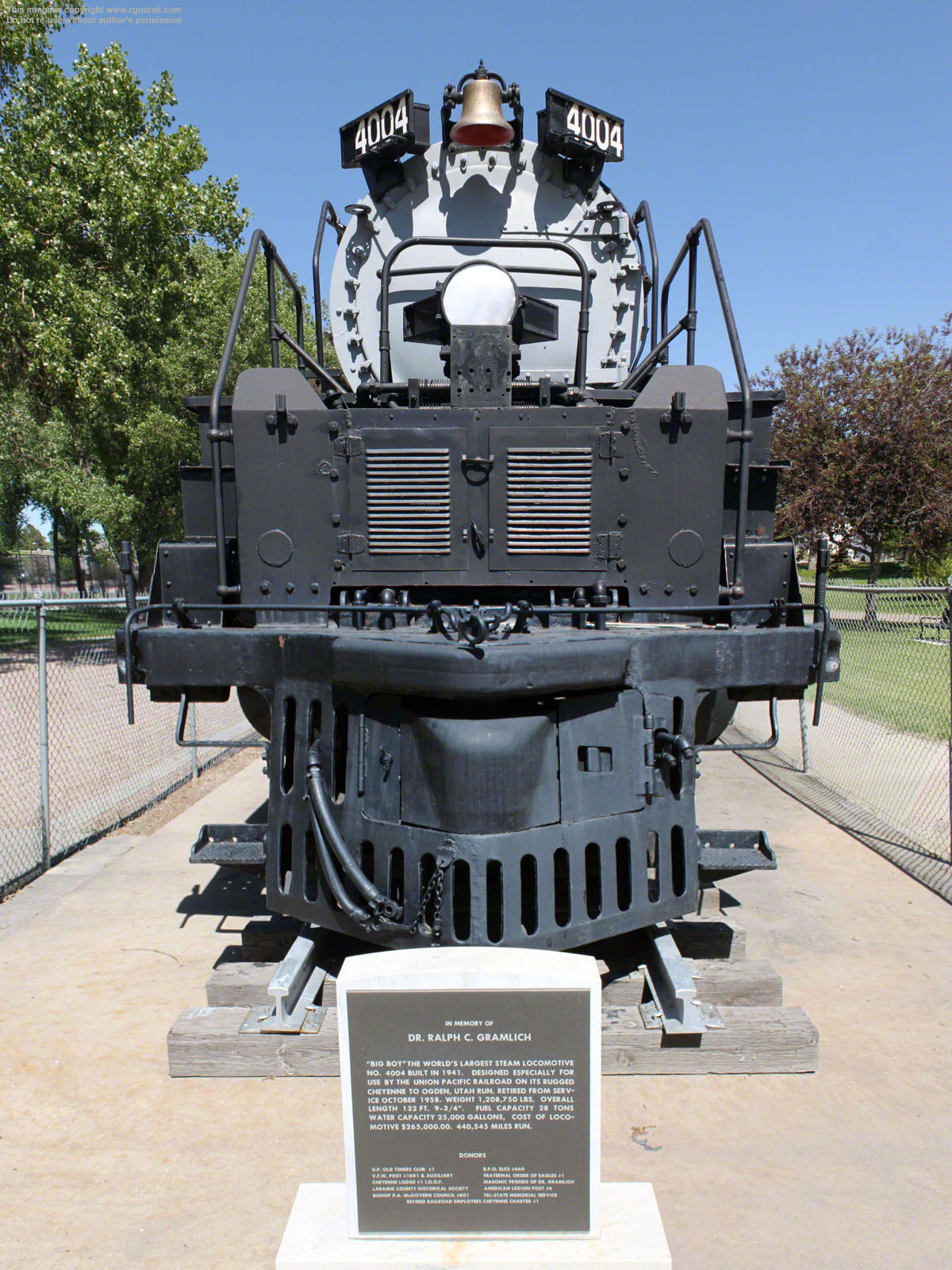

Above, the smoke box was one of the largest ever applied to a locomotive, and the entire end is hinged so that it could be opened in just thirty minutes by a single workman.
The immense firebox and boiler required much lower domes to maintain clearances.
Big Boys proved up to the challenge they were designed to meet, but they arrived on the cusp of dieselisation by the Union Pacific and they had a relatively short operational life: the last revenue freight hauled by a Big Boy was in July 1959, and most were retired in 1961.
#4004 made its last revenue run on 31st October 1958 and was then placed in storage before being officially retired in 1962. The following year, it was donated to the City of Cheyenne, and was moved
to Holliday Park by UP track crew on 28th June 1963.


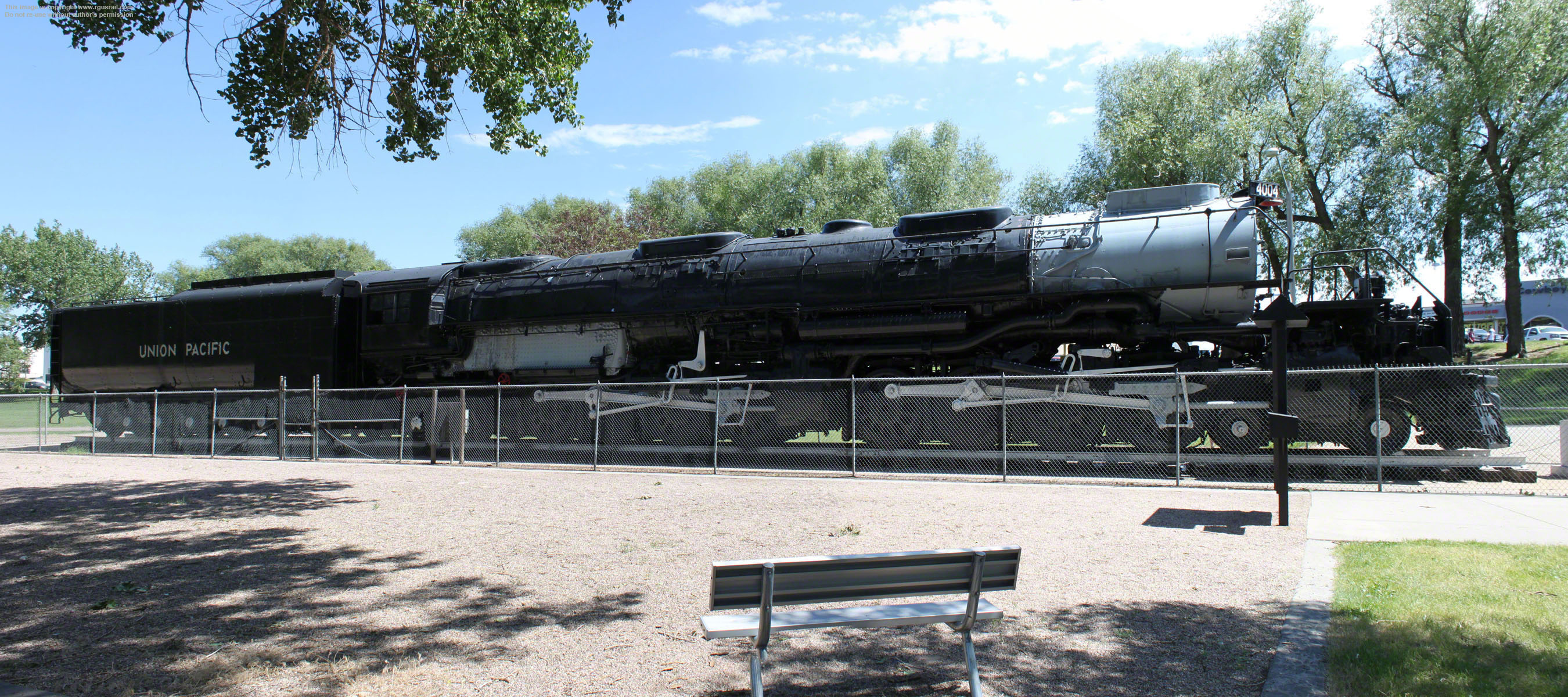



As one of the first series, #4004 was built with finned after coolers fitted to the handrails on the pilot. These were soon removed, however, because of problems with condensation and ice in very cold weather and were set behind the pilot front shield. The engines exhausted to two separate smoke stacks enclosed in a sheet metal casing. A smoke hood to deflect the powerful exhaust from tunnel roofs was also installed and could be raised hydraulically.
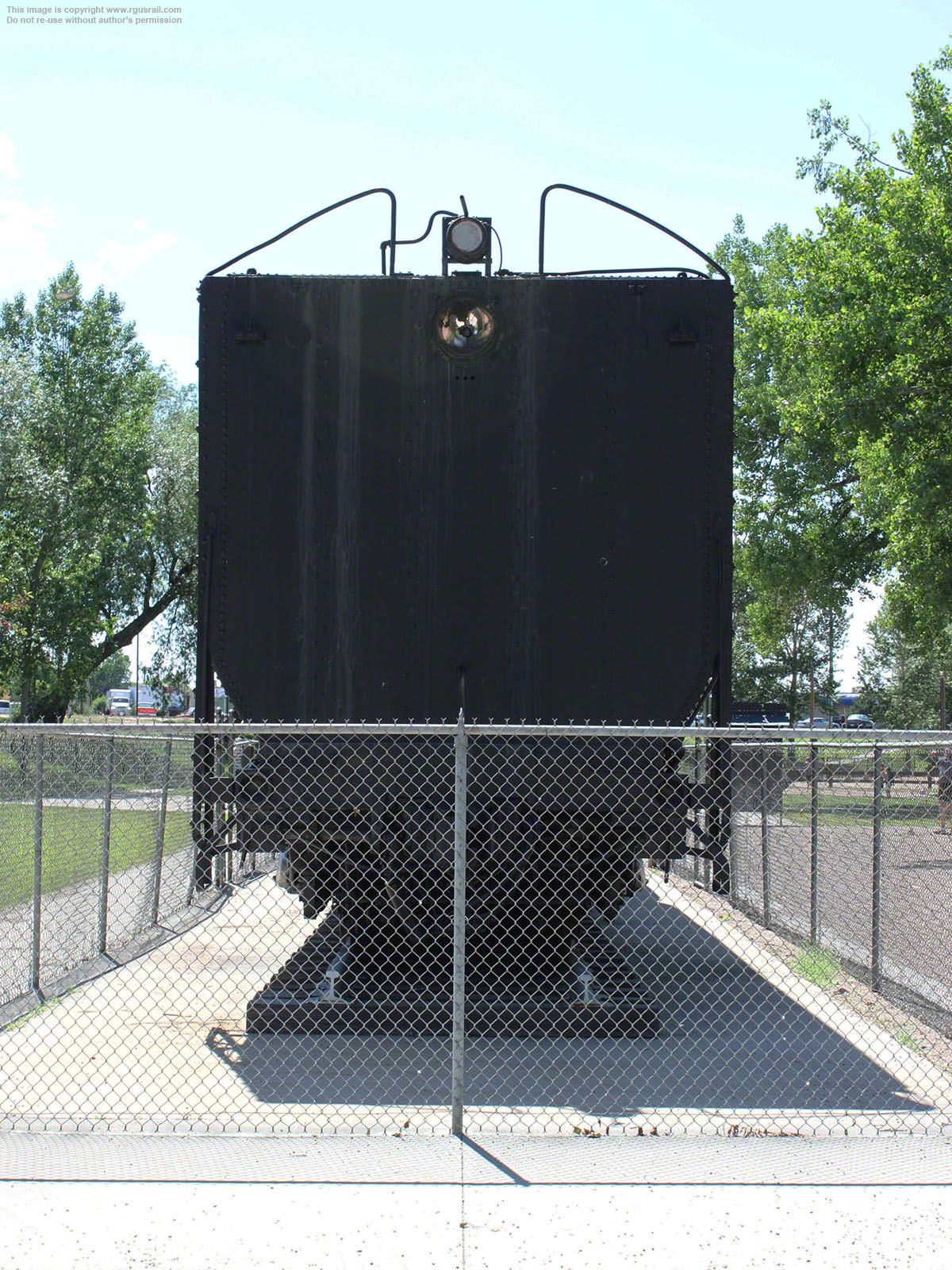
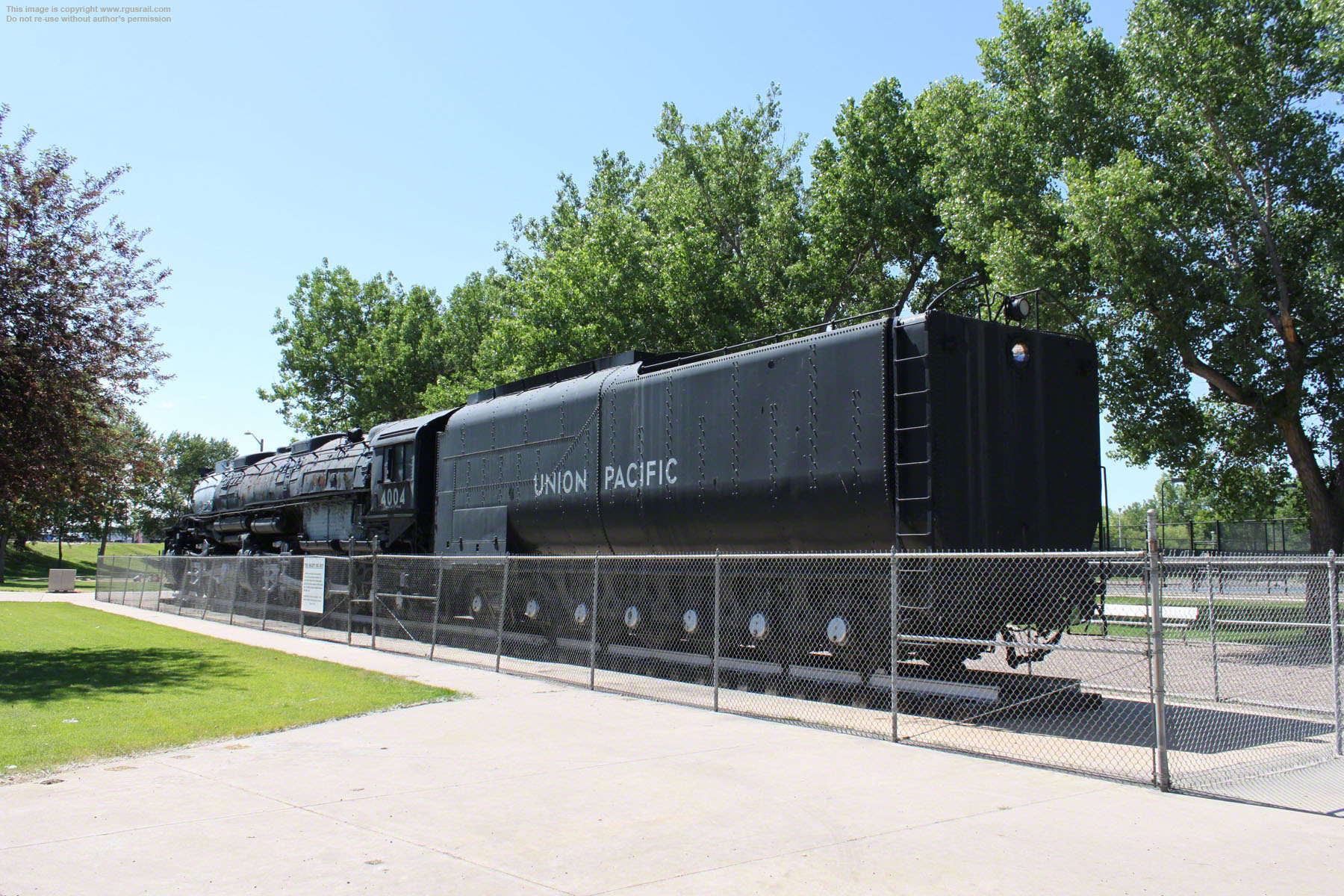
Below, the tender weighs 342,2000 lbs light with a 25,000 gallon water and 28 ton coal capacity.
Big Boys' pilots were cast separately with an opening for a retractable Buckeye Steel cast coupler.
However, they were rarely retracted while the locomotives were in operation, as the build-up of grit and winter ice could make them difficult to move.

Below, Walschaert valve gear was standard on Union Pacific steam locomotives by the time #4004 was built. Note
the wire retainer crosshead nut in both these photos.
This was designed by the Union Pacific to eliminate problems with breaking cotter pins.


Big Boys operated almost exclusively on the Ogden, UT-Council Bluffs, IA, divisions. Despite being designed for heavy freight over the most difficult part of that route, however, the challenge they faced is demonstrated by the fact that they were reduced to just 3 mph on the most adverse parts (climbing heavy grades and tackling reverse curves) and averaged only 17 mph on the entire 24 mile Echo-Wahsatch section eastbound.
The UP soon reverted to Challengers on head end with another pusher for very heavy freight until the end of steam on that division in 1954.


The red handles beneath the firebox in the first photo above release the ash pan. Just above that, and slightly to the right, is the foam meter blowdown, which discharged into a spreader box under the cab.
The middle photograph shows the right rear cylinder, steam supply pipe and front Walschaert valve gear and cylinder.
The last photograph gives a closer view of the front Walschaert gear and cylinder. The black jacket in the centre covers the chain drive to the Nathan lubricator, just out of view on the left.


The tender's rigid frame gave support to the huge water and fuel supply. Train control and fire fighting boxes are at the front of the tender on either side. The recessed ladder gave clean lines as well as maximum fuel and water capacity.
The City of Cheyenne was laid out in 1867 on a site where the Union Pacific crossed Crow Creek, a tributary of the South Platte River and, since then, the city has had a long association with the railroad. As well as #4004, it is home to the Cheyenne Depot Museum housing UP's Heritage fleet, including Challenger #3985 and FEF-3 #844, both of which are regularly steamed (you can see #844 on the Union Pacific Cheyenne Roundhouse page of this website). UP T-57 #1242 is on display in the Cheyenne Botanic Gardens, and you can see photos of it on the UP #1242 page.
You can also visit the Ames Monument thirty-five miles west. Erected in 1882 to commemorate Oakes Ames and Oliver Ames Jr's role in building the transcontinental railway, you can see photos on the Ames Monument page of this website.
You can see more Big Boys on this website. #4006 is on the National Museum of Transportation, St. Louis Yard page, #4012 on the Steamtown page, #4014 on the Southern California RLHS page, #4017 on the National Railroad Museum page, #4018 on the Museum of the American Railroad page and #4023 on the Kenefick Park page.
Will a Big Boy ever steam again?
This question is regularly asked by visitors to sites where Big Boys
are on display, and is one to quicken the hearts of railroad enthusiasts the world over. Plans and rumours over the years had, until recently, come to nothing. Cost had been a major consideration. A 1998 proposal to restore Dallas Age of Steam Museum's #4018, for example, foundered on the estimated $2.5-3 million restoration bill, as well as a lack of interest from promoters in the film it was to star in.
Most surviving Big Boys are on outdoor display, which means they have been exposed to the elements and would require significant investment to make them operable. The most likely candidate has always been the Southern California RLHS's #4014, on display in Pomona, CA, as the dry California climate has probably caused less deterioration than on any of the other surviving Big Boys.
Another major consideration relates to the logistics of operating a 132' long locomotive weighing 1,208,750 lbs. Few locations on the Union Pacific system have wyes or turntables that could accommodate that length and many tracks, bridges and switches could not handle the weight. On the other hand, the 121' long, 1,073,900 lb Challenger #3985 was restored to steam by the Union Pacific in 1981 - so it can be done.
To avoid trackside fires and allow access to ready supplies of fuel, a restored Big Boy would also probably need to be converted to an oil burner. Although this was tried in the 1940s on #4005, it was not a success. On the other hand, a restored locomotive would not be expected to meet the heavy demands made on in-service Big Boys, and a double burner could provide the heat needed for the massive 704 sq ft firebox. After all, #3985 was converted to burn oil in 1990 despite having a very large 602 sq ft firebox, and it has kept up a regular schedule of excursions, travelling as far as Los Angeles, CA, from its base in Cheyenne, WY.
The good news is that, in July 2013, the Union Pacific re-acquired Big Boy #4014 from the Southern California RLHS with the aim of restoring it to working order by 2019. Having a Big Boy steam for the 150th anniversary of completion of the transcontinental railroad that year would be a significant publicity coup for the UP. Whatever happens, however, it's a fascinating prospect, and we await the outcome with great interest.
Related Links:
Trainweb Big Boy Information Center
Train Attractions in Cheyenne
Union Pacific Historical Society
Send a comment or query, or request permission to re-use an image.
William Kratville's Big Boy, published by Autoliner in 2004, provides lots of information and some fine photographs of Big Boys in operation (click on the cover to search for this book on Bookfinder.com).

Ericrated has uploaded UP's Last of the Giants on YouTube. Click to watch this fascinating twenty-five minute, film with an introduction by the Railroad Historian Walter P. Gray:
