


The O. Winston Link Museum is located in the restored Norfolk & Western Railway passenger depot on Shenandoah Avenue in downtown Roanoke, VA. The museum opened on 10th January 2004, and is owned and operated by the Historical Society of Western Virginia.
Ogle Winston Link was born in 1914 and is best known for his black and white photographs of the last days of steam on the Norfolk & Western Railway, but he also made sound recordings of trains, which he released as "Sounds of Steam Railroading" on a set of six gramophone records, and produced commercial photographs of a variety of other subjects. He made a cameo appearance as a locomotive engineer in the 1999 film October Sky, and was actively involved in planning a museum of his work when he died of a heart attack in January 2001.
Note: The photographs made by Link on this page are copyright of the O. Winston Link Museum. They are low-resolution display images only and do not link to larger images.


Planning of the depot building at Roanoke began in 1941, but work was put on hold because of WWII. Then, in 1945, Allmon Fordyce of Raymond Loewy and Associates, produced updated plans for the building but, because of material shortages following the war, building work did not start until early 1948.
The station opened on 1st April 1949.

The view above is of the reception desk in the entrance hall.
Internally, the building has been quite beautifully restored to reflect the original modernist styling.

The Raymond Loewy Museum is also located on the west side of the station building.
Loewy was an influential 20th Century designer, responsible for a number of locomotive streamlinings.

Above, another view of the main entrance hall.
The ticket desk was located at the present reception desk.

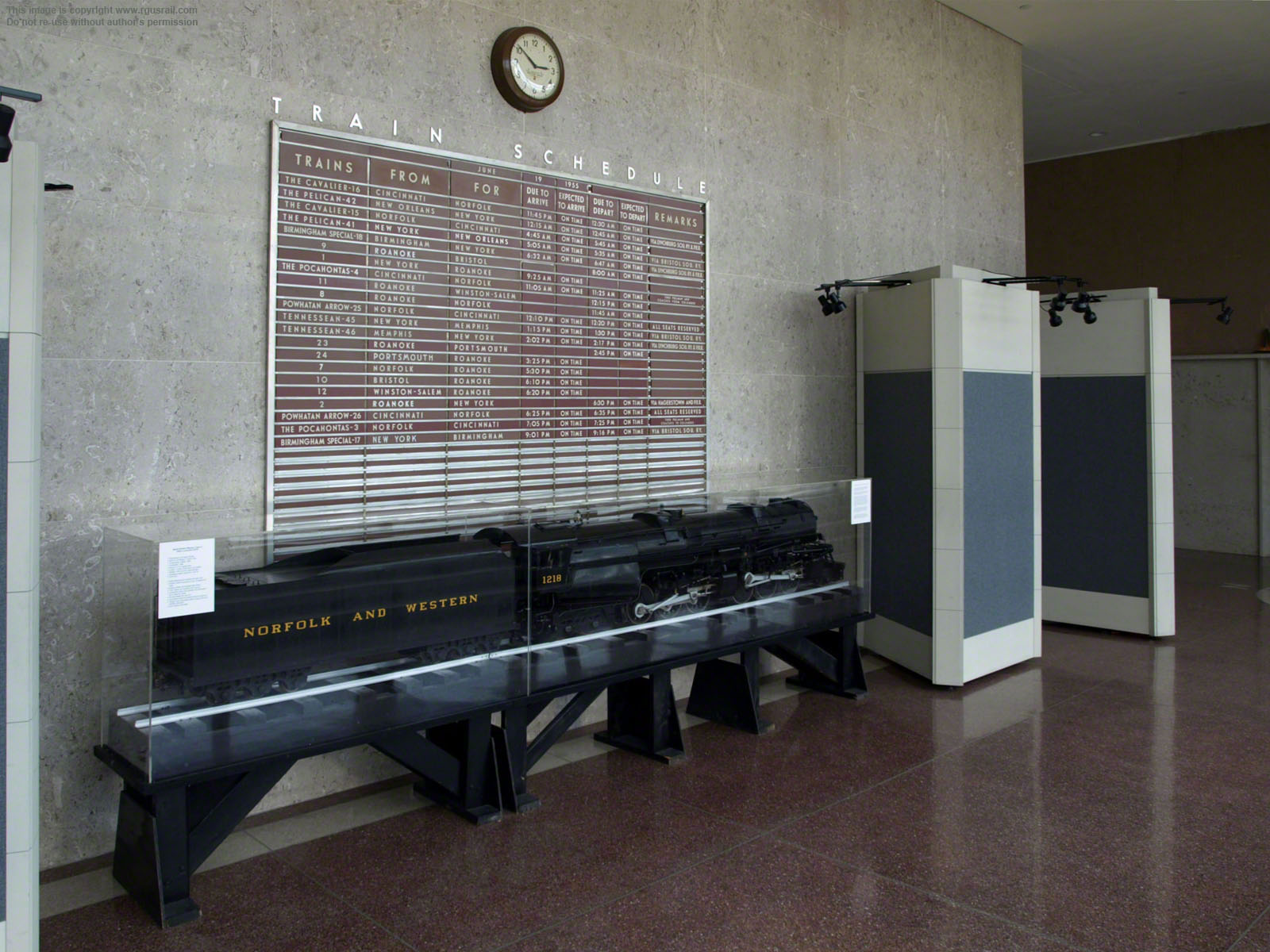

Overlooking what was once the station concourse and passenger platforms, is a 7½" gauge model of Norfolk & Western #1218. It was built by Val Bragg of Toledo, OH, between 1980 and 1989. The locomotive and tender are 15' long and weigh c.1,500 lbs.
The original #1218 is an A class simple articulated 2-6-6-4 steam locomotive. It was built at the Norfolk & Western Roanoke Shops in 1943, and has been preserved at the nearby Virginia Museum of Transportation (you can see photographs of it on the Virginia Museum of Transportation page of this website).


The train schedule board above the model has been set to 3rd June 1956, the date on which O. Winston Link composed a self portrait photograph as a traveller next to the board.


The museum entrance is on the east side of the main entrance hall.

Link is shown in an archetypal pose beside the entrance to the gift shop. This was originally the station cafeteria.
Born and raised in Brooklyn, NY, after graduating from the Polytechnic Institute of Brooklyn with a degree in civil engineering in 1937, Link worked for the public relations firm of Carl Byoir and Associates. During WWII, he worked for the Airborne Instruments Laboratory, part of Columbia University and, after the war, established his own studio in New York City, with clients including Goodrich, Alcoa and Texaco.
It was while he was working on an industrial photography commission in 1955 in Staunton, VA, that Link forged his attachment to the Norfolk & Western Railway, then one of the few Class 1 railroads yet to make wholesale transition from steam to diesel. He took his first night photograph on 21st January 1955 below: "Train No.2 at Waynesboro, Virginia".

Photo Courtesy of the O. Winston Link Museum (NW-1)
It had all the hallmarks of his later work: an array of flash bulbs created a "natural" look at night, capturing streamlined NW K2a 4-8-2 #130 at speed while maintaining a deep focal length. Nevertheless, three months later, Link reshot the scene, illuminating the exterior stairwell, lighting the interior of the waiting room, placing more light on the exposed side of the locomotive, and adding people on the platform.
Link made about twenty visits to various parts of the railroad until 1960, by which time he had accumulated some 2,400 negatives.
Although he is best known for his photographs of steam locomotives, Link also took many photos of the railroad's operating crews, hostlers, shop workers, brakemen, postal clerks, platform and station staff. For Link, these people were integral to the operation of the Norfolk & Western.

Photo Courtesy of the O. Winston Link Museum (NW 1119)
For me, shots like the one above of Buck Stewart, capture the "heart" of the railroad - the men and women who kept it moving every day of the year - and give it a distinctly human face.
Buck Stewart was the train announcer at Roanoke station, and was nearing the end of a long career with Norfolk & Western in August 1956 when this photograph was taken. According to Link, Stewart's voice was "a combination of gravel and southern drawl", but still managed to overcome the din of passengers and trains in the echoing space of the station building (see Thomas H. Garver, The Last Steam Railroad in America, Abrams, 2000, p.12).

Photo Courtesy of the O. Winston Link Museum (NW-696)
Link's photographs in Norfolk & Western's shops and yards provide a fascinating insight into the workings of a Class 1 railroad towards the end of steam, and the Roanoke Shops were the hub of its operations. During their heyday in the 1930s, over six thousand workers produced an average of twenty freight cars and four steam locomotives at the shops every day, ranging from small switchers to streamlined Class J passenger locomotives, the fast freight Class A and huge articulated Y5s and Y6s for low speed coal drags.
In the shot above inside the East Roanoke Shops, two cranes are lowering the cab, firebox, boiler and rear high pressure cylinders and drive wheels onto the front low pressure engine of Y6-b #2180. This was called "wheeling", and was part of the major overhaul every Norfolk & Western steam locomotive underwent roughly every five years (see Thomas H. Garver, The Last Steam Railroad in America, Abrams, 2000, p.27).
#2180 was a compound articulated 2-8-8-2 locomotive, built in 1949 at the Roanoke Shops. Sadly, no Y6-b locomotive has survived, but you can see photos of Y6-a #2156 on the National Museum of Transportation, St. Louis Train Sheds page of this website.
Although entirely self-financed, Link's work was encouraged and facilitated by N&W officials, from President Robert Hall Smith down to locomotive engineers who helped set up some of his shots. In fact, his photographs were always carefully staged, and generally involved a significant quantity of equipment. As a result, often with an assistant, Link had to haul bulky electrical relays, cables and lamps into place and wire them up, although the evidence of this equipment and the preparation involved are never revealed in his final shots.

Photo Courtesy of the O. Winston Link Museum (NW-1103)
"Hot Shot Eastbound at the Iaeger Drive In" above, taken on 2nd August 1956, is perhaps Link's best known photograph. He used forty-three flash bulbs to capture NW class A #1242 hauling Time Freight #78 eastbound on the Pocahontas Division. It is a carefully composed shot: the couple in the foreground, Willie Allen and Dorothy Christian, sit in Link's 1952 Buick convertible. The movie on screen is 1955's Battle Taxi.
Link published photographs like these in Trains magazine, as well as many other publications in the 1950s, until a travelling exhibition in 1983 brought his work to a more mainstream audience.


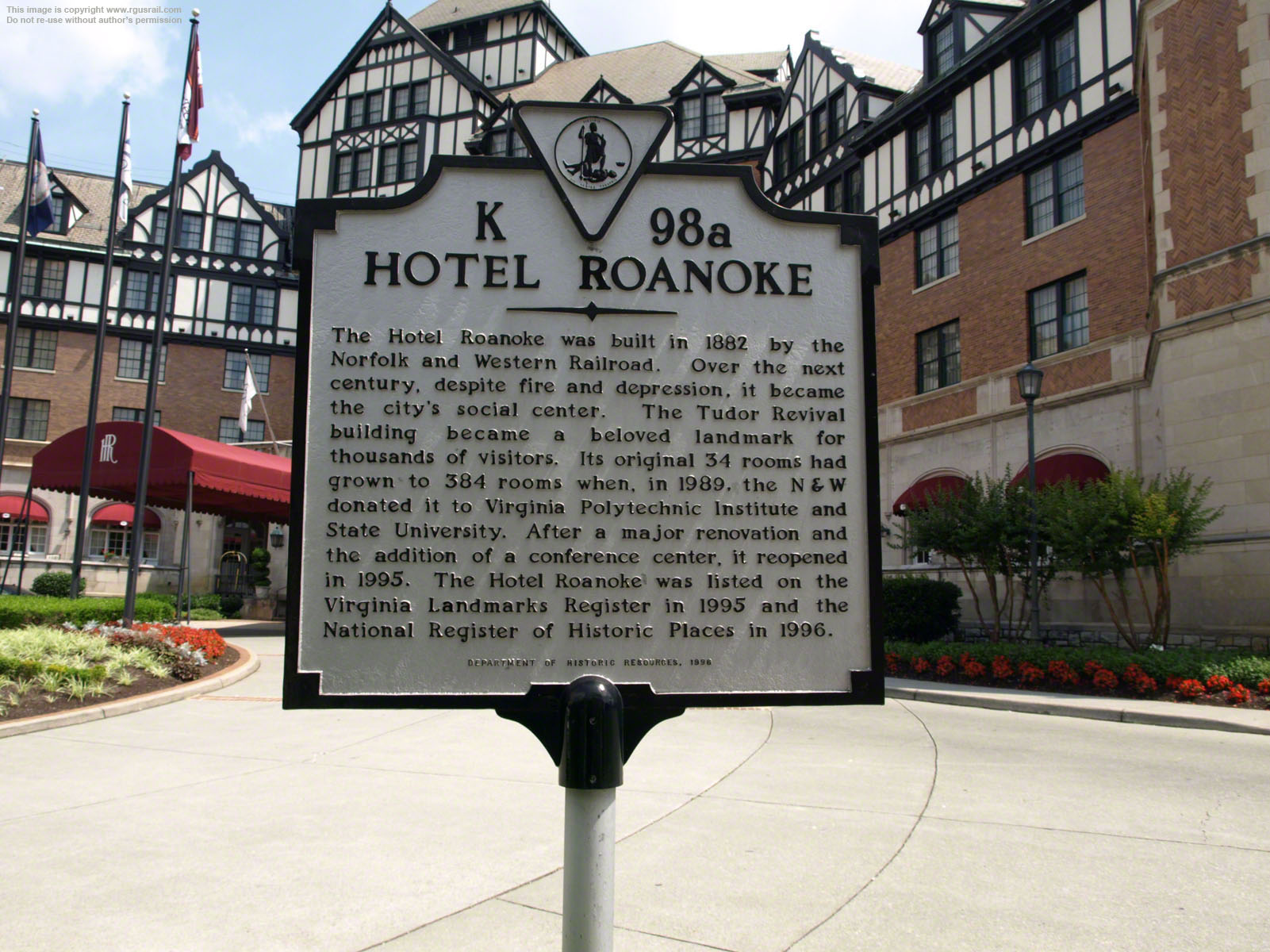
Opposite the museum on Shenandoah Avenue is Hotel Roanoke, built in the mock Tudor style to resemble an old English inn by the N&W Railroad in 1882. It was styled to be in keeping with the original N&W Union Station, on the site of the current passenger station, as well as with the General Office Building nearby. The hotel became a centre of social life in the city, as well as being used by the N&W for many corporate events over the years.
Originally only thirty-four rooms in size, it underwent regular remodelling, although always remaining true to the original styling. By 1989, when it finally closed, the hotel had grown to three hundred and eighty-four rooms. The N&W then donated it to Virginia Tech and, following renovation and addition of a conference centre, it reopened in 1995.
The hotel was added to the Virginia Landmarks Registry in 1995 and the National Register of Historic Places in 1996.
Visiting the hotel is a fine way to end a day of sightseeing in Roanoke, but don't forget to visit the Virginia Museum of Transportation just a few blocks away (you can see photographs of equipment in the museum on this website).
Related Links:
O. Winston Link Museum Website
Website with Works of O. Winston Link
Send a comment or query, or request permission to re-use an image.
There are three main books of Link's photographs of steam: Steam, Steel & Stars, published by Abrams in 1987 and every few years subsequently; The Last Steam Railroad in America, published by Abrams in 1995 and 2000; and Night Trick, a catalogue from the Photographers Gallery published in 1983 (click on the cover of each book to search for it on Bookfinder.com).


