


The Golden Spike National Historic Site is located at Promontory, UT, eight miles off Utah Highway 83, fifty-three miles north-west of Ogden and eighty-six miles from Salt Lake City. The site and Visitor Center is operated by the National Parks Service.
Promontory was established as the meeting place for the Central Pacific and Union Pacific railways by Congress on 10th April 1869. Although a somewhat unassuming place, it is the location of what has come to be seen as a seminal event in US history: on 10th May 1869, the last link in the nation's "first" transcontinental railway was forged by the ceremonial striking of the Golden Spike.
Today, the site is a fascinating place to visit, wonderfully cared for by the National Parks Service. It is better to visit between 1st May and Labor Day, however, when the two replica locomotives are steamed up and on display. On 10th May each year, the site also stages a re-enactment of the ceremony of driving the last spike, with participants dressed in period costume and the two locomotives meeting pilot to pilot as the originals did in 1869.


Above, looking south along the old Central Pacific grade east of Rozel.
The gate in the distance is the western end of the seven mile NPS Western Auto Tour leading back to Promontory. It is one of two vehicle tours on the site (the Eastern Auto Tour appears later on this page). They both include markers at key points that give information on the historic significance, building techniques and people that built the transcontinental railway. It is a fascinating story, and you can find out more about the grade west from Rozel to Lucin, UT, on the Historic Central Pacific Grade page of this website.
The grade had a major operating life of thirty-five years until the Lucin Cutoff was completed in 1904, connecting Lucin with Ogden directly across Salt Lake reducing the overland route by forty-four miles and eliminated the steep grades. Although the old line was subsequently used occasionally when bad weather threatened the cutoff, in 1942, the rails were torn up and salvaged for the war effort, an event marked by the ceremonial "undriving" of the last spike at Promontory.


Miles of track laid per day became a matter of contest between the two companies as they built from east and west. In early April 1869, Union Pacific labourers laid 8½ miles in one day, the greatest distance to date. Central Pacific Superintendent of Construction Charles Crocker then made a $10,000 wager with Union Pacific Vice President Thomas C. Durant that his crew could lay 10 miles in a single day.
It was a wager Durant felt sure of winning but, through careful preparation and excellent logistical management, the Central Pacific labourers duly laid the ten miles on 28th April 1869. The task involved bringing up and locating 25,800 ties, 3,520 rails averaging 560 pounds each, 55,000 spikes, 14,080 bolts and other material totalling 4,462,000 lbs. It was an accomplishment just peaked by the 10½ miles laid by the Kansas Pacific at Comanche Creek, CO, in August the following year.

Left, Charles Crocker, Supt. Construction Central Pacific R. R., from Edwin L. Sabin, Building the Pacific Railway (1919).
Faced with labour shortages grading over California's Sierra Nevadas, Crocker pushed for recruitment of Chinese labourers brought in from Canton. "Crocker's Pets", as they came to be known, proved a hard working, sober work force, and many remained after completion of the railroad to work at section stations or run small businesses in settlements along the route.
You can browse Building the Pacific Railway on the books and manuals page of this website, and download a word searchable pdf copy.

Above, "Central Pacific Construction Camp", from Edwin L. Sabin, Building the Pacific Railway (1919).
This would have been typical of tent and car body camps lived in by labourers as they moved across Utah laying track.

"Crocker's Pets at Work", from Edwin L. Sabin, Building the Pacific Railway (1919).
The Chinese labourers were paid $28 a month for the dangerous work of digging, chipping and blasting at granite cuts, hauling earth and stone, laying ties, ballasting and heaving rails into place.

Above, there is much parallel grade along the way, e.g. the UP grade on the right of this photo.
Both companies graded many miles in advance of each other: two hundred and fifty miles of parallel grade still exist between Echo, UT, and Wells, NV.

Above, an example of the remains of "stair step construction" of a cut. Labourers worked on different levels at the same time to facilitate progress.
The Union Pacific labourers probably abandoned work on this cut in April 1869, as soon as the decision had been made for the two lines to meet at Promontory.

Above, "Union Pacific Grading Outfits", from Edwin L. Sabin's Building the Pacific Railway (1919).
In contrast to Central Pacific's c.4,000 labourers, two-thirds of whom were relatively disciplined Chinese immigrants, the Union Pacific work force comprised Irish, German and Italian immigrants, Civil War veterans, ex-slaves and Native Americans - a volatile mix!
As the head of the Union Pacific grade pushed west, depots were set up along the way to receive supplies and equipment for the ongoing work. At these, tent towns blossomed, providing "services" for the labourers. The mix of merchants, saloons, dance halls, gambling houses and brothels that characterised these towns made them a place of riots, petty crime, gun fighting and murder.
As the grade head moved forward and a new depot was established, the traders, shysters and "women of ill repute" upped sticks and moved along to the next location, earning the towns the name "Hell on Wheels".

Looking west along the old Central Pacific grade in Promontory Hollow.

Above, looking east towards Promontory from the same position.

Above, looking west along the old Central Pacific grade just east of Promontory. The mountain in the centre is King's Peak.


Above, looking east towards the National Park Services Visitor Centre from the eastern end of the West Grade Tour.
"Jupiter" and #119 are at the upper middle of this photo.

Above, looking west from the grounds of the National Park Services Visitor Centre.
"Jupiter" and #119 are standing just behind where this photo was taken.

The Visitor Center building is open 9.00 am-5.00 pm daily except for Christmas Day, New Year's Day and Thanksgiving.
This location was first designated a National Historic Site in non-federal ownership in 1957. In 1965, however, it was finally federally designated and two thousand, seven hundred and thirty-five acres were placed under the stewardship of the National Park Service.
The Visitor Center is not all there is to see. The historic site runs roughly seven miles in a narrow band from about a half mile south east of Rozel to Promontory, and then another seven and a half miles to Utah Highway 83. Along the way, there are many remnants of both the historic Central Pacific and Union Pacific grades.


The opening of the Lucin Cutoff hoisted on trestles in a straight line across Great Salt Lake west from Ogden in 1904 greatly reduced traffic through the old route, and railroad facilities, workers, shops and towns soon began to dwindle and disappear all along the line.
In 1916, the Southern Pacific Railroad, which had assumed control of the Central Pacific in 1885, erected a marker at Promontory to commemorate the Golden Spike ceremony. By that time, however, except for local residents, the original event appears to have been all but forgotten. Above left, the marker still stands adjacent to the main entrance to the Visitor Centre.
In 1938, services to Promontory were discontinued. Four years later, with an "Undriving of the Golden Spike" ceremony, the ninety miles of track from Corinne, about twenty-five miles east of Promontory, to Lucin were pulled up. The metal was destined for the WWII war effort.
After WWII, there was a revival of interest and, in 1952, the Golden Spike Association held its first
re-enactment of the ceremony. In 1969, on the centennial, twenty-eight thousand people attended and the site has continued to draw the curious, historians and railroad enthusiasts ever since.

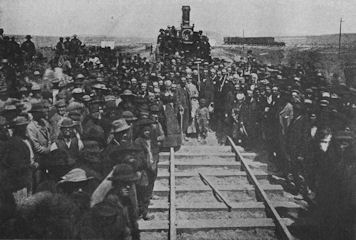
Above, "The Final Act", from Edwin L. Sabin, Building the Pacific Railway (1919).
The meeting place of the Central Pacific and
Union Pacific at Promontory was decided by negotiation between the two railroads in early April 1869, and hurriedly ratified by Congressional resolution.
In May 1869, the rail heads met. The ceremony to drive the Last Spike was scheduled for 8th May, but bad weather and a labour dispute that delayed the Union Pacific entourage, caused it to be postponed for two days. Finally, at 12.30 on the afternoon of 10th May, with Union Pacific #119 and Central Pacific's "Jupiter" facing each other, the final spike was slipped into the waiting hole, and what became known as "The Wedding of the Rails" was christened with champagne toasts from the pilots of the two locomotives.
The photo above, taken by A. J. Russell for the magazine Frank Leslie's Illustrated, captures the scene moments before the ceremony. The great and the good fill the space, crowding out almost all traces of the labourers who actually laid the rails. Estimates vary widely on the number of attendees, from just three hundred to as many as three thousand.
Although not directly involved in constructing the railroad,
completing the last link using a golden spike was the inspired idea of San Francisco financier and contractor David Hewes. He also arranged to connect Central
Pacific's telegraph to the Western Union's, so that the taps of the silver hammer driving the golden spike home could be heard in San Francisco, CA.
The spike is 17.6 carat gold, weighs 14.03 ounces and is just over 5½" long. Manufactured by the William
T. Garratt Foundry in San
Francisco, after casting it was engraved by the San Francisco jewellers Schultz, Fischer and Mahling.
On one side it reads:
May God continue the unity of our Country as the Railroad unites the two great Oceans of the world
Another side reads:
The Pacific Railroad ground broken Jany 8th 1863 and completed May 8th [sic] 1869
The other two sides bear the names of the officers and directors of the Central Pacific Railroad and the top was engraved:
The Last Spike
It is now in the Stanford Family Collection on display at the
Stanford University Museum in Stanford, CA.

Above, a photo of the replica final tie that has been put in place at the National Park Services site.
The original tie was made of polished California laurel by the San Francisco billiard table maker Strahle & Hughes on behalf of West Evans, the Central Pacific's tie contractor.

Above, a replica of the original silver plate that is fixed to the replica tie.
The original tie was taken up and returned to San Francisco but was unfortunately destroyed in a fire there following the 1906 earthquake.
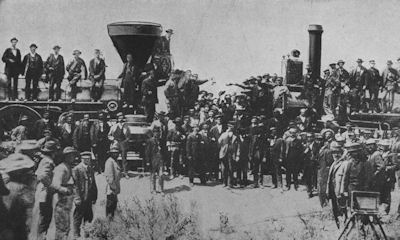
Above, "The Engines Touch Noses", from Edwin L. Sabin, Building the Pacific Railway (1919).
This is perhaps Russell's best known photograph of the meeting of the two railroads, "East meets West shaking hands, May 10, 1869".

Above, "In the Days of the Old Wood-Burners", from Edwin L. Sabin, Building the Pacific Railway (1919).
Taken at Promontory in May 1869, the locomotive is not identified.

"Union Pacific Locomotive 119", from Edwin L. Sabin, Building the Pacific Railway (1919).
The photograph was taken at Promontory on 10th May 1869. Note the dignitaries posed on the
boiler.
You can browse Sabin's Building the Pacific Railway from the books and manuals page of this website, and download a word searchable pdf copy.

Above, the Nevada State Railroad Museum suggests Virginia & Truckee Coach #17 was the one that transported Leland Stanford, Central Pacific officials and the golden spike to Promontory.
It is on display at the museum in Carson City, NV,
The records show that the coach was built in 1868 by the Central Pacific at
its shops in Sacramento, CA, as a private car for company officials. The coach included eating and sleeping quarters, as well as office space and, after attending the Golden Spike ceremony, it was used as Charles Crocker's private car while he continued as Superintendent of Construction. He retired from that position in 1871 but returned as second Vice President of the Central Pacific in 1873.
The Virginia & Truckee bought the coach from the Central Pacific in 1875 for $2,500 for use by its officers. It was renumbered #25 and named
"Bonanza".
#25 was used by Virginia & Truckee Superintendent Henry M. Yerington, but also by V&T President William Sharon, US Senator for Nevada, and travelled as far afield as San Francisco and Washington, DC. From 1878, the Senator leased private Pullman cars, and #25 was remodelled at a cost of $3,197 for passenger use and renumbered #17. It saw service on Virginia & Truckee express trains for many years, including the Virginia City-San Francisco Lightning Express, before being sold to 20th Century Fox in 1939 for use in film making. In 1971, it was sold to Short Line Enterprises for continued film making.
The museum bought #17 in 1988. It is the oldest passenger coach in its collection and is currently housed in the museum's car shop awaiting restoration (you can also see it on the Nevada State Railroad Museum page of this website).


Although there is no longer a continuous railroad track through Promontory, a mile and a half section was relaid for the centennial anniversary in 1969 and is still used by the two replica locomotives when they are in operation.
The replicas were built in 1980 by Chadwell O'Connor Engineering Laboratories of Costa Mesa, CA, for the National Park Service.
They cost a total of $1.5 million and were the first steam locomotives built in the US for twenty-five years. Originally built as gas burners, in 1991, they were converted to burn the fuels used by the original locomotives: wood in the case of "Jupiter" and coal for #119.
When they were first built, the replica locomotives' red and vermilion livery had been designed by the Walt Disney Company. Later research, however, uncovered written records of their original colouring. On 10th May 1994, the 125th anniversary of the Golden Spike ceremony, they first appeared in a probably more accurate blue, crimson and gold livery, which they have worn ever since.


Both locomotives are beautifully maintained and wonderfully photogenic at any time of the year. They are stored and maintained by the National Park Service in an engine house about half a mile west of the visitor center and, when steamed, "Jupiter" is the first to appear at 10.00 am.
In the set of photos above, "Jupiter" runs in reverse from the engine house along the line to the north of the site. It backs up to the eastern side of the site and then pulls forward to one of the raised visitor observation decks


The original "Jupiter" was one of four wood burning American type (4-4-0) locomotives built in 1868 for the Central Pacific Railroad by the Schenectady Locomotive Works, later part of Alco. The other three locomotives were "Leviathan", "Whirlwind" and "Storm".
Because the transcontinental railroad had not yet been completed at that time, all four locomotives had to be dismantled and shipped around Cape Horn to San Francisco, CA. The parts were then reassembled at the Central Pacific workshops in Sacramento and the locomotives were commissioned for service in March 1869.
Although named "Jupiter", the locomotive was numbered #60.

The original "Jupiter" had not been chosen to haul the Central Pacific dignitaries to Promontory. That privilege first fell to a locomotive named "Antelope" but, on the trip, it ran into a log rolled onto the track by inattentive workmen. It was so badly damaged that the locomotive hauling the regular train ahead had to be pressed into service, and so "Jupiter" took its special place in history.
"Jupiter" continued in service as a passenger locomotive but lost its name in the 1870s when it was repainted and, in 1891, was renumbered from #60 to #1195.
Over the years, the locomotive was converted to a coal burner, it received a new boiler, the bonnet stack was replaced with a diamond stack, new sand and steam domes were fitted, and the vertical slatted pilot was replaced by one with horizontal slats. In 1893, #1195 was sold to the Gila Valley, Globe & Northern Railroad in Arizona and, as their first locomotive, was renumbered #1. It continued in service until 1909, when it was sold for $1,000 and scrapped.


About thirty minutes after "Jupiter", #119 is brought over from the engine house. There are steam demonstrations of both locomotives at 1.00 pm, and #119 returns to the engine house at 4.00 pm and "Jupiter" at 4.30 pm.
In the set of photos above, #119 runs over from the engine house and crosses onto the inner track just past Golden Spike Road. It then backs off to a set of points at the east end of the site and pulls forward to a second visitor observation platform on the north track just in front of "Jupiter".


The original #119 was also an American type (4-4-0) locomotive. It was one of five built for the Union Pacific in 1868 by the Rogers Locomotive and Machine Works of Patterson, NJ, also later part of Alco. The other four locomotives were #116, #117, #118 and #120.
#119 had 54" drivers and 16" x 24" cylinders, but little else is known for certain about its original specification.
After the Golden Spike ceremony, #119 served as a freight locomotive at various locations on the Union Pacific system. At some point, its drivers were increased to 69". Renumbered #343 in 1885, the locomotive was eventually sold for scrap in 1903. Like "Jupiter", it made just $1,000.

Also like "Jupiter", the original #119 had not been the Union Pacific's first choice to haul the dignitaries to Promontory. The identity of that locomotive remains unknown, but it was halted and forced onto a siding at Piedmont, WY, by a group of laid-off Union Pacific labourers who had been waiting three months to be paid. Two days later, the dispute was settled and the party was allowed on its way.
At Devil's Gate in Weber Canyon, however, just east of Ogden the train encountered a bridge with some of its supports washed out. Although this would not support the weight of the locomotive, it was able to carry the weight of the cars, which were given a push by the locomotive and allowed to coast to the other side of the bridge.
Unfortunately, the train was then without a locomotive, so a wire was send to Ogden, where the five Union Pacific locomotives #116-#120 were based. Fortuitously, #119 happened to be fired up and standing next to the main line, so it was immediately sent back to pick up the cars and return to Promontory.


Above, two views of the locomotives standing at the visitor viewing platforms.


From the viewing platforms, visitors are able to look into the cabs of the two locomotives. Neither locomotive offers cab rides to the public, but visitors can visit the engine house by getting a special pass at the visitor centre.
While the locomotives are running from the engine house, National Park Service staff are on hand to explain the significance of the site and the history of the locomotives. At the viewing platform, visitors can also talk to the firemen and engineers. All the staff are extremely knowledgeable and friendly.


Three miles east of the visitor centre, the Eastern Auto Tour begins. The tour splits from Golden Spike Drive just below the head of King's Peak on the horizon in the left of the view above. The two main features on the tour are the Chinese Arch and the "last cut".
The "last cut" is exactly that: the last cut completed by the Union Pacific as it edged westward towards the meeting of the two railroads at Promontory. The cut is a short walk from a parking area along the tour.
The Chinese Arch is a 20' natural limestone formation that has become a memorial to the thousands of Chinese labourers employed by the Central Pacific in building the railroad. Originally called "Chinaman's Arch", as the result of a petition, the name was officially changed in 2006 to appease sensitivities about the term "Chinaman". However, the name "Chinaman's Arch" remains in use.


Above, three shots looking down into "last cut" moving from west to east.
The pile of debris on the edge of the cut is spoil from the original excavation, which would have been used for nearby fills and embankments along the grade had it been required.
The shallow cut in the distance on the far upper left of the two views above is a Central Pacific cut and formed part of the final grade.
The deeper cut to the right of this, lower down the hill side, was part of the Union Pacific grade and was never used.


Above, three views walking west inside the "last cut".


The three views above are taken walking east inside the "last cut".

From "last cut", the tour follows the old Central Pacific grade north east round the flank of the North Promontory Mountains.
Above, another cut with the Bear River Range in the background.

Further on, the old grade continues to hug the flank of the North Promontory Mountains. The Chinese Arch is just a short walk to the right from where this photo was taken.
Once again, the evidence of parallel grading is clear. The old Union Pacific grade runs parallel at a slightly lower level on the left of this view. The Promontory Mountains are in the distance.

Above, another cut on the Central Pacific grade.
Note the continuation of the Union Pacific grade into another abandoned cut to the right of the view.

Above, a view of "Chinese Arch".
An estimated ten thousand Chinese worked on building the Central Pacific, although
probably no more than three thousand at a time. Many stayed after the line was finished, and travellers often noted their camps along the route. One such camp was apparently here during the 1880s when the arch was given its original name.

In the view above, both grades cut back across Golden Spike Drive and continue east towards Big Fill and Big Trestle.
Blue Spring Hills and the Bear River Range are in the distance.

The view above is a telephoto shot of the first Central Pacific cut on the Big Fill Loop Trail. The Union Pacific grade hugs the right of the hill.
You definitely need a motor vehicle to access the more interesting parts of the site. I don't know of any organised tours, and the nearest hotels are in Tremonton about twenty-seven miles east of Promontory.


Above, the old Central Pacific grade cuts across Golden Spike Drive. The last two views in the Eastern Auto Tour section of this page were taken where the grade emerges from the cut on the far left of this photo.
A short distance to the right of the gate in the view above, you can access the Big Fill Loop
Trail. Except for the Big Fill Trestle cut on the Union Pacific grade you can walk both grades for a mile or more east. The trail gets its name from the "big fill" built by Central Pacific labourers to carry the grade around Spring Creek ravine on the eastern flank of the North Promontory Mountains.
You can't drive the Big Fill Loop, but there is a car park just off Golden Spike Drive where you can leave your car and then walk the loop. It is a relatively easy walk unless you decide to go down into the ravine and explore the "big cut" as I did.

Above, looking north east as the old Central Pacific grade (on the left of this view) curves towards the cut shown in the last two photos in the Eastern Auto Tour section of this page.

Above, looking north east further along the Central Pacific grade. The old Union Pacific grade runs slightly lower on the right.

Above, looking west in the opposite direction towards the car park. In this view, the old Union Pacific grade runs to the left. The road on the far left is Golden Spike Drive.

Above, inside the first Central Pacific cut. This is the one in the view on the left.

On the eastern side of the cut, there is a fine view of both grades. The upper one is the Central Pacific, the lower is the Union Pacific.
The buildings in the distance are part of the ATK Launch Systems Group complex on Utah 83 just south of Thiokol.

Above, inside the next Central Pacific cut.
This the cut on the left in the view on the lower left.

Beyond, the grade emerges onto Big Fill.
Five hundred Central Pacific labourers hauled ten thousand cubic yards of dirt in small hand carts to this spot over a period of two months to make the fill.

Big Fill is 500' long and 70' high. It curves gracefully north east across Spring Creek ravine on the eastern side of the North Promontory Mountains.
Just below the next cut in the middle distance of this panorama, you can see the eastern abutment of what was once Big Trestle, a bridge built by the Union Pacific.

Above, looking south west down Spring Creek ravine. Golden Spike Drive snakes across the Blue Creek Valley floor towards the Wellsville Mountains. On the left and right are the eastern and western abutments of Big Trestle.

Above, a panorama looking south west from the east end of Big Fill. The Promontory Mountains are on the horizon. To the left is the Blue Creek Valley floor and Great Salt Lake.
The panorama captures what remains of two great engineering feats on the transcontinental railroad.

Left, a view of Big Trestle: "On the Last Leg", from Edwin L. Sabin, Building the Pacific Railway (1919). You can browse Sabin's book and download a word searchable pdf copy from the books and manuals page of this website.
The Union Pacific was lagging at least a month behind the Central Pacific when Big Trestle was built as a hasty alternative to constructing their own fill. It was 400' long, 85' high and completed in thirty-eight days, just five days before the Golden Spike ceremony. Only a few trains edged their way across this flimsy bridge as, within six months, the Central Pacific was granted control of the line from Promontory to Ogden and rail traffic was diverted to Big Fill instead.

Entering the cut at the east end of Big Fill.

Beyond, both grades continue north east towards Blue Creek.

The view above is looking north east along the old Union Pacific grade just below the Central Pacific cut shown above.

Above, looking south west across Big Trestle just below the Central Pacific cut.

Above, looking south west across Big Trestle from the Union Pacific grade.

Above, looking south west across Big Trestle from below the Union Pacific grade. The eastern abutment is on the right of this view.

Looking north east just below the western abutment of Big Trestle.

Above, looking north east from the southern edge of the Union Pacific grade on the western abutment of Big Trestle.

Looking north east from the western abutment of Big Trestle.

Looking south west from the western abutment of Big Trestle.

Above, a view looking north east of the cut just west of Big Trestle. The remains of the "steps" cut into the left wall as it was made are clearly visible.

Another view looking north east into the cut just west of Big Trestle. On the left is "false cut".
The Union Pacific began blasting a cut on the left to line up with
the partially built western abutment of Big Trestle, but it was decided the location would create a very sharp curve that would greatly slow trains and potentially cause other problems. Both projects were consequently abandoned and realigned to the right.


Above, three more views of "false cut" looking north east.
The line of the original Central Pacific grade cuts diagonally across the upper left of the two lower views. Like many of the other photos on this page, it shows just how closely the two grading crews worked.


Above, two views looking south west along the old Union Pacific grade just past "false cut". King's Peak is in the distance.

Above, a view looking east showing the parallel grades. The Central Pacific grade is on the left. The Wellsville Mountains are in the background.

Above, the Union Pacific grade hugs the edge of the North Promontory Mountains. Bear River Range is in the distance.

Above, looking west on the Union Pacific grade..

Above, looking south east, the Wasatch Range and Wellsville Mountains on the horizon.

Above, looking west through a Union Pacific cut near the start of the Big Fill Trail.

Above, on the west side of the cut looking east.

Above, looking west along the Union Pacific grade on the other side of the cut shown above. The old Central Pacific grade runs at a slightly higher elevation to the right.

Above, looking east back along the Union Pacific grade close to the start of Big Fill Trail. The old Central Pacific grade is on the right. Compare this view with the second view in this section, which shows a similar view from the old Central Pacific grade.

Big Fill and Big Trestle from the Big Fill/Big Trestle Viewpoint on Golden Spike Drive.

Above, the information panel at the Big Fill/Big Trestle Viewpoint.

Above, a distant view of both grades as they head east from Big Fill towards Blue Creek ravine.


From Big Fill and Big Fill Trestle, both grades turn north along the edge of the Promontory Mountains, crisscross each other several times as they swing north east to Blue Creek and then head south west to Corinne.
Above, looking north, the old Union Pacific grade curves across Blue Creek. The old Central Pacific grade runs to the left, although only barely visible here. Utah Highway 83 is on the right.


Above, three more views of the old Union Pacific grade crossing Blue Creek. The remains of an old bridge lie at the foot of the northern abutment. These are likely to date from the early 20th Century. Both grades at this location are still part of the National Historic Site.

Looking south east along the old Union Pacific grade from Blue Creek in the early morning. Utah Highway 83 runs from the left. The ATK Launch Systems Group complex is in the distance.

Above, looking south along the old Union Pacific grade a short distance south of Blue Creek. The old Central Pacific grade is faintly visible on the right.

Above, looking north east to where the Union Pacific grade crossed Blue Creek. The old Union Pacific grade runs diagonally through the centre of this view. The Central Pacific grade is visible just above the fence line on the left.

Above, looking north along the old Union Pacific grade at Lampo Junction.

Above, a view looking south from close to Lampo Junction.
The line of the old Central Pacific grade crosses the middle
distance from the right. The Union Pacific grade is just out of view on the left of where this photo was taken.
Lampo Junction is where Utah Highway 83 joins Golden Spike Drive / 7200 N Road. From there, you turn off west to travel about seven and a half miles to the Golden Spike National Historic Site Visitor Center.

The view above is looking north west from Utah Highway 83 across Blue Creek Valley about two miles south of Lampo Junction. The Promontory Mountains are on the horizon.

Above, the old Union Pacific grade crossing Duck Lake seen from Utah Highway 83 about seven miles south of Lampo Junction. The trace of the old Central Pacific grade can just be made out by the turf mounds in the curve. The Hansel Mountains are in the distance.
Golden Spike National Historic Site is a little out of the way, but it offers a fascinating glimpse into 19th Century railroad engineering and touches on one of America's great efforts at nation-building: the transcontinental railroad. The trails are well sign posted and not too demanding. Perhaps the highlight, however, the two replica locomotives are immaculately maintained and it's wonderful to see them steamed up.
All in all, it's well worth a visit!
The first transcontinental railroad?
Well, no. In reality, in May 1869 the Central Pacific/Union Pacific line did not form a continuous transcontinental connection because, until March 1872, there was no bridge linking Council Bluffs, IA, and Omaha, NE.
After the Chicago & North Western reached Council Bluffs in 1867, the Union Pacific for a while actually tried to run freight trains across the frozen Missouri River during the winter (not always successfully!). It then used ferries, not a particularly economical or customer-friendly solution because of a constantly shifting river bed and sometimes rough crossings. It was therefore soon clear that the absence of a bridge was a major impediment to effective operations. Once completed, however, the bridge made Council Bluffs a major railroad centre, and a number of other railroads soon made connections to the city.
Hannibal Bridge was the first rail crossing on the Missouri River. Completed in July 1869, it connected the Kansas Pacific Railroad to Denver. From there, the Denver Pacific connected to the Union Pacific at Cheyenne. In August 1870, the Kansas Pacific then drove its "last spike" a half mile east of what is now Strasburg, CO, and the first truly transcontinental railway was completed. The final work involved laying 10½ miles of track in nine hours, more even than Crocker's "Chinese Pets" had achieved a year earlier, and was celebrated with the cracking of a cask of whiskey at the meeting point at Comanche Crossing.

Above, the Union Pacific have placed a commemorative sign near the site at Strasburg.
Photographs from this page featured in the July 2009 edition of Tehnikamaailm magazine.

Related Links:
Send a comment or query, or request permission to re-use an image.

The complex machinations and huge challenges of constructing the line west from Omaha to Promontory are covered in the first volume of Maury Klein's two volume history, Union Pacific, published by Doubleday in 1989 (click on the cover to search for these books on Bookfinder.com).


Lucius Beebe provides a less detailed but still entertaining story of the other side in The Central Pacific & The Southern Pacific Railroads, published by Howell-North in 1963 (click on the cover to search for this book on Bookfinder.com).