


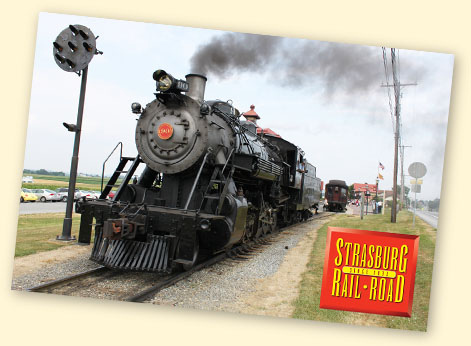
The Strasburg Rail Road is located on Gap Road / Pennsylvania Highway 741, close to the township of Strasburg, PA, just across the road from the Railroad Museum of Pennsylvania (you can see photos of that museum's collection on the Railroad Museum of Pennsylvania Train Shed and Railroad Museum of Pennsylvania Yard pages of this website).
The Strasburg Rail Road has had a long life. It was incorporated by the Pennsylvania General Assembly on 9th June 1832, although it is not known when initial construction was completed. A horse drawn railroad probably operated from the mid 1830s until 1851, when heavier rail was installed to accommodate the railroad's first steam locomotive, a 4-2-0 named "William Penn". The railroad provided both freight and passenger services with an interchange with the Pennsylvania Railroad at Leaman Road.
In 1901, a tram line opened from Strasburg to Lancaster, PA, and the railroad then ceased regular passenger services, although it continued a daily mixed train for some years. After WWII, business declined and then, after suffering washouts and storm damage in the 1950s, the Homsher Estate, owners of the line, ceased all operations in 1957. However, there were some who did not want to see the shortline die.


In 1960, the Strasburg Rail Road purchased an 1882 Victorian train station from East Petersburg, PA, and moved it in sections to Strasburg where it was reassembled. There is also a restored Pennsylvania Railroad switch tower built in 1885 (left) originally located in Lemoyne, PA, once part of the Pennsy's Cumberland Valley Branch.
Over the years, the railroad has continued to acquire and restore a variety of motive power, maintenance of way equipment and passenger and freight cars.
Railfans Henry K. Long and Donald E. L. Hallock organised a non-profit group that bought the right-of-way for $18,000 on 1st November 1958.
Ten days later, the first carload of revenue freight was hauled to what was then the railroad's only customer, a mill in Strasburg.


A tourist excursion service began on 4th January 1959 powered by a Plymouth gasoline engine, and the first steam locomotive, CN O-9-a #7312, arrived the following year (above). An 0-6-0 switcher, it was built by Baldwin in 1908 for the Grand Trunk Railway as #118 and went through several renumberings over the years, finally becoming #7312 in 1957. Two years later, it was sold to private owners who leased it to the Strasburg. It was purchased outright by the railroad in 1968.
A coal burner, #7312 weighs 153,384 lbs, has 56" drivers and 22" x 26" cylinders. Operating at a boiler pressure of 165 psi, it delivers 31,515 lbs tractive effort.
The railroad is a tourist operation, so there are plenty of other entertainments, including gift stores, a restaurant and fudge shop, and a model railroad. A limited number of passes are also available to tour the railroad's shops. Tours begin at midday. But, as well as a very popular visitor experience, the Strasburg Rail Road is also an operating business.
It hauls freight for the local community and has a much used repair and restoration facility. Services include constructing new locomotive equipment, restoring and making historic railroad parts, locomotive overhauls, boiler work and railroad car repair.


Above, Strasburg Railroad #89, one of two locomotives in steam on one of my visits, heads east in reverse with an excursion train.
There are no turning facilities at either the depot or Leaman Road, so the locomotives reverse on the trip out, change to the head of the train at Leaman Road and return. When there are two locomotives operating, the first train leaves Leaman Road as soon as the second has arrived.
The round trip is forty-five minutes long and covers nine miles in total. Trains usually leave at midday, 1.00pm and 2.00pm. They include open air, coach, first class and dining cars.
Below, #89 returns to the depot.


Above, #89 uncouples, pulls forward, switches onto the siding and reverses along the train.
Below, the locomotive reverses past the water tower and back over the points.


The Canadian Locomotive Company built #89 in 1910 as Grand Trunk Railway E-10-a #1009. It was later renumbered #911 and kept that number when it joined the Canadian National roster through until 1951, when it became #89.
#89 was sold to the Steamtown Foundation in 1961 (check out the Steamtown NHS page on this website). In 1972, it was sold to the Strasburg but, en route that June, was caught in Penn Central's Buttonwood, PA, yard when the Susquehanna River flooded. The water rose over the top of #89's stack!

A 141,800 lb Mogul type (2-6-0), #89 has 63" drivers and 21" x 26" cylinders.
Operating at a boiler pressure of 170 psi with a 30.8 sq ft grate, 166 sq ft firebox and total heating surface of 1,146 sq ft (incl. 200 sq ft superheating), it delivers 26,300 lbs tractive effort.


Above, after switching tracks, #89 pulls forward and reconnects to the train for the next trip.


The Great Western of Colorado Railroad was founded in 1901 to serve the Great Western Sugar Company and other sugar, beet and molasses companies operating in Colorado. #94 spent over forty years hauling forty- to fifty-car sugar beet trains between the Great Western's Loveland, Longmont, Windsor, Johnstown and Eaton, CO, factories.
Purchased by the Strasburg in 1968 for $50,000, it is the railroad's youngest locomotive and the most powerful. It is also currently the only operating decapod in the US.

Built in 1924 for the Great Western Sugar Company #90 is based on a stock Baldwin light decapod
(2-10-0), a type bought by many railroads in the
1920s.
The lack of a rear truck meant they had narrow fireboxes set over the rear drivers, which limited the driver size.


Above, the engineer does some lubricating as #90 waits to haul an excursion train out.
##94 weighs 212,000 lbs, 190,000 on its 56" drivers and has an engine wheelbase of 28' 8" and driver wheelbase of 20'. With 24" x 28" cylinders, the engine has a 54.3 sq ft grate and 197 sq ft firebox. The total heating surface is 2,896 sq ft, including 553 sq ft superheating. Operating at a boiler pressure of 190 psi, it delivers 46,512 lbs tractive effort. The tender weighs 161,000 lbs light and has a capacity of 9,000 gallons of water and 15 tons of coal.
You can see other decapods on the North Carolina Transportation Museum page of this website, the Museum of the American Railroad page, the Gainesville Midland #208 page and the Gainesville Midland #209 page.
Below, the locomotive reverses the train of cars out of the depot


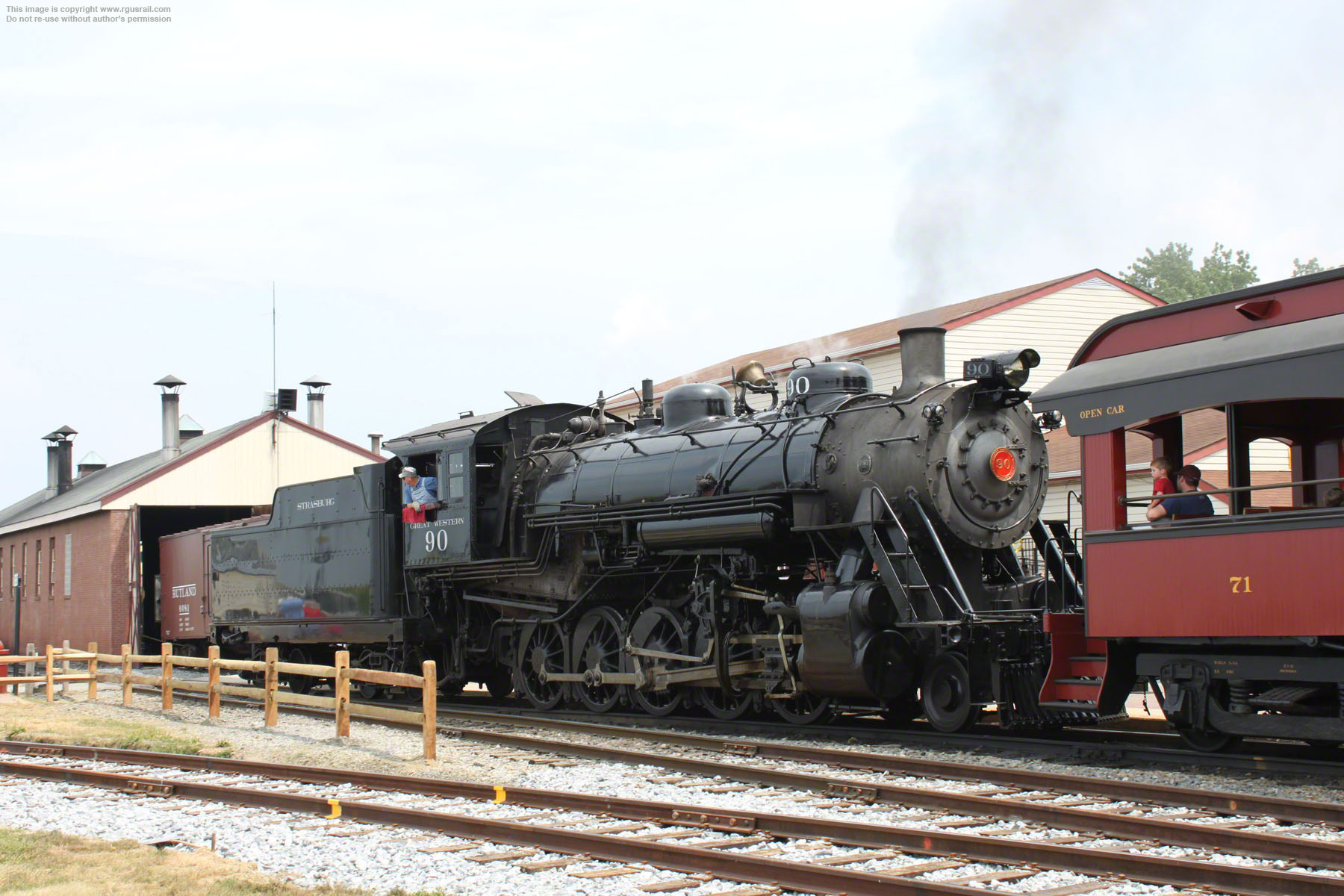


Above, having returned from Leaman Road, #90 uncouples from the train and pulls forward.


The locomotive then reverses the length of the train ready for the next excursion.

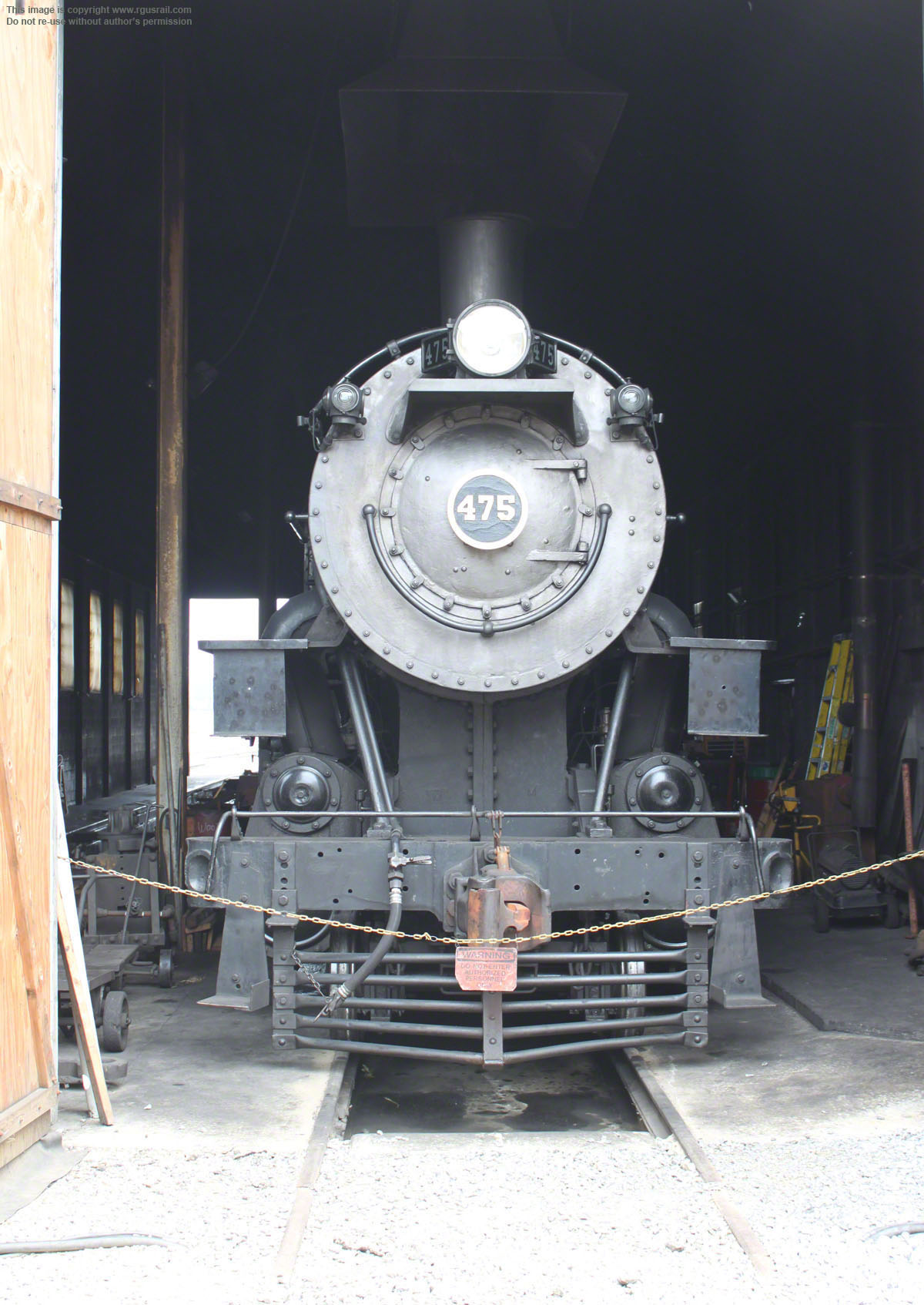


Above and left, on one of my visits to Strasburg, #475 was in the engine shed.
It is one of fifty M class twelve wheeler type (4-8-0) locomotives built by the Baldwin Locomotive Works for the Norfolk & Western in 1906 (#450-#499). Another seventy-five were also built at Alco's Richmond, VA, works that year (#375-#449). #475 spent most of its life on branch line service. After retiring, it occasionally hauled excursions. Then, from 1985 to 1991, the locomotive sat on a siding in Boone, IA, on the Boone & Scenic Railroad.


Above right, on another visit, I caught #475 waiting in the yard to take an excursion out. The locomotive was bought by the Strasburg in 1991.
#475 was restored at the Strasburg shops and went into service in 1993. It is the only 4-8-0 operating in the U.S.


Above, the hostler water jets the ash pan and engine deck.


The tender weighs 167,500 lbs and has a 10,000 gallon water and 10 ton coal capacity.


#475 weighs 206,200 lbs, 169,800 lbs on its 56" drivers. The engine wheelbase is 26' 5" and the driver wheelbase 15' 6". With 21" x 30" cylinders, a 45 sq ft grate, 173 sq ft firebox and total heating surface of 2,797 sq ft, it operates at a boiler pressure of 200 psi delivering 40,163 lbs tractive effort.
You can see other M class locomotives on this website: there is a page on NW M #433 in Abingdon, VA, NW M2 #1134 at Plymouth, VA, and NW M2c #1151 on the Virginia Museum of Transportation page.
Above, originally fitted with Stephenson valve gear, thirty Ms, including #475, were later fitted with Baker valve gear.
The engine's current tender is actually a USRA 10,000 gallon tender modified by the Norfolk & Western for hand firing.


Above middle, all the M Class engines were equipped with Alco power reverse gears by the N&W in the late 1930s.