


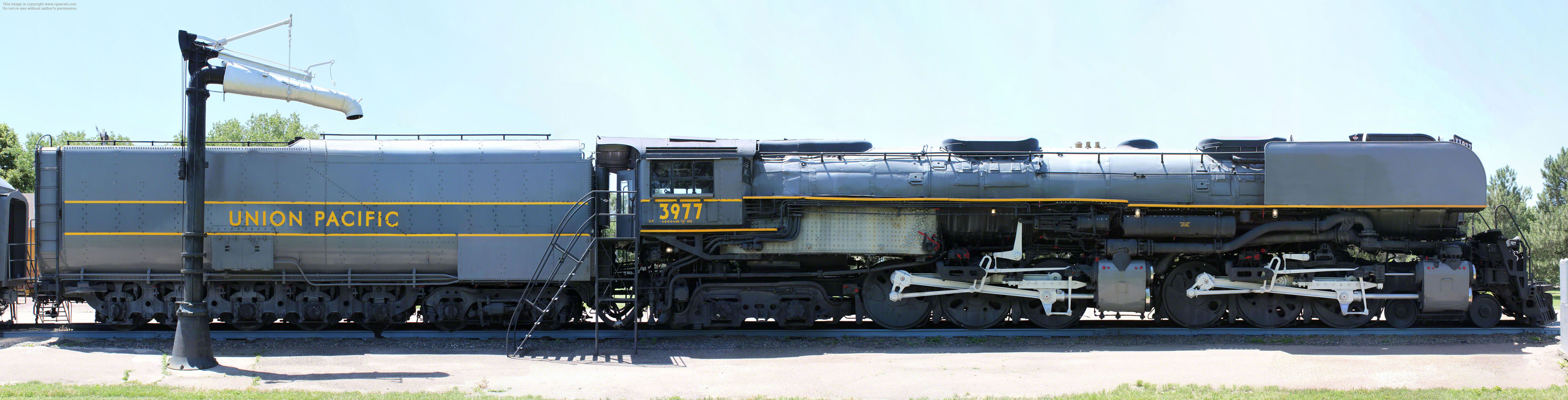
Union Pacific Challenger Class 4-6-6-4 #3977 is on display at Cody Park in North Platte, NE. It was donated to the City of North Platte by the Union Pacific and installed at the park in October 1968. UP Centennial Class DDA40X #6922 joined #3977 in August 1985.
The park. is open 10.00 am - 7.00 pm daily from 1st May until 21st September each year. There are attendants on site in the restored depot building from Hershey, NE, where you can also see railroad memorabilia such as telegraph equipment, train dispatch boards and historic depot furniture.
I've been to see the exhibits several times and the photos on this page are from various visits.


Above, a somewhat "personal" welcome to the park from #3977.


Above, as #3977 stands on a slight curve, it reveals how the front engine of an articulated locomotive swung at an angle from the boiler as it passed around curves.
Articulation of steam locomotives was first tried by the Swiss engineer Anatole Mallet (1837-1919). The rear engine is rigidly attached to the main frame and boiler of the locomotive, while the front engine rides on a separate frame attached to the rear frame by a hinge so that it can swing from side to side. To make this work, the front end of the boiler rests on a sliding plate on top of the swinging front frame.

Mallet also gave his name to a type of locomotive in which steam is reused from one set of cylinders in lower pressure cylinders, usually at the front of the locomotive. He first applied this system, called compound compression, in 1876 to a series of 0-4-2 tank locomotives on the Bayonne-Anglet-Biarritz Railway in France.
Although sometimes referred to as a Mallet, the Challenger is not of that type. Steam is supplied directly to both sets of cylinders in a process called simple expansion, and it should be referred to as a simple articulated locomotive.


Building on its long time relationship with the company, UP designers began working with Alco as early as 1934 on the design. With a generally high quality roadbed, heavy rail, slight curvatures, solid bridges and few constricted clearances, they faced few limitations.
The team initially looked at a freight design to handle the grades and tonnage, but were soon convinced of the benefit of a dual purpose locomotive. This would eliminate double heading of passenger trains and the need to run second sections during periods of high demand.
Despite being years of the Great Depression, the 1930s saw increased freight traffic on the Union Pacific. It had been using 2-10-2 locomotives with 2-8-8-0 compound pushers to get its trains over the tough grades of the Wahsatch Mountains but, to stay competitive, it required a faster and more powerful locomotive.
Since 1918, Arthur H. Fetter, General Mechanical Engineer, had designed locomotives for the UP, including its 4-8-2 and 4-10-2. He proposed designing a simple articulated 4-6-6-4 locomotive to fill the need.


The locomotive would reduce the reciprocating weight of a compound and increase the 50 mph speed limit of the railroad's then most powerful locomotive, the 4-12-2 (you can see the sole survivor of this type, UP #9000, on the Southern California RLHS page of this website).
The first batch of fifteen Challengers were delivered in 1936 designated Class CSA-1 (#3900-#3914). The first, #3900, was taken delivery from Alco at Council Bluffs, MO, on 25th August 1936 and, after a brief ceremony, left at the head of a refrigerator train going west.

The last twenty Challengers arrived in 1944 and were designated Class 4664-5. Costing $130,000 each, they were numbered #3930-#3949, which meant the Class CSA-1 and CSA-2 locomotives were renumbered into the #3800 series. The 4664-5 was similar to the 4664-3 except it weighed an additional 7,500 lbs, again because of wartime restrictions on the use of materials.
The final twenty locomotives brought the Union Pacific's total roster of Challengers to one hundred and five.
In 1937, the Union Pacific bought another
twenty-five of the type from Alco (#3915-#3939), which were designated Class CSA-2, then a further twenty (#3950-#3969) designated Class 4664-3 in 1942.
#3977 was delivered in June 1943, one of
twenty-five of the next Class 4664-4 Challengers (#3975-#3999) bought by the Union Pacific that year. Although very similar to the Class 4664-3s, they weighed 6,500 lbs more because raw material shortages during WWII meant heavier metals had to be used in some components.


The 4-6-6-4 type received its name "Challenger" in 1936 during a meeting between Otto Jabelmann, Vice President of Research, William Jeffers, Executive Vice President of the UP system and J. W. Burnett, General Superintendent of Motive Power and Machinery.
Burnett proposed a test run for the new locomotive operating unassisted from Ogden to Wahsatch, UT, and then running fast to Green River, WY, before returning to Ogden with another train.

The Union Pacific was the first to take delivery of a 4-6-6-4 locomotive , but other US railroads also rostered the type.
That year, the Northern Pacific ordered twenty-one, which were delivered during 1936 and
1937. Other railroads to purchase Challengers were the Clinchfield, Delaware & Hudson, Denver & Rio Grande Western, Spokane, Portland & Seattle, Western Maryland and Western Pacific. The Great Northern bought two from the SP&S, and the Clinchfield six from the D&RGW.

Burnett noted such a run really would be "a challenge for any locomotive". "It certainly is", Jeffers replied, "Let's call them 'Challengers'". Immediately after the meeting, Jeffers then sent a memo to the railroad's Advertising Department advising them that he wanted the name "Challenger" to be used in all future press releases about the new locomotive.
Although the Union Pacific was not the only railroad to roster the 4-6-6-4 type, the name stuck.


Most of the Challengers were built by Alco, with Baldwin only delivering fifteen to the D&RGW and twelve to the Western Maryland out of a total of two hundred and fifty-two. The last of the type was built in 1947, when Alco delivered four to the Clinchfield.
Although they worked across the continental US, only two Challengers have survived, both from the Union Pacific. As well as #3977 on display at Cody Park, the Union Pacific still steams #3985 as part of its Heritage Fleet stationed in Cheyenne, WY.


Above, three views of #3977's backhead. The first is from the engineer's seat, the second is from the footplate, the third from the fireman's seat.
The locomotive has a 132 sq ft grate and 602 sq ft firebox.
The firebox has a horizontal mud ring with a 106" long combustion chamber.


In 1952, #3977 was converted to burn oil, when five circulators in the firebox were removed.
However, left, the coal firing plate appears to be still in place.


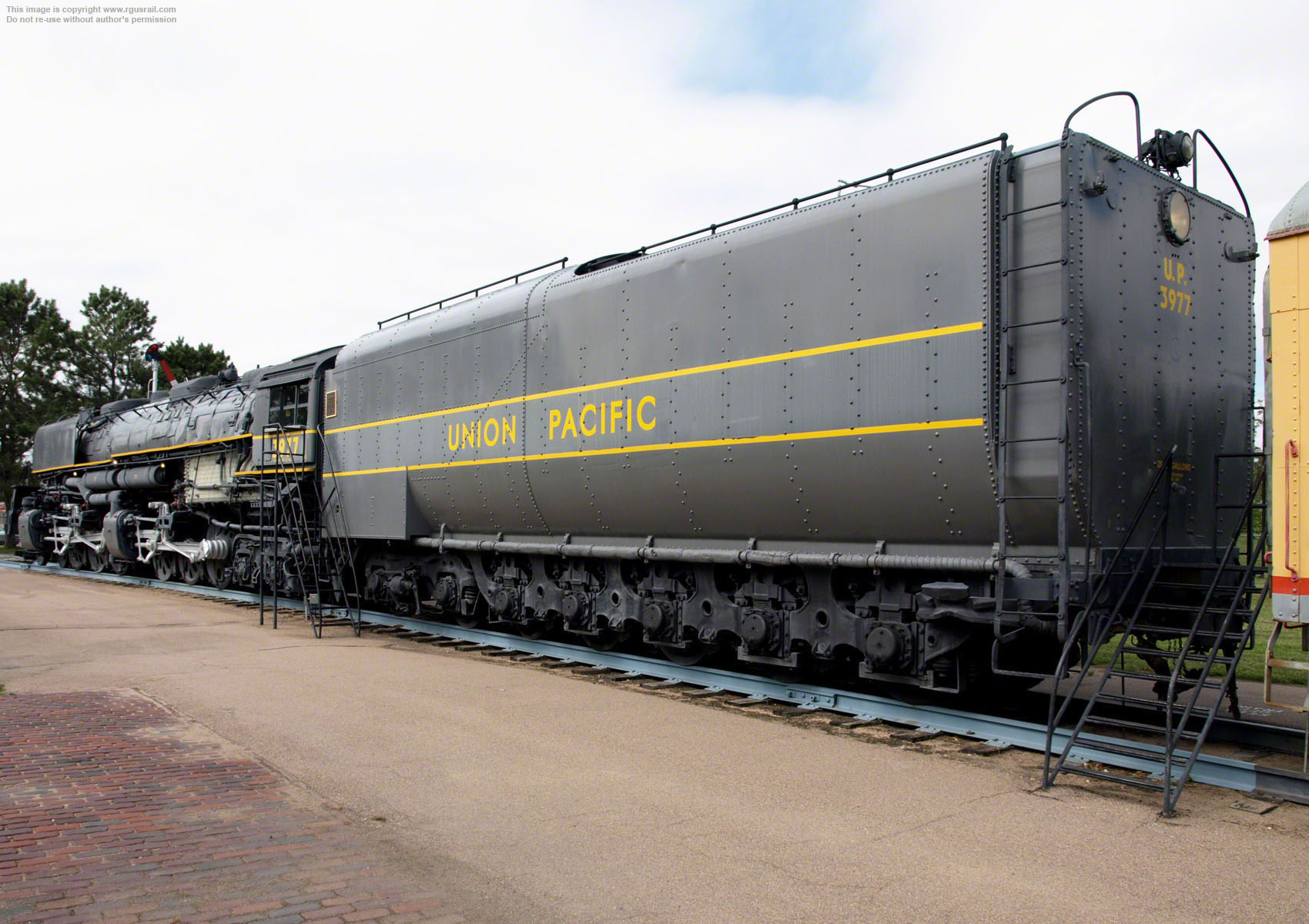
The tender is the same design as the one used on the UP FEF 4-8-4 series and the 4-8-8-4 Big Boy locomotives.
Carried on a fourteen wheel (4 + 10) centipede truck, it weighs 342,2000 lbs light and has a capacity of 25,000 gallons of water and 28 tons of coal.
The trailing truck is a Commonwealth four spoked wheel design fitted with SKF roller bearings on the outside journals. It is equipped with a geared roller type centering device that produces an initial resistance of 8% building up to a constant 15%.
#3977 was one of ten Challengers liveried in two-tone grey with yellow striping and lettering, fitted with "smoke lifters" and put into passenger service between Portland, OR, and Seattle, WA, as well as along the Columbia River to Huntington, OR, in 1946.


The two tone grey and yellow livery used on #3977 was also applied to Union Pacific FEF 4-8-4s and some Pacific 4-6-2 and Mountain
4-8-2 class locomotives hauling passenger trains on the Portland and Huntington divisions.
When first relocated to Cody Park in 1968, however, #3977 had the usual UP black boiler and graphite smokebox, although it was subsequently restored to the two tone livery it had sported while working in the north west.


Above, the pilot, air pumps, front cylinders with flexible steam piping joint and steam delivery pipe to rear cylinder. All four cylinders are 22" x 23".
The pilot trucks were built by Alco. They have geared roller lateral resistance devices, with low initial resistance building up to a constant at about 1" of lateral movement. A vertical damping device is built into each side, with fibre disks holding two metal plates that restrain vertical movement via a coil spring.


The crosshead and guides are of the multiple bearing type clamped into place with the Alco "Slidguide" device, which helps prevent distortion. The main and side rods are low carbon nickel-steel. The Walschaert valve gear is fitted with McGill needle bearings throughout except at the rear end of the eccentric rods, which have an SKF self-aligning roller bearing.
The design featured a lubricated slide shoe at the firebox end of the boiler to allow for expansion, instead of a rigid connection.


The 69" drivers are of Alco Boxpok design. The main driver axles (the rear pair on each engine) are made of carbon nickel-steel, while the others are carbon steel. All are hollow bored and equipped with Timken roller bearings. Lateral motion devices were fitted to the first and second sets of drivers. Combined with the spring rigging, these helped reduce wheel binding on curves.
Lower photo, the Alco type H reverse lever with a 12" cylinder and 24" stroke is on the right rear engine.


There are four, thirty pint capacity, Nathan mechanical force-feed lubricators. Two of them lubricate the guides, driving box shoe and wedge faces, trailing truck pedestals, articulated hinge pin, pilot truck centre castings, trailing truck centre plate, radial buffer, power reverse gear and intermediate reach-rod crosshead.
The boiler has an Electro-Chemical automatic blow down and foam collapsing trough system and, below, Prime washout plugs and Wilson blow-off cocks.


Two 8½" cross compound air compressors are mounted on the frame at the front end operated by superheated steam. They have fin type aftercoolers mounted on the pilot deck. The brake system is New York Schedule 8-ET, with KM vent valves on both the engine and tender.
An Elesco feedwater heater and Type E superheater were used. The forty-five 2¼" tubes and one hundred and seventy-seven 4" flues were supplied by the Republic Steel Company and are 20' long.


The engine frames are General Steel Castings Corporation with integral cylinders, including the back cylinder heads. A tongue cast on the front frame fits into a cavity at the front of the rear frame with an articulation pin to allow movement.
Steam pipes to the front cylinders are hinged on semi-ball joints. The exhaust pipes from the rear cylinders join under the base of the exhaust stand. The single exhaust pipe from the front cylinder has ball joints front and rear with a slip joint.


The other two Nathan lubricators fed lubrication to the locomotive's cylinders, valves, steam pipe joints, throttle, piston rod glands, boiler bearing and front exhaust pipe slip joint.
The pilot truck uses parallel spring suspension. The driving springs are all seated on rollers. Coil springs are located at the ends of the equalisation system of both engines and at the bottom end of the trailing truck and between the pilot truck equaliser and front cross equaliser.


#3977 weighs 634,500 lbs. The weight on
each axle was 67,500 lbs, making a total of 404,000 lbs on its drivers. The pilot truck carried 101,000 lbs and the trailing truck 122,000 lbs. With a total heating surface of 6,957 sq ft, including 2,162 sq ft
superheating, it operated at a boiler
pressure of 280 psi delivering 97,352 lbs tractive effort.
Unofficially, Challengers could easily reach 90 mph, and they proved extremely versatile, hauling freight and passenger services over most of the UP system.
The Challengers like #3977 sent to the north west divisions eliminated helpers and
double-heading, and were amongst the last steam locomotives retired by the Union Pacific. After dieselisation of those
divisions, they were sent to Ogden for
helper service and some freight use. Finally, in 1958, they were forced out of regular service by parts shortages. The last Challenger was retired in July 1962 and except for #3977 and #3985, all had been scrapped by November 1962.
Top, one Nathan live steam injector was
fitted on the fireman's side capable of supplying the boiler at maximum output and, below, an Elesco TP exhaust steam injector of equal capacity was located on the engineer's side.
The locomotive has a double smoke stack with four large exhaust nozzle jets. A side folding smoke hood similar to the one used on UP's Big Boys is fitted to the top of the double stack. To avoid potential damage, it was enclosed in a sheet metal casing.


#3977 is on display with UP Postal Storage Car #1350, UP Postal Car #2069 and UP CA-4 Caboose #25161.
The steel cupola
caboose was built by Pullman-Standard Manufacturing Co., at its Michigan City, IN, works in 1944. It was retired after being in a wreck at North Platte in August 1971 and was later donated to the park.
#1350 was originally delivered as Baggage Dormitory Car #2760,
one of seven built in 1927 by the American Car & Foundry. It was converted to a Postal Storage Car by the Union Pacific and renumbered in 1957.


Top, a view inside the caboose.
Above and left, three views inside postal car #2609. This Harriman Heavyweight Postal Car is one of six built for the Union Pacific in 1914 by Pullman. It was retired in 1968 and went on display in Cody Park the following year.


#6922 is one of forty-seven
DDA40X diesel-electric locomotives built for the Union Pacific from 1969 to 1971. The "Centennial" name was used to mark the celebration of the 100th anniversary of completion of the transcontinental railroad in May 1869 at Promontory, UT.
You can see photos of the Golden Spike NHS at Promontory on this website.
At 98' 5" and weighing 521,980 lbs, the DDA40X is the longest and most powerful hp rated diesel-electric unit ever built.
It has two 16 cylinder 645E3A prime movers developing 6,600 hp to power powered two GM AR12 generators to drive eight GM D77 traction motors. It developed 103,000 lbs continuous tractive effort at 12 mph and 19,800 lbs at its top speed of 90mph.


The 'X' stood for Experimental, as they were used as testbeds for technology that would go into future EMD products.
They used the wide-nosed cab from the EMD FP45 cowl units, built from 1967 to 1968 (you can see ATSF FP45 #97 on the Museum of the American Railroad page of this website).
Left, inside the nose of the cab. Note the toilet facility on the upper right. It can't have been easy perching on this while the engine ran through some of the railroad's rougher divisions!
The cab design was similar to the Canadian comfort cab introduced by Canadian National soon after in 1973, but lacked CN's structural reinforcements, which were carried over to future wide-nosed cabs.


Above, a view of the cab from the fireman's side much as it would have been when in service. Left, a view from the engineer's side.
The DDA40X modular electronic control systems were later used on EMD's Dash-2 diesels.

Above, a view of the control panel at the rear of the cab.
The DDA40X was the first diesel-electric to be able to load-test itself using its dynamic braking resistors as an electrical load, which meant that external testing equipment was not required.
By 1980, the Centennials had accumulated an impressive average of 2,000,000 miles each on the road, but their
service life was actually relatively short. With a decline in freight traffic
in 1980, the Union
Pacific took the DDA40Xs out of service and placed them in storage at Yermo, CA.


Above, two views of #3977 from the cab of #6922.
In 1984, an economic recovery brought a resurgence in demand for Union Pacific motive power, and twenty-five Centennials were returned to service. However, growing maintenance costs, concerns about stress cracking of the frames and newer, more reliable units with improved technology (SD40-2s from EMD and C30-7s from GE) led to retirement of most of the DDA40Xs by the end of 1986.


#6922 is on display with Union Pacific Fruit Express Reefer Car #458266.
Thirteen DDA40Xs have survived. You can see the first Centennial, #6900, on the Kenefick Park page of this website. #6901 is on the UP #2005 page, #6913 on the Museum of the American Railroad page, #6915 on the Southern California RLHS page, #6916 on the Ogden Union Station page, #6930 on the Illinois Railway Museum Yard page, #6936 (still occasionally operating as part of Union Pacific's Heritage Fleet) on the Cheyenne Roundhousepage and #6944 on the National Museum of Transportation, St. Louis Yard page.
Related Links:
Union Pacific Historical Society
Send a comment or query, or request permission to re-use an image.
William Kratville's The Challenger Locomotives, published by Kratville Publications in 1980, provides lots of information and some fine photographs of Challengers in operation (click on the cover to search for this book on Bookfinder.com).
