


There are currently three historic steam locomotives on display at the Museum of American History (part of the Smithsonian Institute) in Washington, DC. Except for the "John Bull", however, they are rather badly lit, in cramped spaces and surrounded by lots of extraneous material (mannequins, ramps, plaques, railings, etc.) that can make it difficult to get good photographs.
The museum is a fascinating place to visit. There is an incredible amount to see and do there, but you need to spend at least half a day to get the most out of it. And... arrive early if you want to get good photographs - it can get very crowded as the day goes on!
I have visited the museum on several occasions, and the photos on this page were taken at various different
times. You can see other locomotives from the Smithsonian collection on the B&O Museum
Roundhouse, the Railroad Museum of Pennsylvania Train Shed and Railroad Museum of Pennsylvania Yard pages of this website.




The locomotive was built as an 0-4-0 type, but a leading truck was added to assist road holding along with the characteristically long, low cow catcher (right). As a result, the connecting rods had to be disconnected, leaving the rear axle as the sole driving wheel. The "Stevens" then became, arguably, a 2-2-2.
Crews soon began calling the locomotive "the old John Bull", a reference to the personification of England under that name. Eventually, this was shortened to "John Bull" and the name became so widely used that "Stevens" fell out of use.

The "John Bull" was shipped in parts to Philadelphia in 1831 from the United Kingdom, where it was built by Robert Stephenson & Co., in Newcastle. The parts were then shipped from Philadelphia to Bordentown, NJ, where Isaac Dripps assembled them for Robert L. Stevens. It was then named "Stevens" after the engineer.
Stevens was building one of the first railroads in the US from Camden to Perth Amboy, NJ. The line was not completed until 1833, and the locomotive helped construct the final section. It then went into regular service on 9th September 1833.


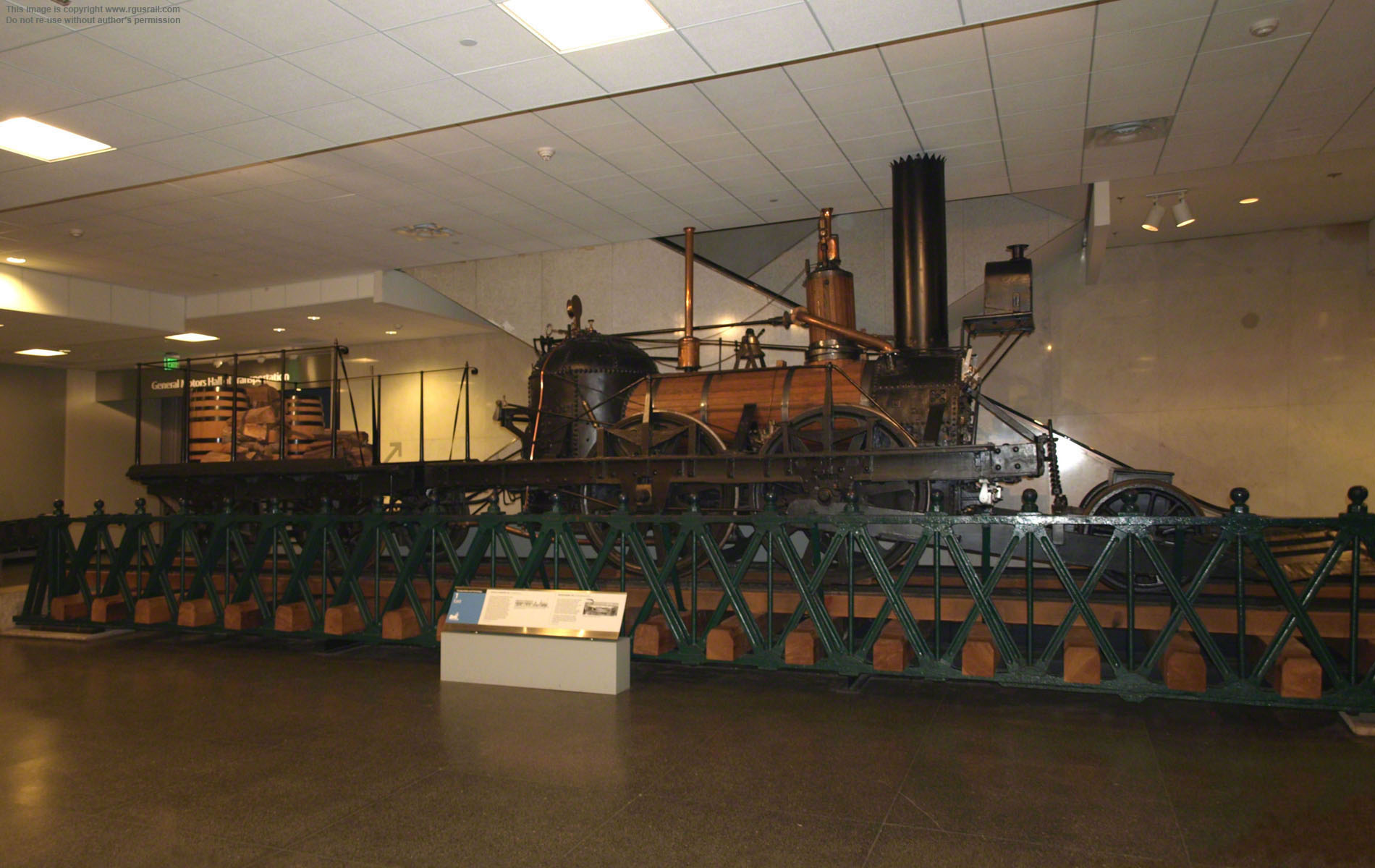
The "John Bull" weighs 22,000 lbs and has 54" drivers and 11" x 20" cylinders. A wood burner, it operated at a boiler pressure of 50 psi delivering 1,900 lbs tractive effort.
Soon after entering service, a cab was added to protect the crew from the weather. Other modifications included addition of a bell and headlight. The cab was removed when the locomotive was overhauled for display at the 1876 Centennial Exposition in Philadelphia by the Pennsy, which had absorbed the C&A in 1871. Other changes were made in an affort to make it look more "authentic", including, ironically, replacing the original bonnet exhaust stac with a straight one.
The "John Bull" later appeared at the World's Columbian Exposition in Chicago in 1893, the Baltimore & Ohio's 1927 Fair of the Iron Horse in Halethorpe, MD, and the 1933-34 Chicago World's Fair before being retired by the Smithsonian.


The "John Bull" rests on a section of the first bridge built entirely of iron in the US. Designed by Richard B. Osborne, it was constructed by the Philadelphia & Reading Railroad in 1845 to carry coal trains over a creek emptying into the Schuylkill River near West Manayunk north west of Philadelphia, PA.
A double line ran across the 34' long bridge, which remained in service until 1901. It was decommissioned the following year and a section was eventually relocated to the Smithsonian. An historical marker at the south-east corner of High St and York St in Pottstown, PA, commemorates the nearby workshop location where the bridge was built.


"Jupiter" is an American type (4-4-0) locomotive built by Baldwin in 1876 for the narrow gauge (36") Santa Cruz Railroad in California. It weighs 44,000 lbs, 28,000 lbs on its, with 42" drivers and 12" x 18" cylinders. An oil burner, it operated at a boiler pressure of 140 psi delivering 7,346 lbs tractive effort. It was one of three locomotives operating on the twenty mile Santa Cruz Railroad.
The line was absorbed into the Southern Pacific in 1881 and shortly after converted to standard gauge. "Jupiter" was then sold to the Ferrocarril Guatemala Central Railroad in 1885. The FGC became part of the Ferrocarriles Internacionales de Centroamerica in 1921, on which "Jupiter" ran right up until 1960. In 1963, the Washingtonian O. Roy Chalk bought the FIdeCA.
Chalk brought "Jupiter" to DC in 1964, where it was placed on open air display in the John F. Kennedy playground at 7th and O St. Chalk then donated the locomotive to the Smithsonian in 1975. It went on display the following year as part of the 1876 Exhibition at the Arts and Industry Building. On 30th January 1999, it was moved to the American History Museum, where it has been on display ever since.


#1401, a Pacific type (4-6-2) locomotive, was built for the Southern Railroad at Alco's Richmond, VA, works in 1926. Sixty-four of these Ps-4 Class were built, the first twenty-seven by Alco between 1923 and 1924 (#1366-#1392).
Derived from the USRA "heavy" Pacific type, but with smaller drivers (73" instead of 79"), the first twenty were amongst the largest locomotives built for the Southern, only slightly smaller than its Ts-1 Class Mountain (4-8-2) types. The engine weighed 300,000 lbs, 180,000 lbs on its drivers. With 27" x 28" cylinders, a 70.4 sq ft grate, 314 sq ft firebox, 4,578 sq ft heating surface (including 860 sq ft superheating) it operated at a boiler pressure of 200 psi, delivering 47,535 lbs tractive effort. The tender weighed 195,600 lbs light with a capacity of 16 tons of coal and 12,000 gallons of water.
#1401 was one of the second batch of thirty-seven Ps-4s delivered in 1926 (#1393-#1409, #6476-#6482 and #6688-
#6691), thirty-two from Alco and five from Baldwin. At 304,000 lbs, they were slightly heavier than the first batch and, with a 7.5 sq ft grate and total heating surface of 4,594 sq ft, including 905 sq ft superheating, had slightly more heating surface, although this made no appreciable difference to the 47,535 lbs tractive effort. They were also mated with larger tenders weighing 261,600 lbs with a capacity of 16 tons of coal and 14,000 gallons of water.
On a trip to the United Kingdom in the mid 1920s, Southern Railroad President Fairfax Harrison had seen and admired the UK London & North Eastern Railway's green liveried locomotives and decided the second batch of Ps-4s should be painted Virginia Green, with gold trim and lettering, aluminium painted running board edges and tyres, chrome plated rods, valve gear and cylinder heads, and a silver smoke-box.
In operation, all the brass and metal fittings were highly polished.


The four locomotives working Southern's Washington, DC, to Atlanta, GA, section also had Crescent Limited lettered in gold on their tenders. Seven went to the Southern's subsidiary the Cincinnati, New Orleans & Texas Pacific to pull the Queen & Crescent Limited from Detroit, MI, through Cleveland and Cincinnati, OH, to New Orleans, LA, as well as other named trains to Florida such as the Royal Palm, Ponce de Leon and Florida Sunbeam. Four more went to the Alabama Great Southern.
#1401 hauled passenger trains mainly on Southern's Charlotte Division between Greenville and Spencer, NC, until the railroad dieselised in the 1950s, when it was relegated to locals. Its tender capacity permitted runs of about 150 miles between stops, the full length of the Charlotte Division, although one intermediate water stop was normally scheduled.
A Ps-4 could haul 12-15 steel passenger cars, about 700-1,000 tons, at 80 mph on level track,
but the rolling profile of the Charlotte Division kept #1401's average speed down to about 50-60 mph.
#1401 is perhaps best known for joining one of eight double-headed Ps-4s (with #1385 from Greenville to Spencer, NC) that pulled President Franklin D. Roosevelt's funeral train from Warm Springs, GA, to Washington, DC, in April 1945. #1401 was fully shopped in 1951, retired in 1952 and donated to the Smithsonian in 1953.

Taken to the Henry Street Yard in Alexandria, VA, it was cosmetically restored at Shelton Paint Shop in 1961. Southern paid for and supervised the restoration, as well as for transporting #1401 to the museum in November that year.
Above, #1401, mounted on a flatbed trailer waiting to move into National Museum of History & Technology. Note that the pilot has been removed. The tender is nowhere in evidence and must have been transported separately. #1401 was officially dedicated in June 1962, and went on display in 1964.