


John Henry Park is off WV Route 3, just west of Talcott, WV.
Big Bend Tunnel, Talcott locals claim, was the site of John Henry's famous battle with the steam drill on what was then the Chesapeake & Ohio Railroad (now CSX), although arguments continue over the actual location of that mythic event. It has been pointed out, for example, that there were several tunnels in the local area, as well as further afield, that went by the name "Big Bend". There are also no records of a steam drill ever having been employed on this particular Big Bend tunnel.
I have visited the location a number of times and the photos on this page are from various
visits.


Talcott is a small, unincorporated community in southern West Virginia straddling the Greenbrier River ten miles west of Hinton. It is about a hundred miles from Roanoke, VA, but because of the winding, two-lane country roads, it can take up to two hours to get there.
Talcott styles itself
the "Home of the
John Henry Legend" and, every year on the second weekend in July, events are held to commemorate the legend, including live music at the site of
the statue, a parade, crafts and food
shops, exhibits, fireworks and a community worship service.


Above, the statue at its new location. The tunnel on the right in this view is the old Big Bend Tunnel, renamed Great Bend Tunnel when the tunnel on the left, still in use today by CSX, was built by the C&O in 1932.
The 750 lb, eight-foot high bronze statue was commissioned by the Hilldale-Talcott Ruritan Club for the 100th anniversary of the 1872 completion of Big Bend tunnel. It was produced by Michigan sculptor Charles Cooper and delivered to Hinton in late December 1972, just making the anniversary it was intended to commemorate.
For some time, there had been a promise of a new site for the park and statue.
The statue used to be located on a turnout on a sharp curve of WV 3 directly above the east portal of Big Bend Tunnel but, in May 2012, in time for that year's celebrations, it was moved opposite the tunnel portal itself.

Donations to the effort included $500 from Johnny Cash.


A mobile crane supplied by the newly formed Chessie System, successor to the C&O, lifted the statue onto a flat car in Hinton, and a special train ran to Talcott through Big Bend Tunnel to the east portal. The statue was then lifted onto a truck and carried up to the its original location above the tunnel, where it was placed on its base by the Chessie crane.
Before being moved to its new location in 2012, the statue was fully restored by local welder Larry Moorman, vice president of the John Henry Historical Park Association. Durung its forty years at the original site, the statue had been pierced by at least nine gunshots and dented by a dozen more.

Above, a view looking south at the original location of the statue just off WV 3 above Great Bend Tunnel. The demounted caboose apparently once served as a visitor centre, but it has obviously been closed for many years. Right, the State of West Virginia has erected a plaque commemorating the legend of John Henry in a small plot by the road side.
Bottom view, looking north as the road drops down to Talcott. The State of Virginia plaque has not been moved, and the statue's original plinth remains.


You can see a full, 360° flash panorama of the original site by
clicking on this link:


Above, the statue at its original location.
In the famous song that describes the story, John Henry is born strong and grows to
become the greatest steel driving man in the land. When the owner of the railroad on which he is working buys a steam powered hammer drill, to save his job and those of his crew, he challenges the owner to a contest: him against the steam drill. Although he beats the drill, John Henry collapses exhausted and dies, and is replaced by the new steam drill in any case. The victory reputedly saved a number of rock-drilling jobs at the construction site, as well as becoming the inspiration of numerous songs and folk stories.

Above, the original plaque has been moved to the base of the relocated statue.
The truth about the legend of John Henry will probably never be fully known. In Steel Drivin' Man, Scott Reynolds Nelson argues that John William Henry, a prisoner in Virginia leased to work on the Chesapeake & Ohio Railroad in the 1870s, is the basis for the story. However, he suggests the contest actually took place at Lewis Tunnel, between Talcott and Milboro, VA.
On the other hand, in "Chasing John Henry in Alabama and Mississippi: A Personal Memoir of Work in Progress", John Garst has suggested the contest took place at either the Coosa Mountain Tunnel or the Oak Mountain Tunnel on the Columbus and Western Railway (now part of Norfolk Southern) near Leeds, AL, on 20th September 1887. He bases his claim on documentation and the account of one C. C. Spencer, who claimed in the 1920s to have witnessed the contest.


In the view above looking down onto the CSX main line, the paved road on the left indicates the bed of the original railroad track to the first Big Bend Tunnel, completed in 1872.
When built, the tunnel was 6,477' long. In 1917, it was extended 23' when a ventilation plant was built on the western portal.
A second tunnel
went into service in 1932, indicated by the single line of track in the view above. The 1872 tunnel was renamed Great Bend and the new tunnel became Big Bend. The original tunnel was taken out of service in 1974 and the tracks lifted.

Above, the eastern portal of the 1932 Big Bend Tunnel is on the left, the renamed Great Bend Tunnel is on the right.
The original John Henry Park was on the upper left, directly above the Big Bend Tunnel portal.
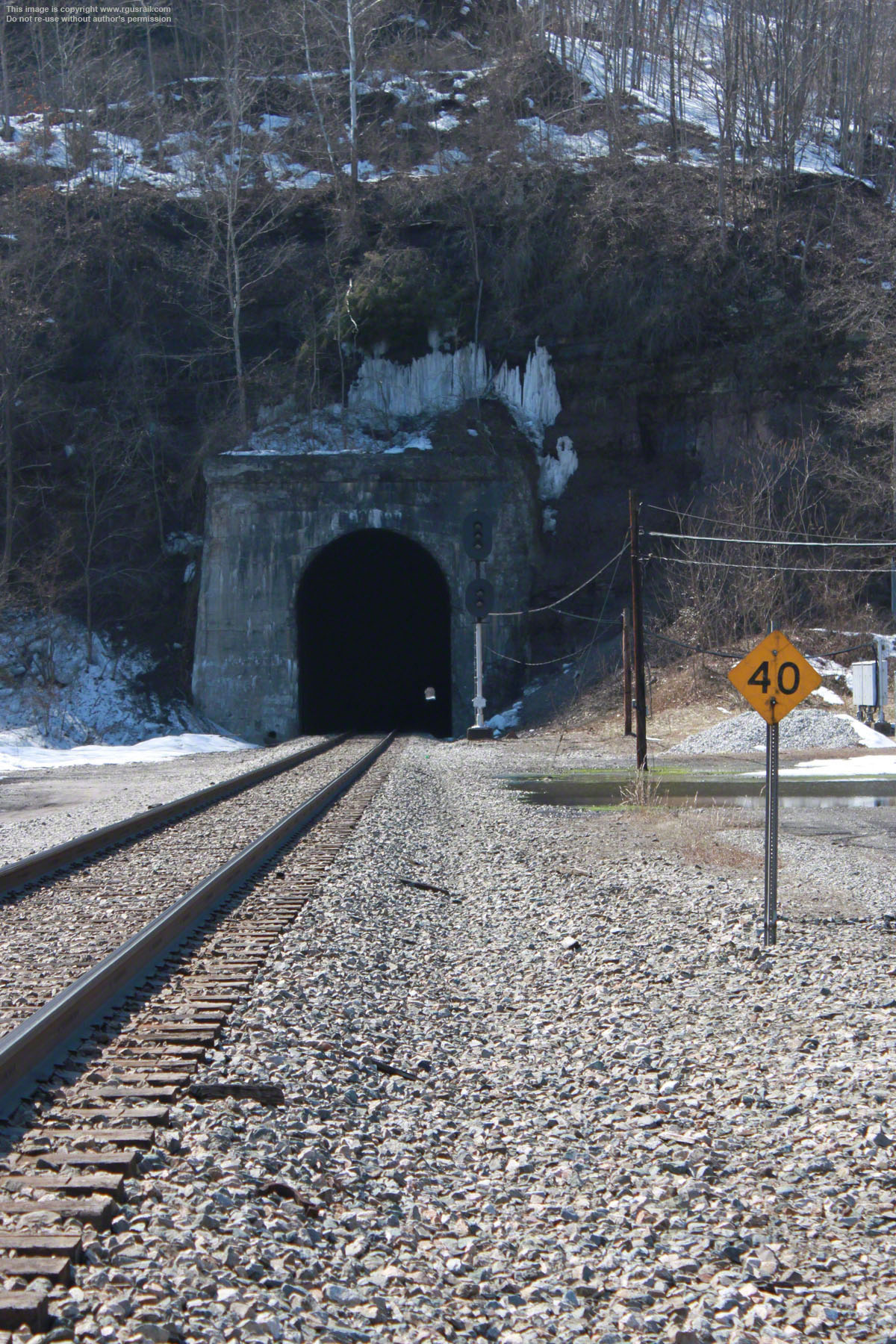
Above, the eastern portal of 6,188' long Big Bend Tunnel.


Above, three views of Great Bend Tunnel in the winter of 2009 before the statue had been relocated. When completed, it was then the longest tunnel on the C&O system.
It took one thousand men three years to finish working from both west and east portals, as well as from two vertical shafts down which men
and mules were lowered in large buckets. The crews eventually met, at which time, a celebration was held with a barrel of bourbon and a gold watch for the first man to break through. Many workers were newly freed slaves, schooled only for heavy labour under the South's system of slavery. Although well paid at $1.25 a day, it was back breaking, dangerous work.


Above, when I visited in early spring 2011, a fence had been built across the opening to the tunnel. This is to stop anyone entering the flooded, boulder strewn structure.
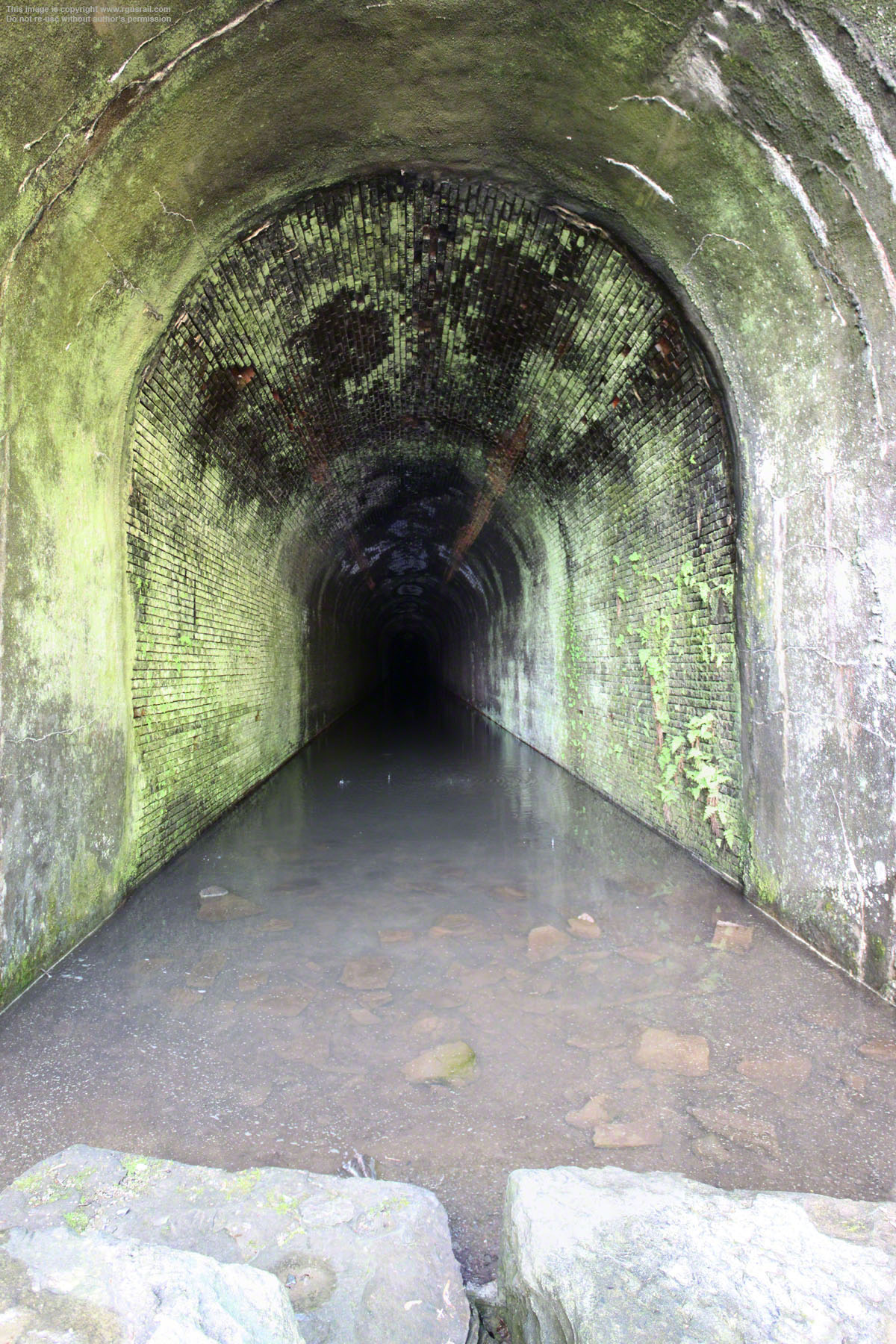

During construction, the air inside the tunnel would have been thick with noxious black smoke and dust, and hundreds lost their lives through rock falls, asphyxiation and silicosis, as well as the casual violence that went with construction camps. Their bodies were dumped into makeshift, sandy graves just outside the tunnel portals.
In many ways, steel drivers were amongst the most skilled of 19th Century manual labourers. They worked twelve hour shifts, wielding 14 lb hammers to drive drills into the rock to place powder charges. As many as fifty holes, sometimes 14' deep, were required for each blast and, once the rock was blasted free, it had to be shovelled by hand and hauled out in mule carts.
As a figure of American folklore, John Henry is, in many ways, an epitome of the indomitability of individual effort (a recurrent theme in American culture and life), as well as signalling the increasing marginalisation of the skilled American working class during the nation's relentless industrialisation during the 19th Century. The fact that he is also African-American complicates things and, for African-Americans, his meaning is perhaps far more complex.

Above, looking east along the trace of the ex-Chesapeake & Ohio railroad grade leading away from Great Bend Tunnel.
This is now one of two access roads to the new park, which allowed me to take photos of the tunnels on the left. The
fencing on the right shows the limits of CSX property. From there, you can get some good views of action on the line.
In 1972, the C&O, Baltimore & Ohio and Western Maryland Railway merged to form the Chessie System. In 1987, the Chessie merged with the Seaboard System to form CSX Transportation.
Related Links:
John Henry: The Steel Driving Man Discussion
Send a comment or query, or request permission to re-use an image.
The most recent volume on John Henry is Scott Reynolds Nelson's Steel Drivin' Man: John Henry, the Untold Story of an American Legend published by Oxford University Press in 2006 (click on the cover to search for this book on Bookfinder.com).
