

The Western Maryland Scenic Railroad is a tourist line operating out of Cumberland, MD, on ex-Western Maryland and ex-Cumberland & Pennsylvania Railroad trackage to Frostburg. It began operations in the spring of 1991, using a series of diesel locomotive borrowed from other railroad heritage museums.
#734 joined the WMSR roster in 1991 but it did not start in service until 1993 because it required extensive restoration. Since then, the WMSR has taken ownership of two EMD GP30s (#501 and #502) purchased from Conrail in 1995, and has collected a variety of passenger coaches, cabooses and freight cars.
I have visited on several occasions, and the photos on
this page are from different visits. I also joined an excursion in June 2009. The route from Cumberland is challenging, and this is evident in the amount of work #734 has to do climbing nearly thirteen hundred feet in the sixteen miles to Frostburg. The average grade is 1.78% with a maximum of 3% on the old Cumberland & Pennsylvania section. The return trip is, naturally, somewhat easier!


Above, two views of the old Western Maryland Railroad passenger depot on West Harrison Street in Cumberland. It was opened in 1913 and contained the offices of the railroad's Western Division.
The building was listed on the National Register of Historic Places in 1973. Major restoration was carried out in 1999 and, today, it is called Canal Place. Operated by the National Park Service, as well as serving as a station for the Western Maryland Scenic Railroad, it includes a visitor centre for the Chesapeake & Ohio Canal National Historic Park at what is the western end of the 185 mile long C&O canal path.


Rebuilding of the original track and platform arrangement at the station was completed in 1998.
The work included installing the water column, shown left, acquired from the North Carolina Transportation Museum at the northern end of the main platform.

It is fully operational and regularly waters #734.


The rail bridge was built in 1910 when the Western Maryland extended its line to Connellsville, PA, which includes the section now used by the
WMSR.
The fifteen acre Ridgeley Yard was formerly used by the Western Maryland as a Car Shop. The West Virginia Central Railroad built the first yards and tracks in Ridgeley in 1887. In 1904, the West Virginia Central became the Western Maryland
and, today, the WMSR uses what remains of the yards for locomotive and rolling stock maintenance work.
Above and right, #734 crossing the North Branch of the Potomac River from Ridgeley Yard in WV.


Above, #734 passes under the I-68/US Highway 220 bridge spanning the Potomac River.
#734 is one of three class SC1 Consolidation type (2-8-0) locomotives built in 1916 by the Baldwin Locomotive Works in Philadelphia, PA, for the Lake Superior & Ishpeming Railroad (#18-#20). Originally numbered #18, it was renumbered #34 in 1923. You can see LSI SC1 #35 on the Illinois Railway Museum Yard page of this website.


Above, the engine pulls to a halt at the station where the fireman starts taking on water.
With an engine weighing 268,000 lbs, 238,000 lbs on its 57" drivers, #734 is about average for a Consolidation of the time, but it has a sizeable firebox area (245.2 sq ft), which includes 29 sq ft of arch tubes. With an additional 844 sq ft of superheating, the total heating surface is 4,487 sq ft. It delivers 55,948 lbs tractive effort.

Above, the SC1s were built with a particularly large boiler and piston valves (14" diameter), which give them a rather "puggish" look.
The grate is 58.7 sq ft and the boiler originally operated at 185 psi (now 200 psi). The cylinders are
26" x 30" and the drivers 57".


Above, #734 at Cumberland Station taking on water and waiting to start on the day's excursion.


Two views from the train as #734 waits to leave Cumberland station.
#734 eases out of the station yard and crosses Baltimore Street.
The original Western Maryland was mainly a coal hauling and freight railroad, with a small passenger operation. Chartered as the Baltimore, Carroll & Frederick Railroad in 1852, it changed its name to the Western Maryland Rail Road Company in 1853.
Construction began on a line from Owings Mill in 1857 to connect with an existing line from there to Baltimore, MD. In 1891, the WM acquired trackage rights on the Cumberland and Pennsylvania Railroad, which included the line into Frostburg.


#734 leaving Cumberland across Wills Creek.


Approaching Market Street overpass just outside the station yard.
Passenger service on the old WM started in 1859 but, by the 1950s, like most US railroads, had largely declined. The service ceased on the Frostburg section as early as 1918, and stopped completely on the rest of the railroad in 1959.

Above, #734 nudging round the Narrows where Wills Creek cuts between the 1,000' Haystack and Wills Mountains.
For years this was a natural access point west to the Ohio Valley. The old B&O (now CSX) line and the National Road (40A) run on the other side of Wills Creek.

Above, The WMSR line crosses the highway and Braddock Run on a 300' truss bridge built in 1910. It is about 60' above the water level of Braddock Run.
The WM was bought by the B&O and C&O in 1968, after which much of its trackage was abandoned. In 1973, as part of the Chessie System, ownership went to the C&O although it was operated by the B&O. The B&O then merged with the C&O in 1986 and became part of CSX Transportation.

From Braddock Run, the line continues about two miles further near Wills Creek heading north-
east before swinging back through almost 180° into Cash Valley.
The view above is on the curve turning back to the south-west. Near this point is a rock cave often pointed out by WMSR crews and known as "Bone Cave". It was uncovered when a new cut was being excavated along Andy's Ridge for the railway in 1912.
The cave was found to contain fossilised bones of forty-one different species, a number of which were from the Pleistocene Age, including a sabre tooth tiger. Today, little is left of the original contents.

Above, #734 on the straight section of track heading south-west and approaching Helmsetter Curve.
The crossing ahead is Manteo Drive NW.

Above, #734 entering Helmsetter Curve.
It is apparently named after the family that owns the farm inside the
curve.


Above, two views of #734 on Helmsetter Curve. At the top, Cash Valley Road crossing.
This is a favourite spot for photographing WMSR trains, with its unobstructed views from a nearby cemetery. Much of the land is privately owned but access is sometimes arranged by WMSR for photo-freight runs.


As the track passes across Cash Valley, the locomotive is climbing a 1.78% grade.
A half mile from Helmsetter Curve, the train approaches Brush Tunnel, the only one on the WMSR. It passes through a ridge on the north-eastern side of Piney Mountain at the northern end of the Blue Ridge Mountain Range.


Brush Tunnel opened in 1911. It is 914' long and 26' high from the rail head.
The tunnel was originally built with two tracks but, as one track has been abandoned, this allows the Allegheny Highlands Trail, part of the Great Allegheny Passage Trail, to pass through the tunnel for both hikers and cyclists.


Beyond Brush Tunnel, the track rounds the north face of Piney Mountain and continues high above Jennings Run for about two miles. The train then enters Woodcock Hollow, where it traverses another horseshoe curve. The four views above show #734 approaching and then rounding the curve at Woodcock Hollow.
There are places on this curve where both sides of
the track can be seen at the same time. When long freight trains ran through here, engine crews could look directly across the valley and see the train's caboose. From this point, trains head north up the opposite side of the valley along the east side of Federal Hill.

Above, the summer sunlight slants through trackside trees and reflects on the boiler, cab and tender of #734.
Two miles before reaching Frostburg, the WMSR line leaves what used to be the Western Maryland main line.
From here, the main line once continued west towards Connellsville, PA, but it is now abandoned.
At this point, known as "Number Nine" junction or "Number Nine Switch", #734 crosses onto the old Cumberland & Pennsylvania tracks. The grade reaches 3% on this last stretch up to Frostburg. It is the steepest part of the line, and #734 is working
hard!


Above, after the long climb, #734 pulls into Frostburg.
The train lays over here for about an hour so that passengers can stretch their legs and get lunch. When I travelled, there were also Park Rangers on the train who
provided information on the railroad and entertained child passengers.


Above and right, a series of views of #734 standing at Frostburg. The station is nestled at the head of Georges Creek Valley.
The Cumberland & Pennsylvania was chartered in 1850. It was primarily a coal hauler, owned by the Consolidation Coal Company, headquartered in Cumberland and the largest bituminous coal company in the eastern US. Its main line ran thirty-two miles from Cumberland to Piedmont, through a tunnel under the town of Frostburg. It interchanged with the B&O at Cumberland and Piedmont, with the Western Maryland at Westernport and with the Pennsylvania Railroad at State Line, just north of Ellerslie, MD.
With twelve stations along the route, the
C&P served Frostburg and mining communities in the Georges Creek area until 1944, when it was purchased by the Western Maryland.
The WM formally merged operations with the C&P in 1953. The following year, it abandoned redundant C&P track between Mt. Savage Junction and Mt. Savage and discontinued use of the tunnel under Frostburg, because of the tunnel's relatively low clearance.


Above, the locomotive's big front end.
The WM owned fourteen hundred miles of track at its most extensive, serving Maryland, parts of Pennsylvania and West Virginia and competing with the B&O over the Alleghenies. After being bought by the B&O and C&O in 1968, it ceased operating as a separate entity.
Many of the original lines are now rail trails. However, portions are now operated by the Durbin & Greenbrier Valley Railroad (you can see photos on the Durbin & Greenbrier Valley page of this website), the Maryland Midland Railway, York Railway and Baltimore Metro, as well as WMSR.


#734 being turned on the turntable at Frostburg.


From left to right above, turning #734 is probably one of the most photographed parts of every run. The 100' turntable was moved to Frostburg from another ex-Western Maryland railway yard in Elkins, WV.


After making the turn, #734 runs past the cars on a siding, passes through a set of points and reverses to rejoin the train ready to haul it back to Cumberland.
As #34, the locomotive had a long career
with the Lake Superior & Ishpeming
Railroad, working out of Marquette, MI. It
was retired in 1951 and stayed on the company's dead line at Marquette until the railroad sold three SC1s (#32, #34 & #35) to the Marquette & Huron Mountain tourist railroad in 1963.
#34 worked for four years hauling passengers from West Yard to Big Bay, WI, and West Yard to Marquette, WI, on old LS&I trackage. In November 1967, the locomotive was sold to the Illinois Railway Museum.
Then, in 1991, it was bought by the WMSR and underwent a restoration and rebuild, including increasing boiler pressure to 200 psi, replacing the tender with New York Central Mohawk #2662's, as well as a number of other cosmetic changes to make it more resemble a WM H-7 class 2-8-0.

Above, a panorama (note the Western Maryland "fireball" on the tender) and, below, a series of photographs of #734 standing at Frostburg prior to departing on the return trip.
The locomotive was not originally fitted with an automatic stoker, nor was this done during the 1992/3 WMSR restoration. The current stoker was finally installed by the WMSR in 1998.
Other changes to ex-LSI #34 to make it look more like WM H-7 #734 included relocating the cross-compound air pump from the side of the pilot to the running board on the left side and removing the feedwater pump.
The bell is from WM H-9 class #816, also a 2-8-0.


Frostburg depot was built for the Cumberland & Pennsylvania in 1891. The building now has a seating area where passengers can eat lunch.
The township of Frostburg is on the east side of Big Savage Mountain, about 2,000 feet above sea level and 1,500 feet above Cumberland. It had its beginnings in 1811, when work started on the National Pike, a road built to transport crops and raw materials over the Alleghenies to East Coast markets. It was called Mount Pleasant until 1820, when the postal service arrived and it was renamed Frostburg. It now has a population of about 8,000 and is home to the Frostburg State University.

Top, the Thrasher Carriage Museum is opposite the depot. It has a large collection of old horse-drawn vehicles, including sleighs, funeral wagons and freight carts on display. It is open to the public noon to 2.00pm, Thursday to Sunday, from May to October, and Saturday and Sunday from November to mid-December.
Below, the Trail Inn is also located opposite the Frostburg depot. It offers bed and breakfast accommodation, a camp ground and bike rental. The Trail Inn has a cafe at which you can buy light snacks while the train rests at the depot.

However, in my experience, the queues can be long and the service somewhat desultory.
Related Links:
Western Maryland Scenic Railroad Website
Western Maryland Railway Historical Society
Thrasher Carriage Museum, Frostburg, MD
Trail Inn, Frostburg, MD
Send a comment or query, or request permission to re-use an image.
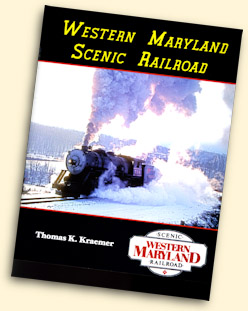
Thomas K. Kraemer produced an illustrated guide, Western Maryland Scenic Railroad, published by RR Trax Studios in 2003 (click on the cover to search for this book on Bookfinder.com).