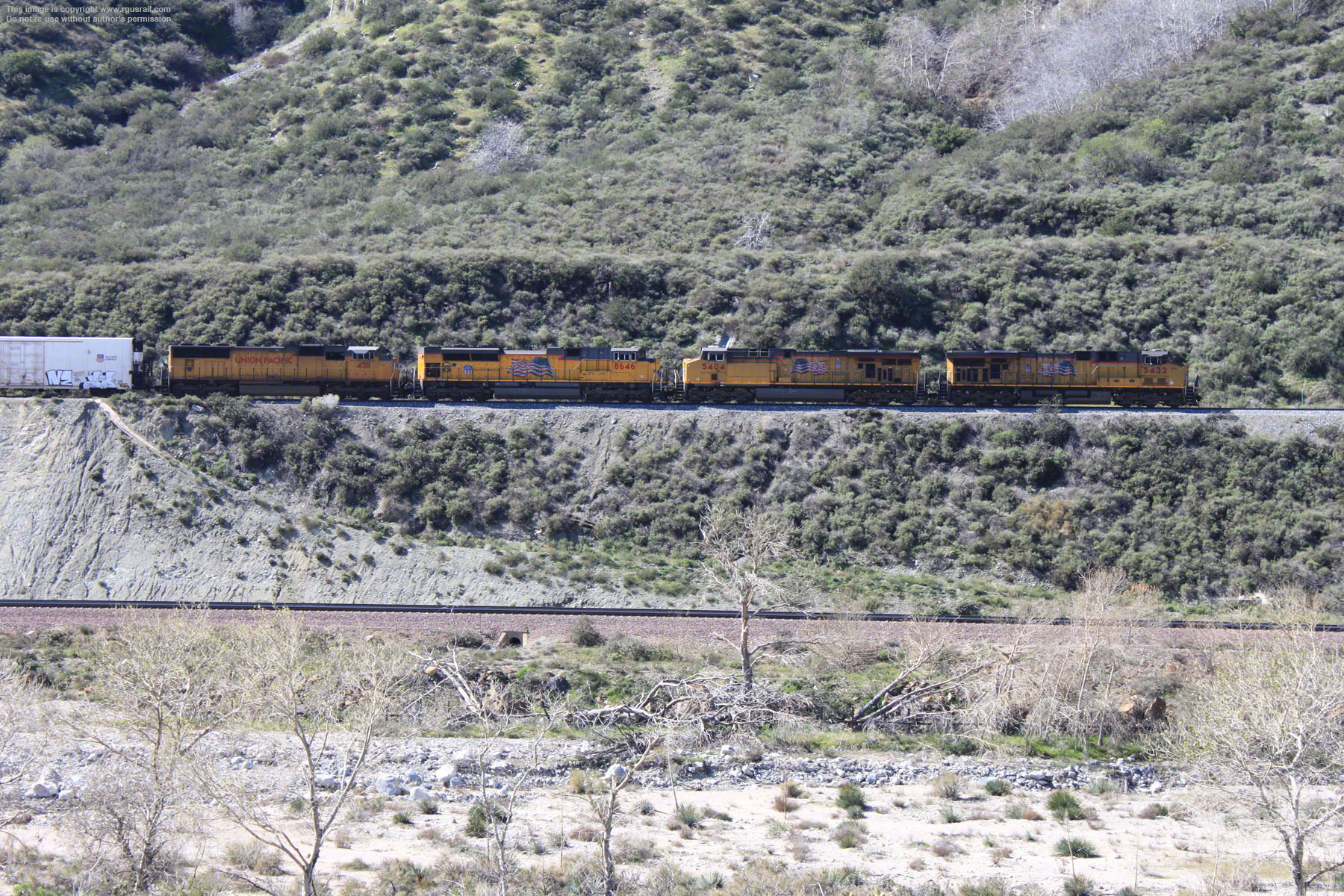
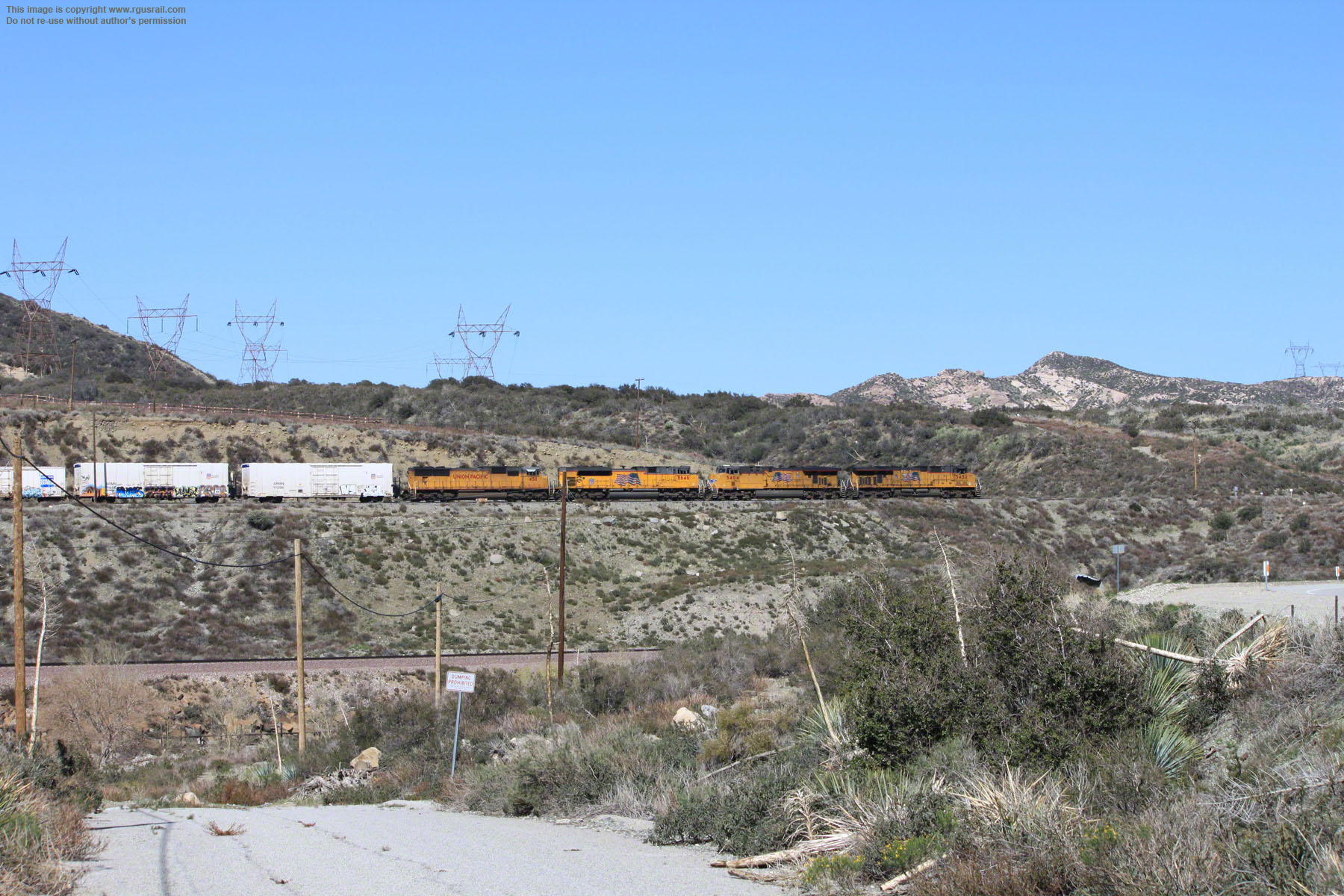
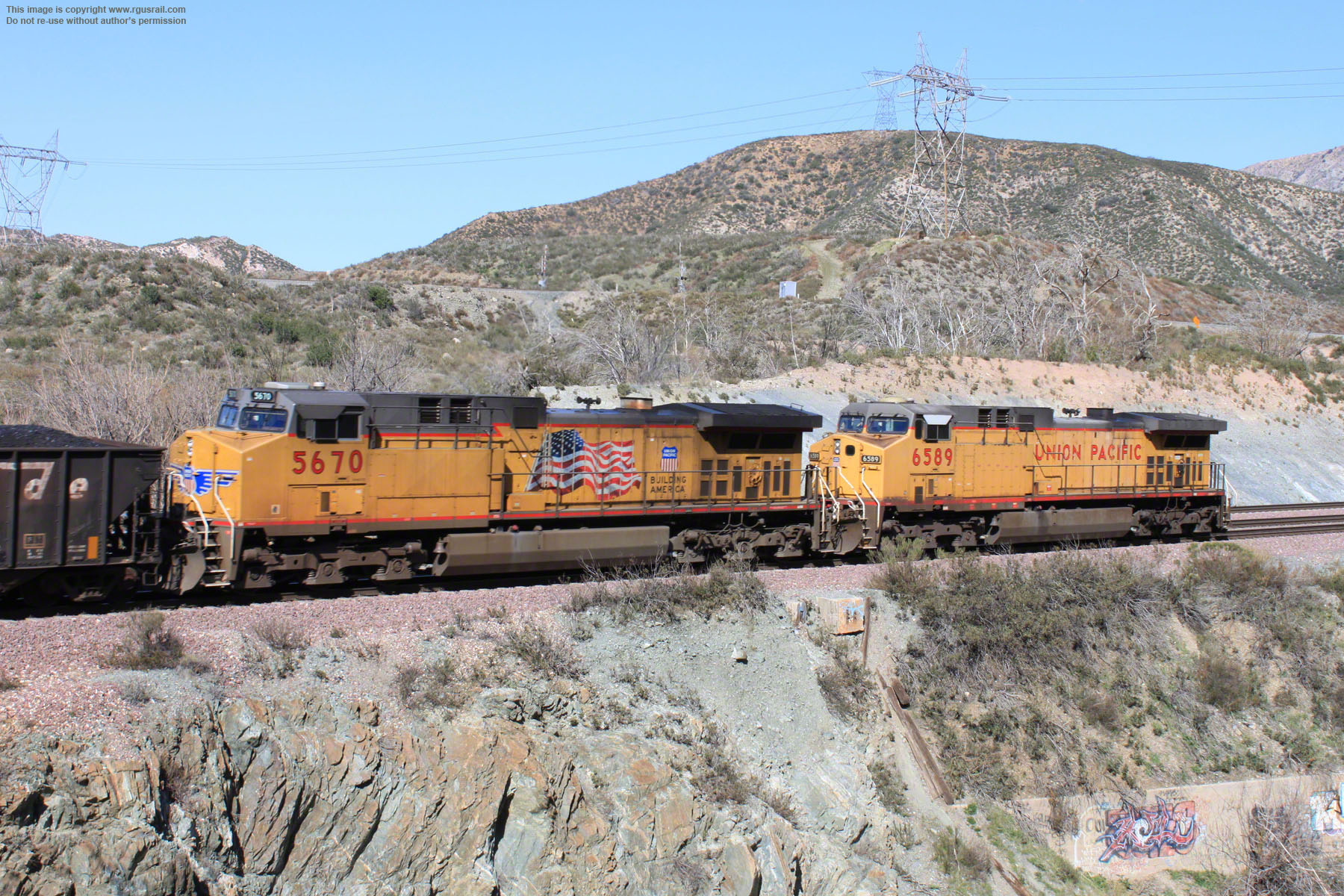
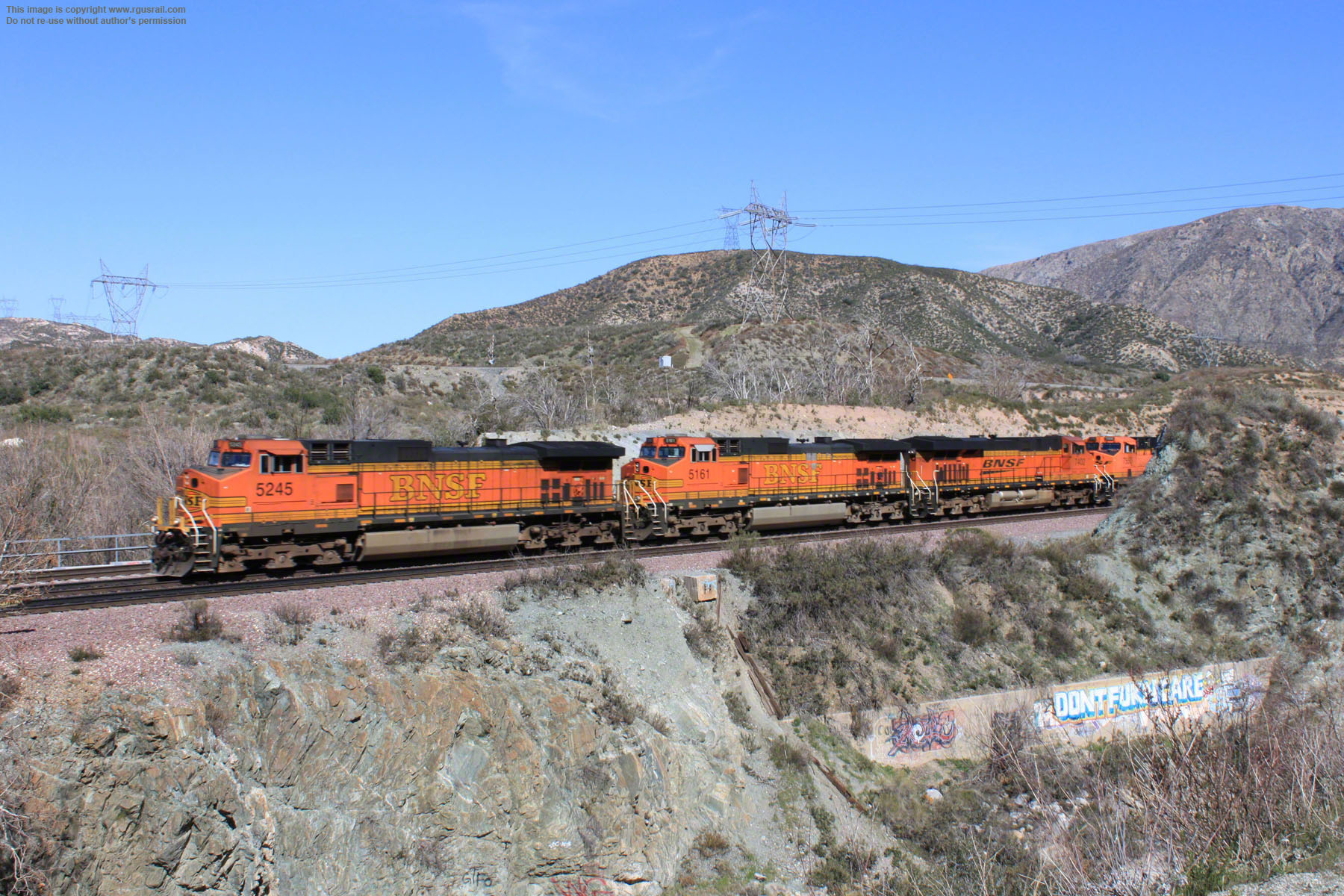
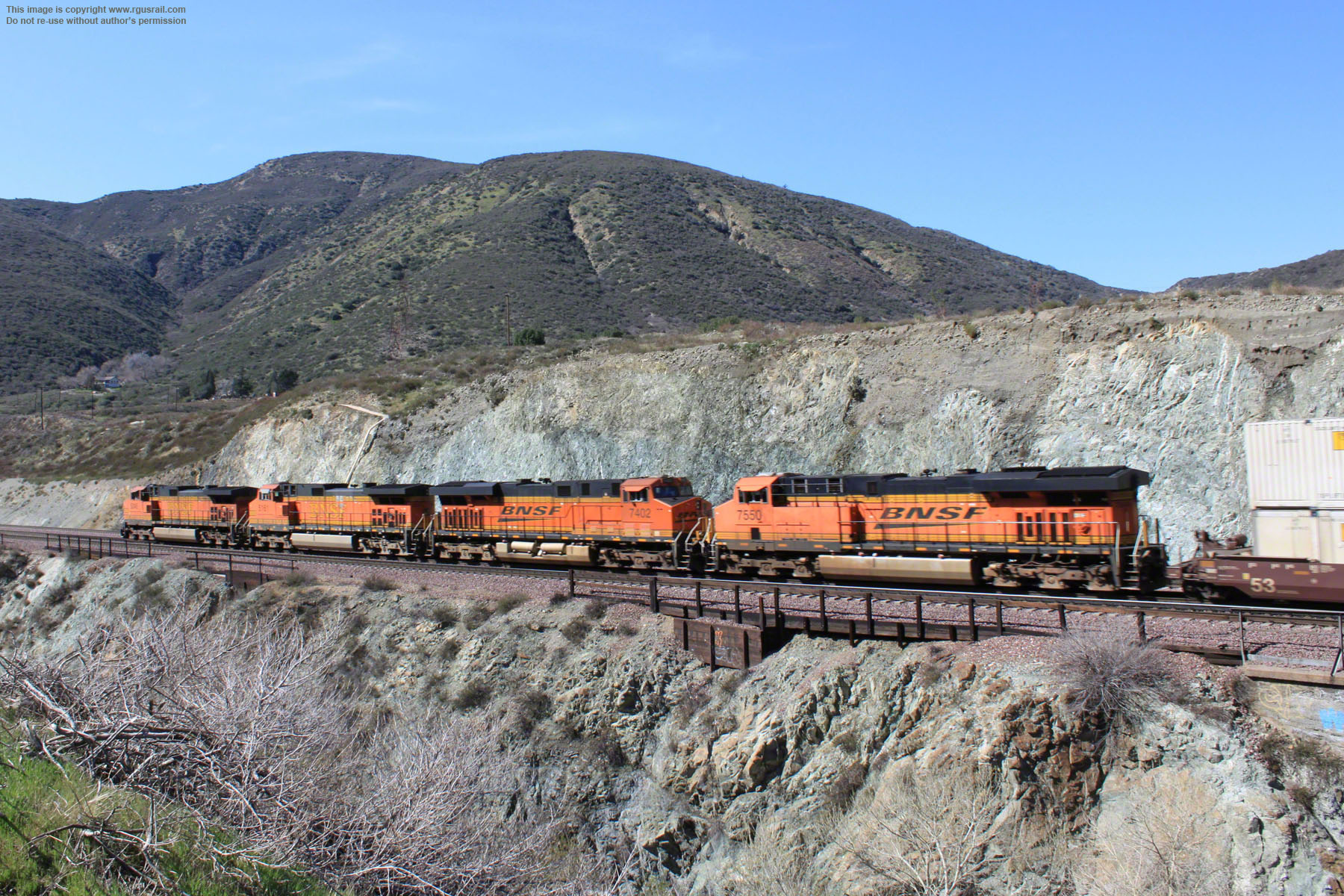
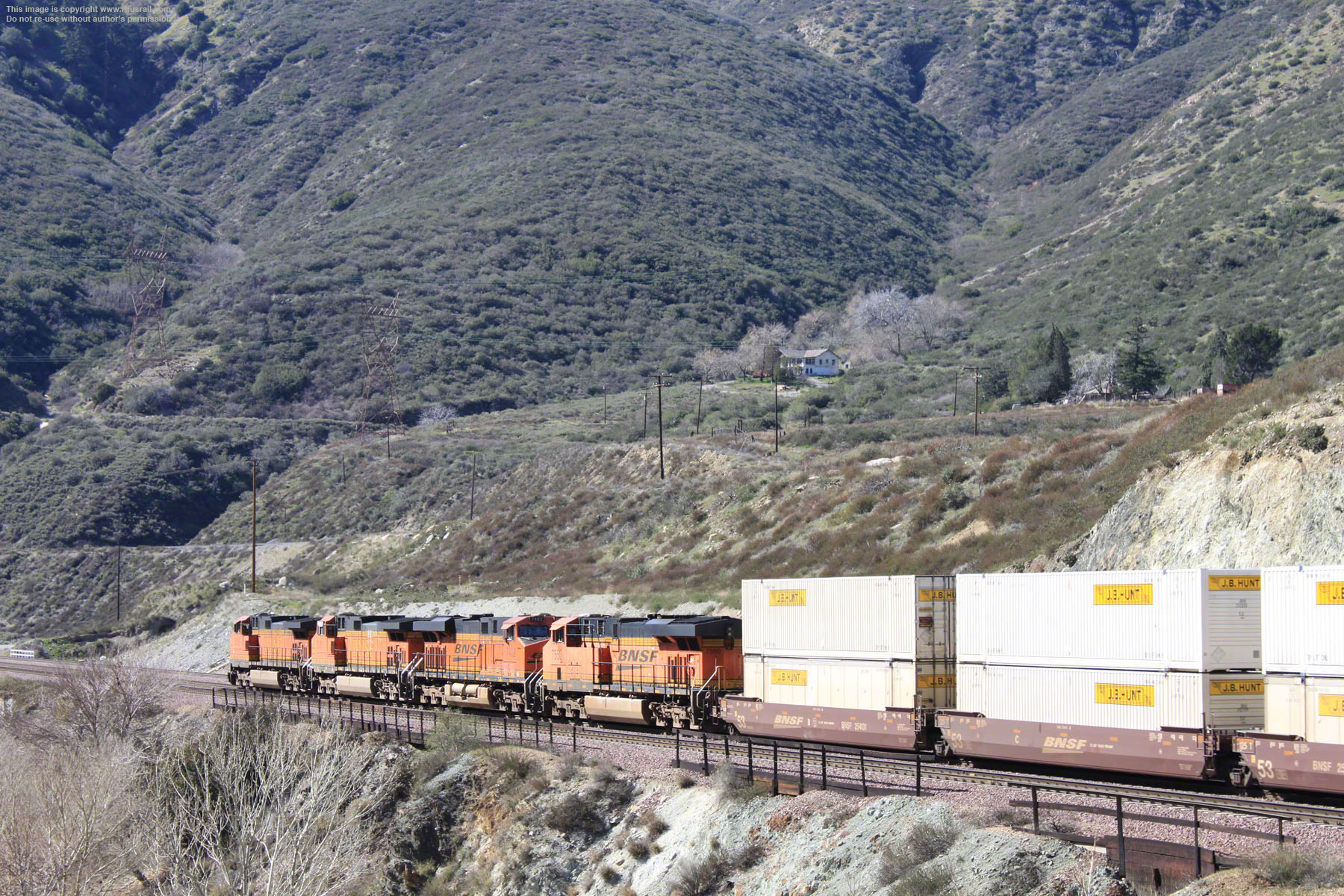
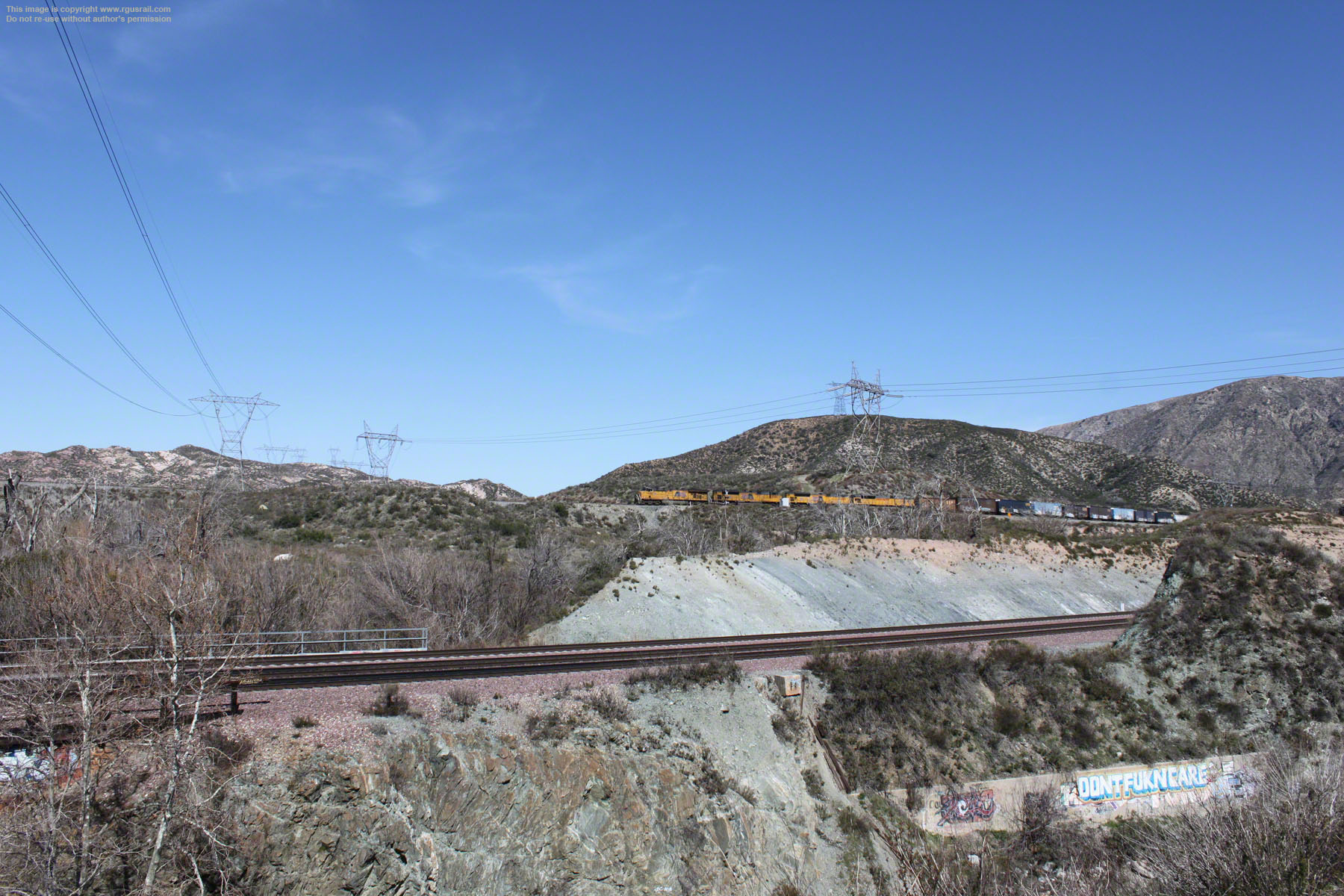
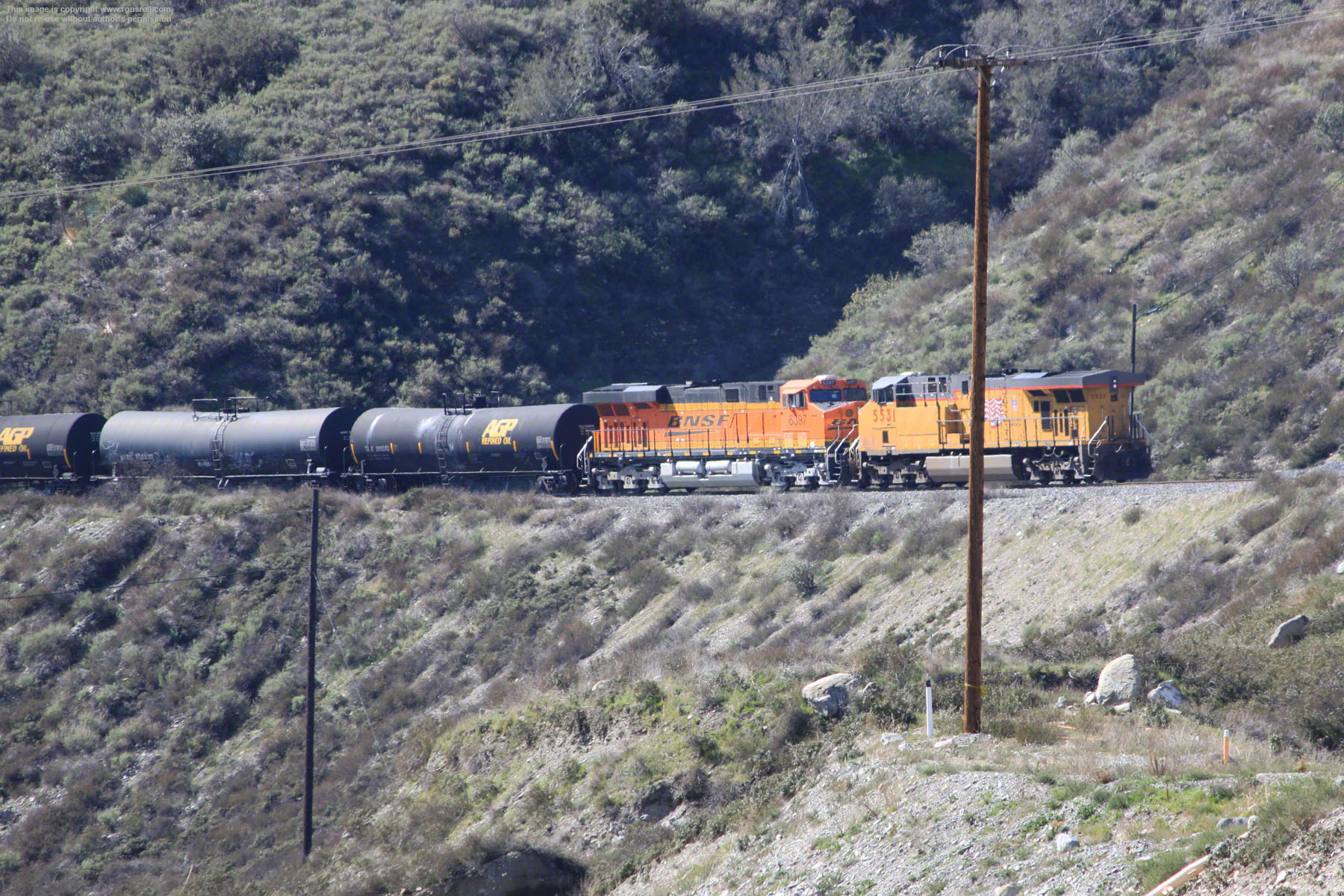
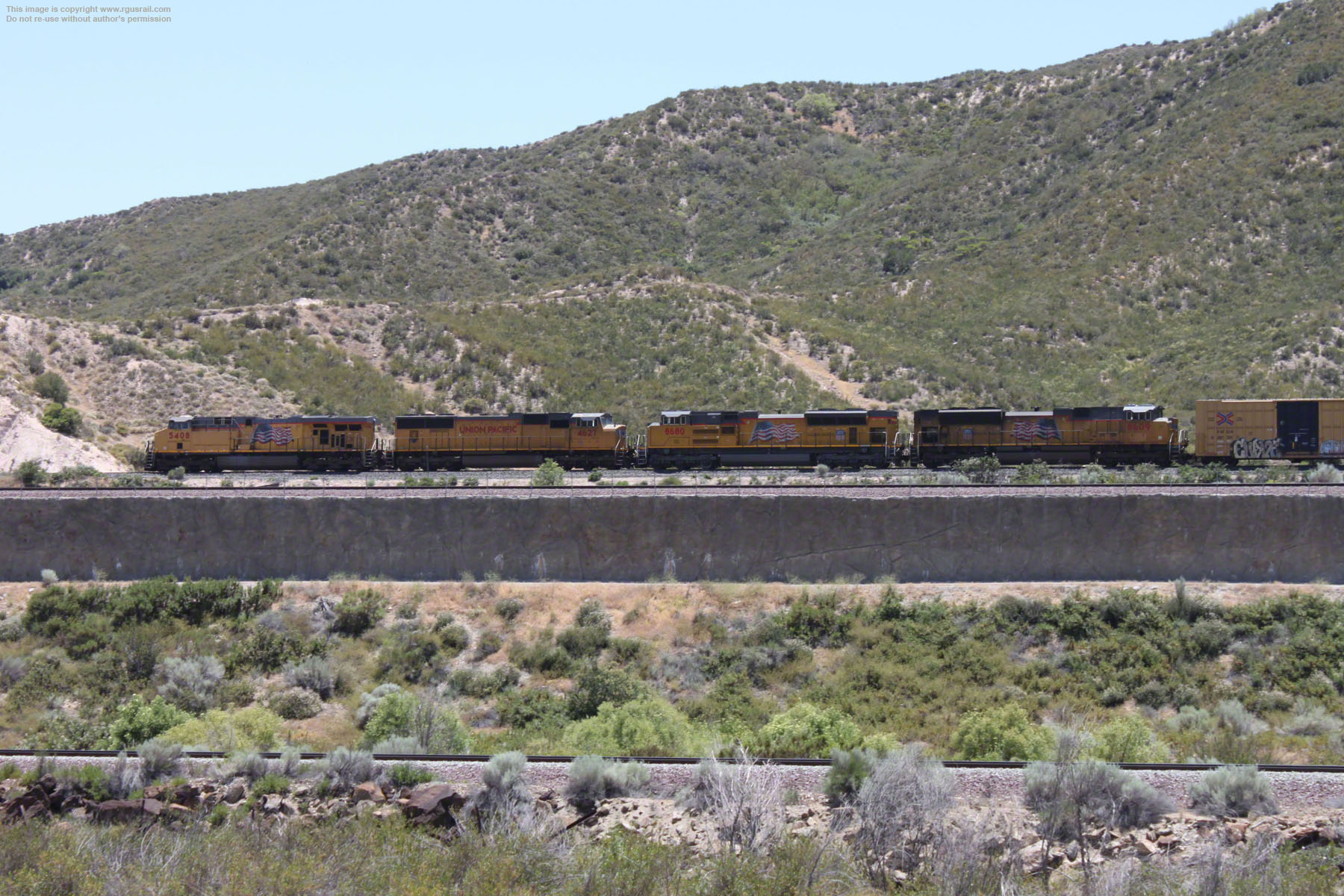
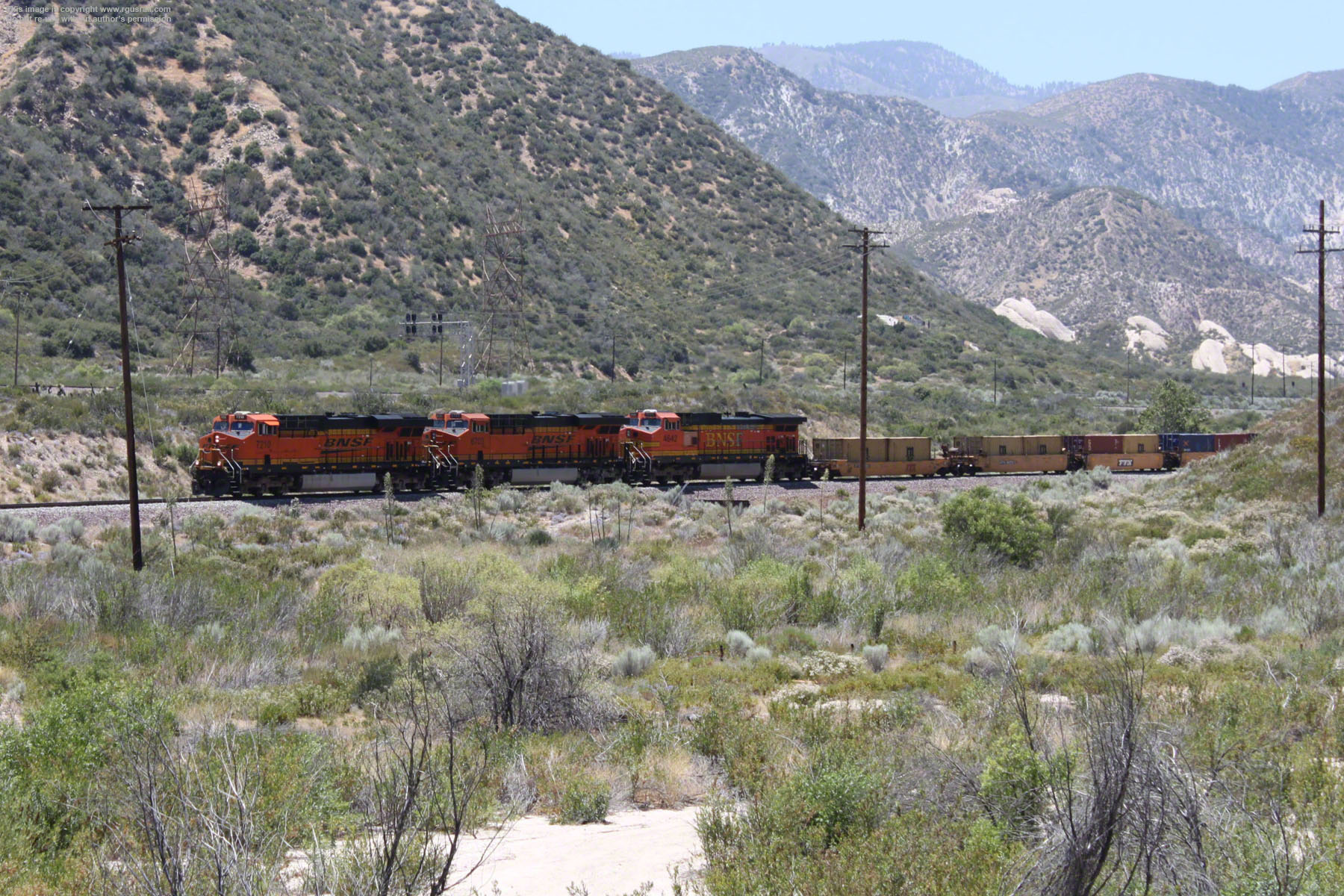
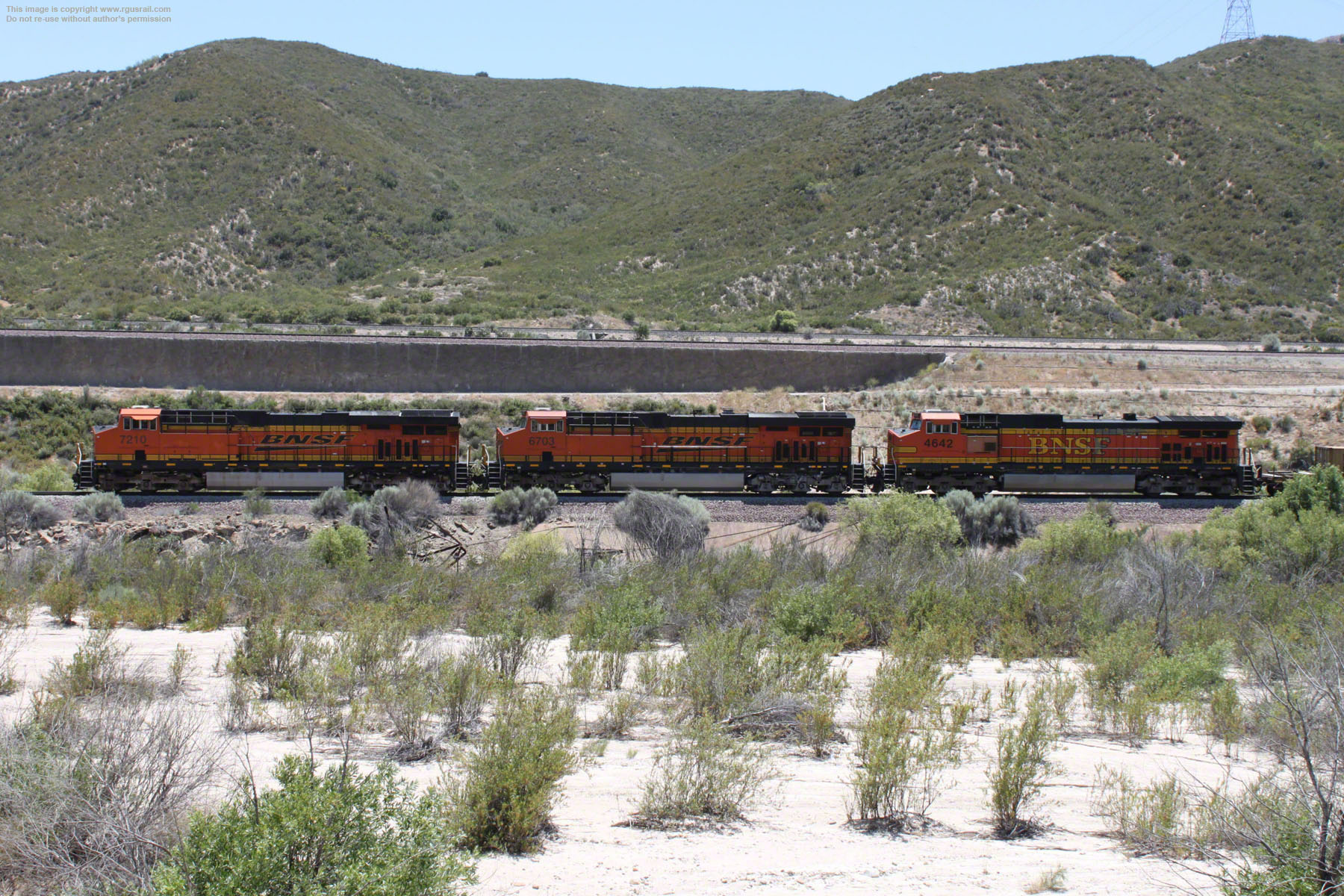
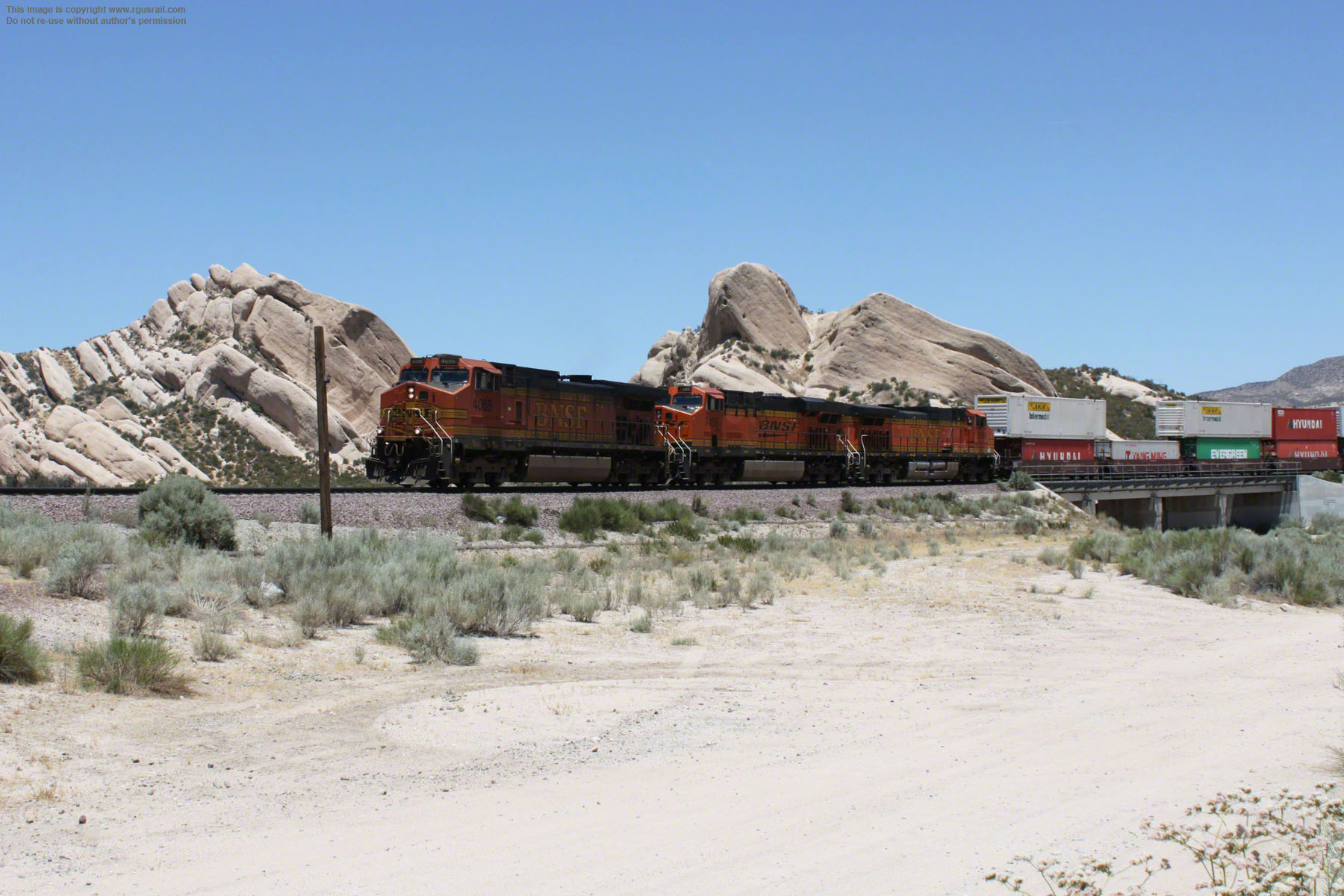
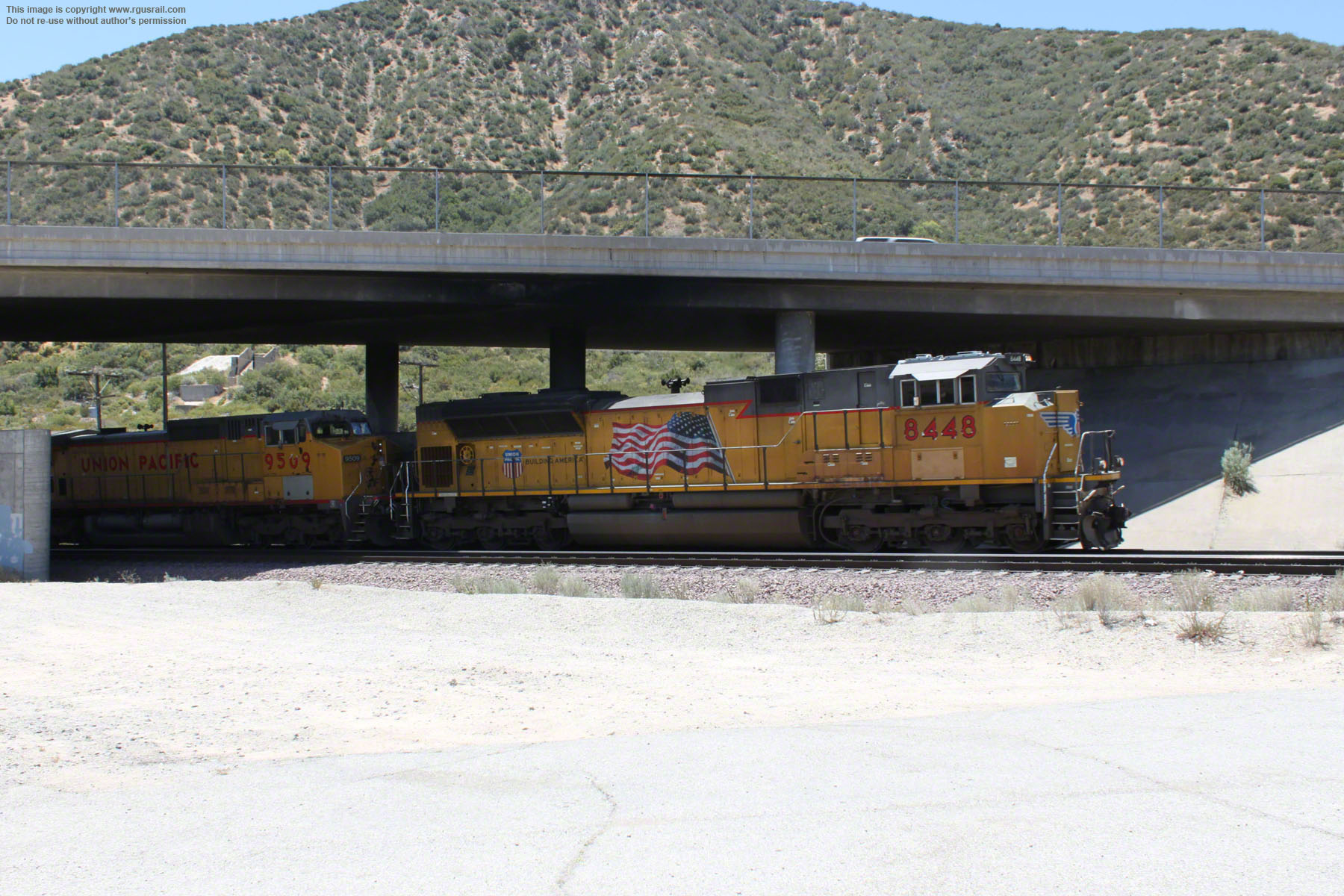
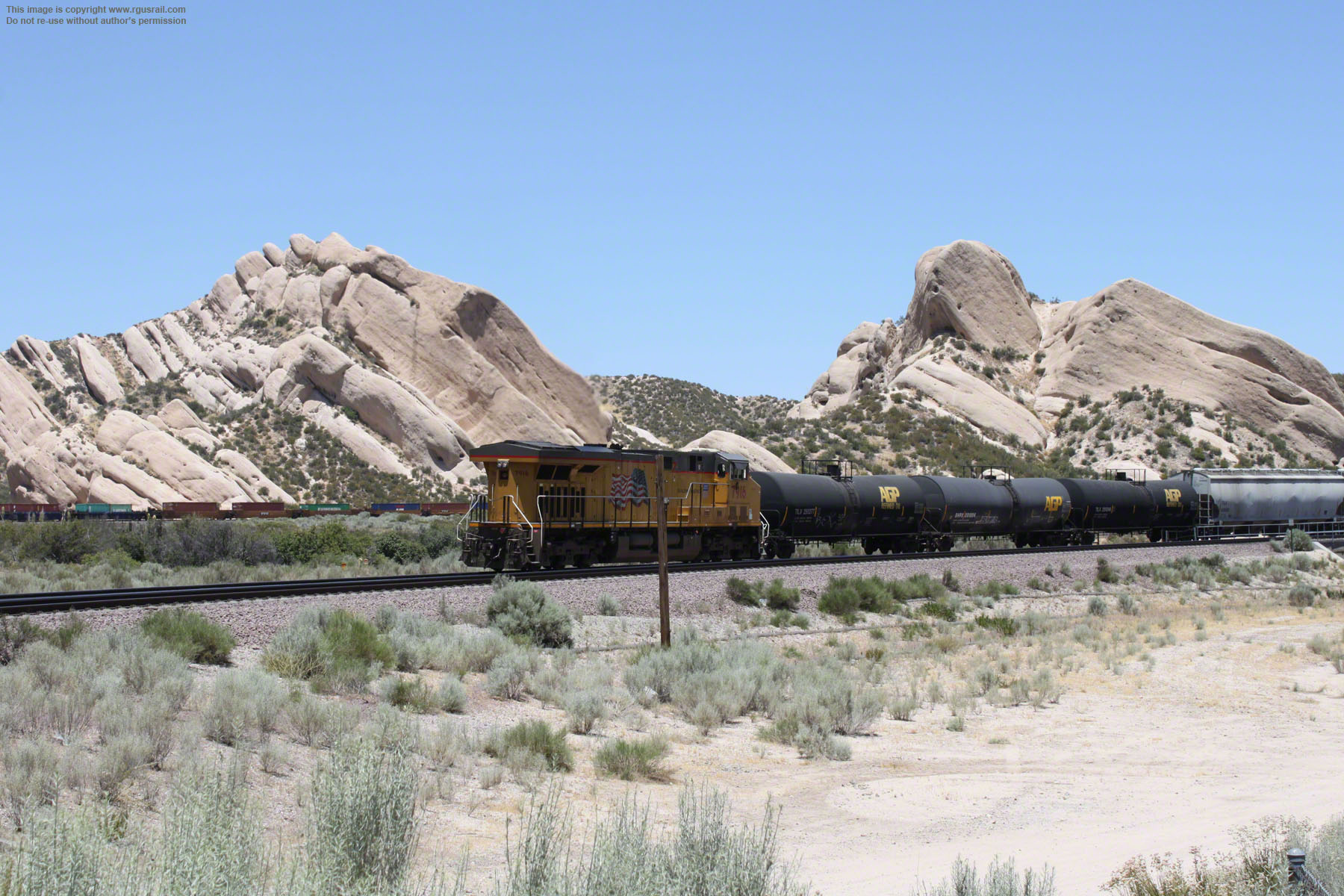
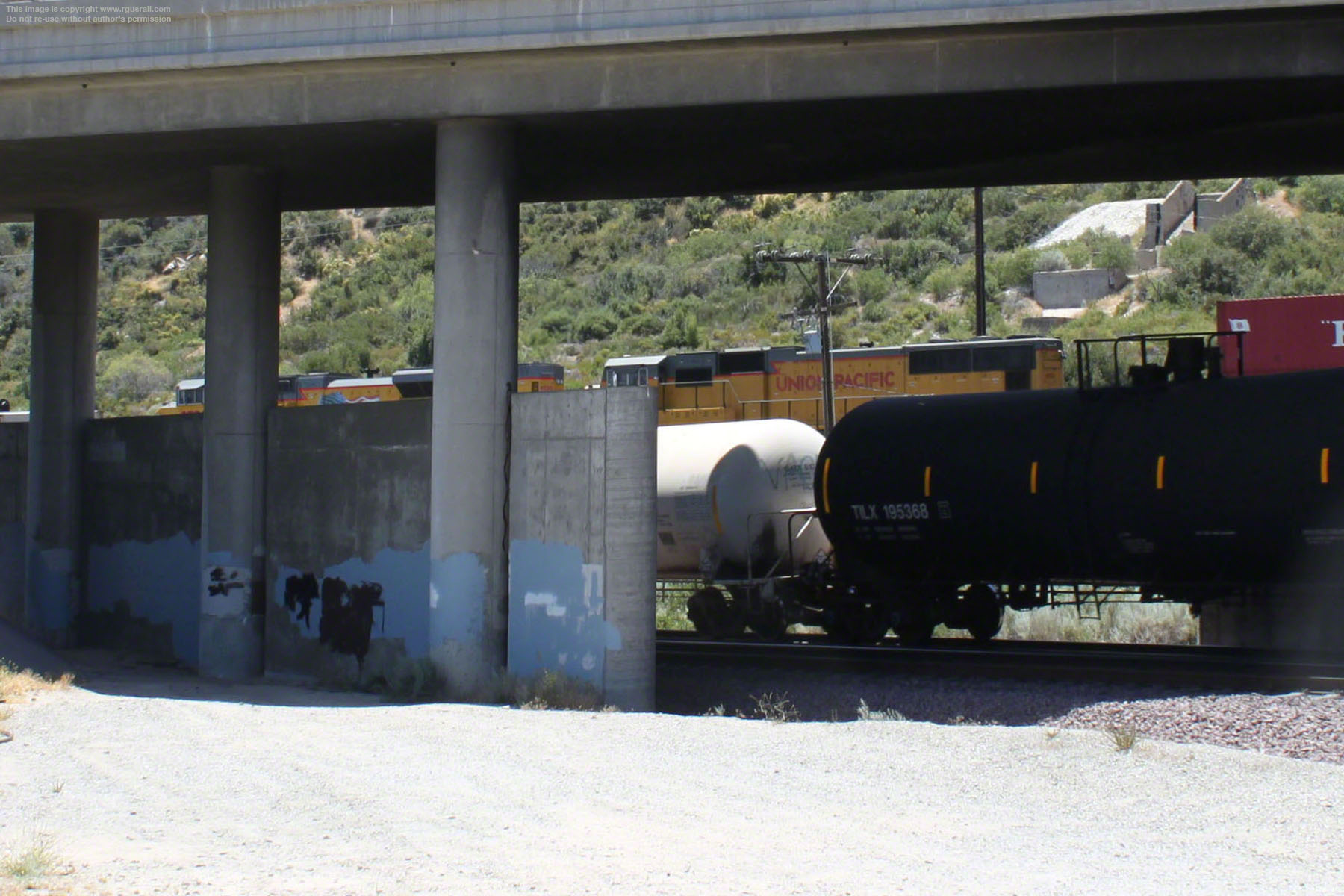
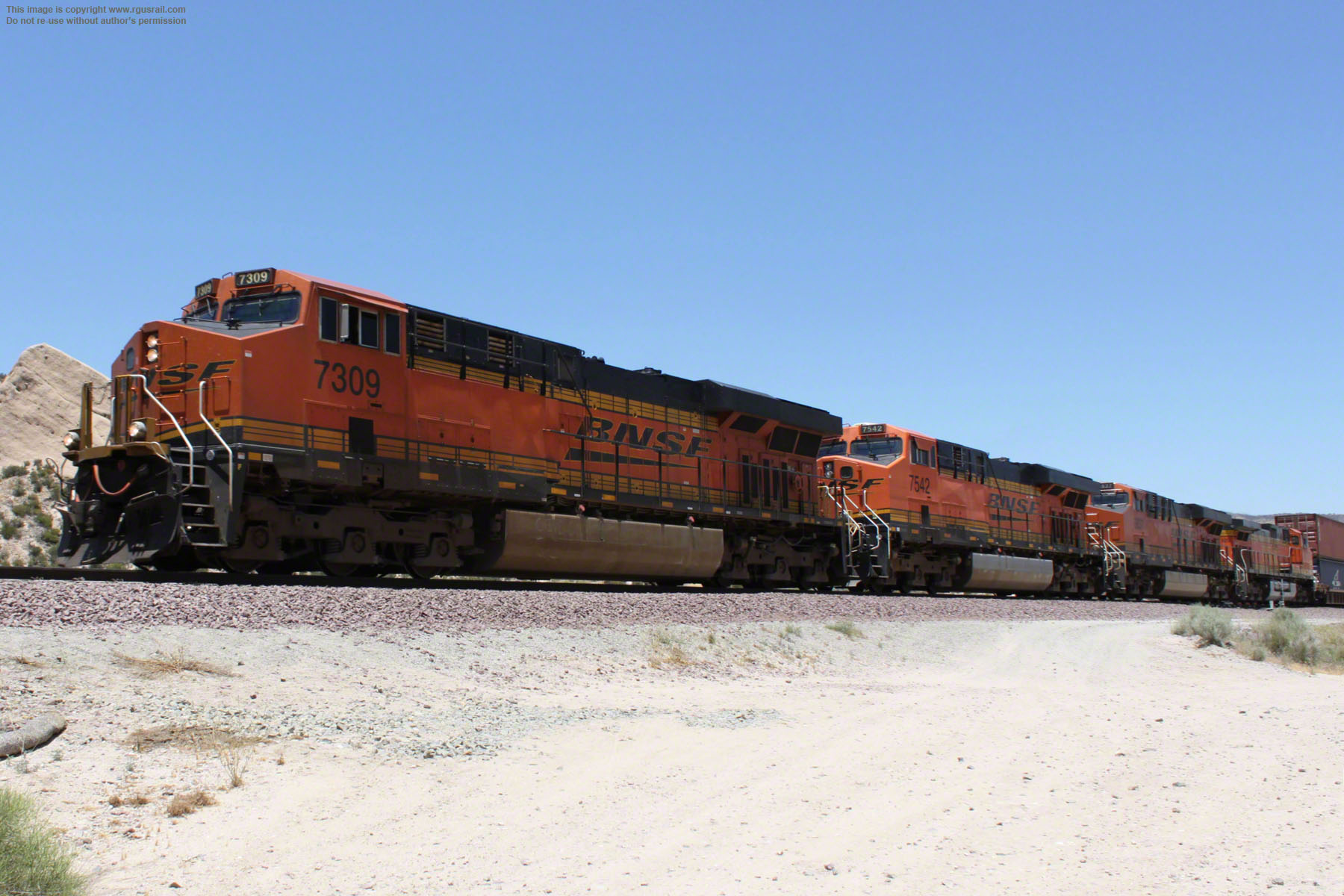
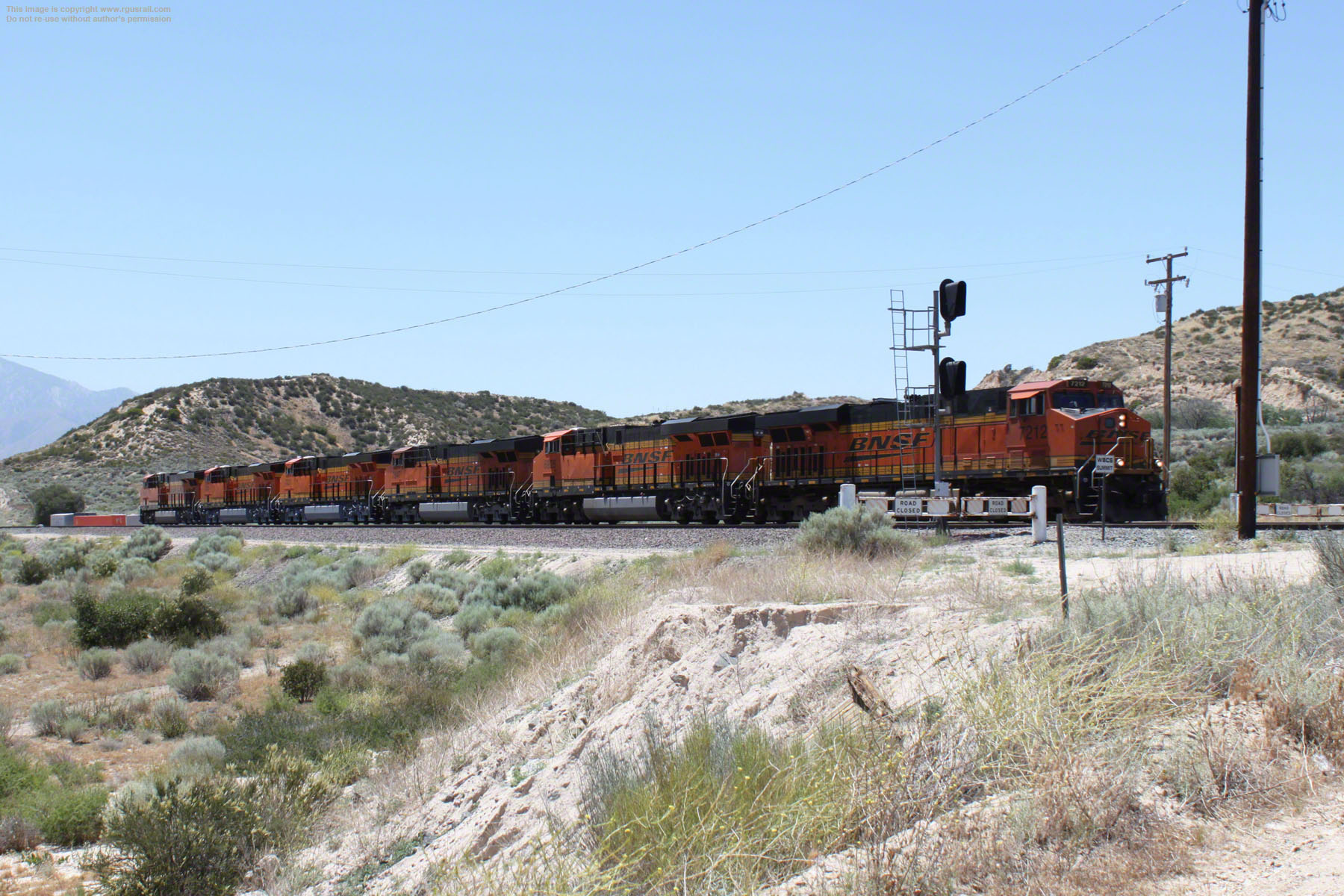
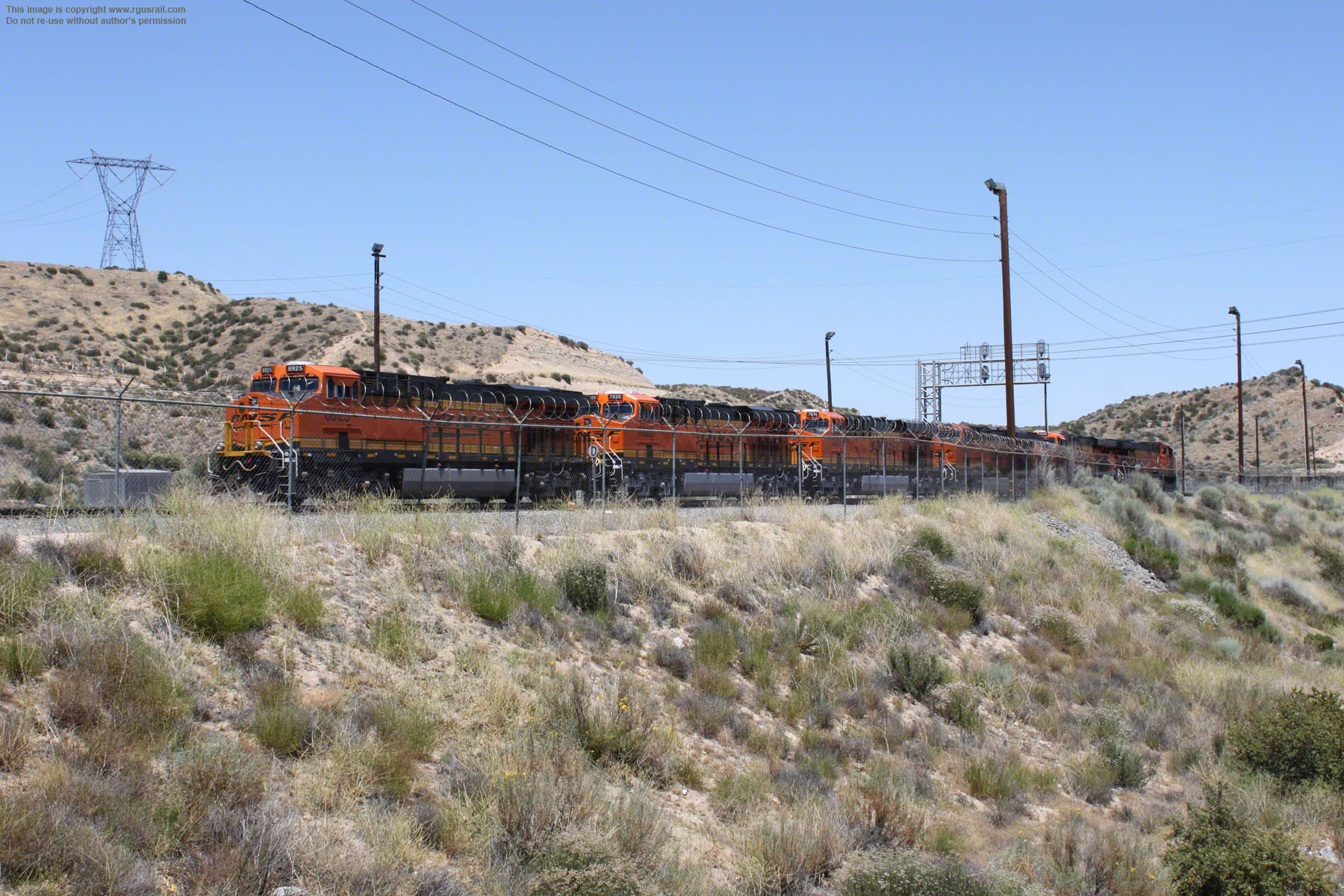
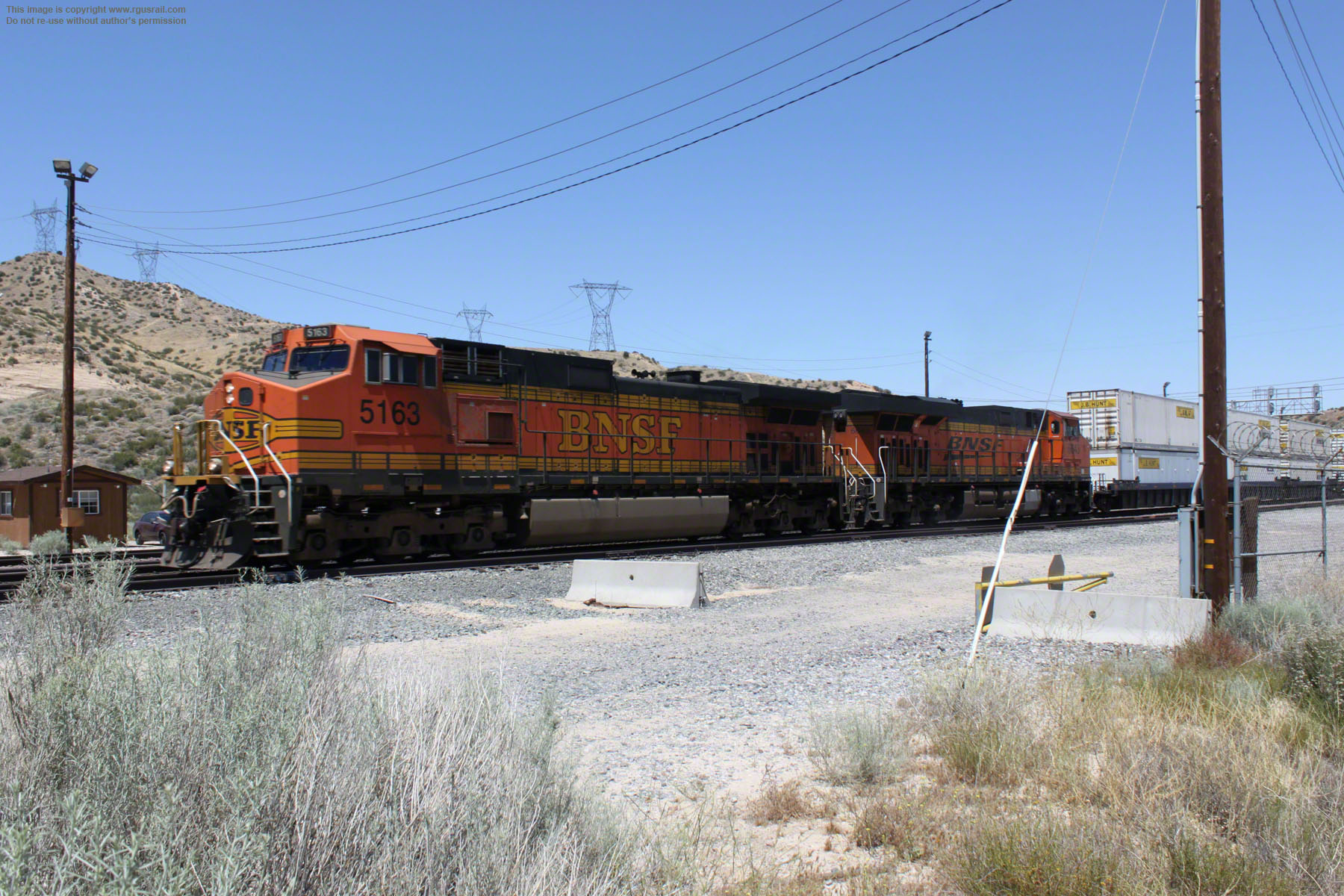
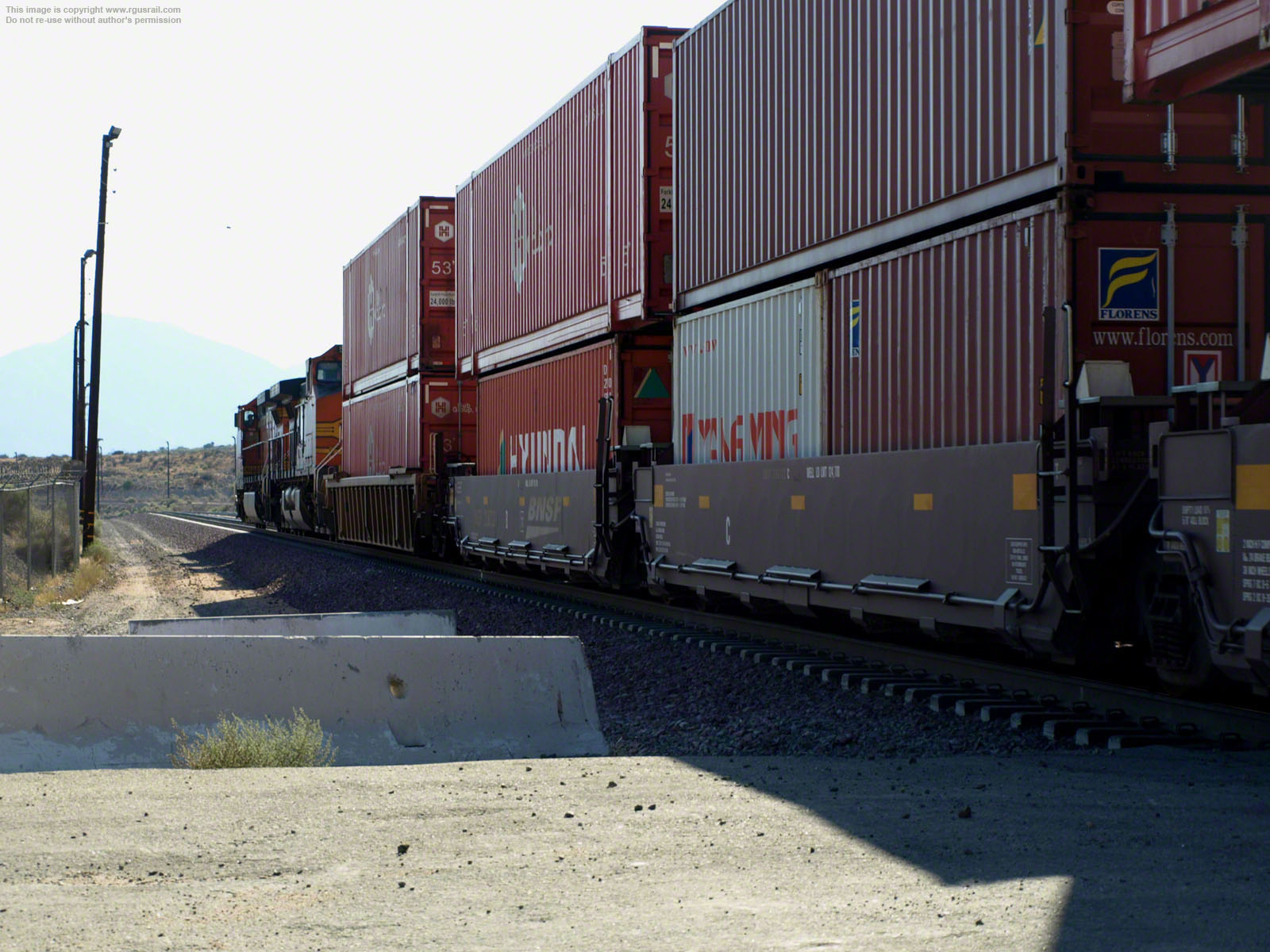
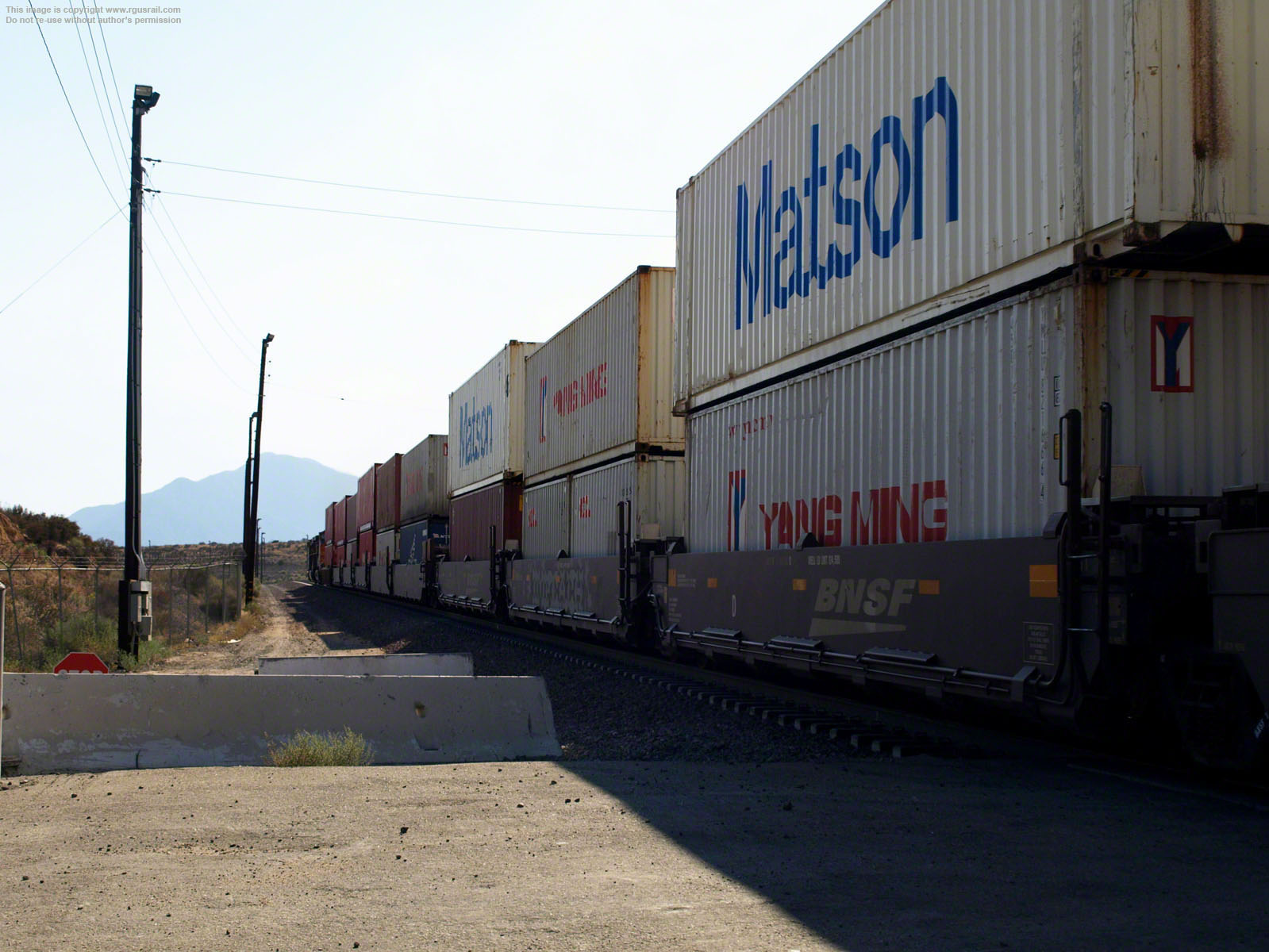
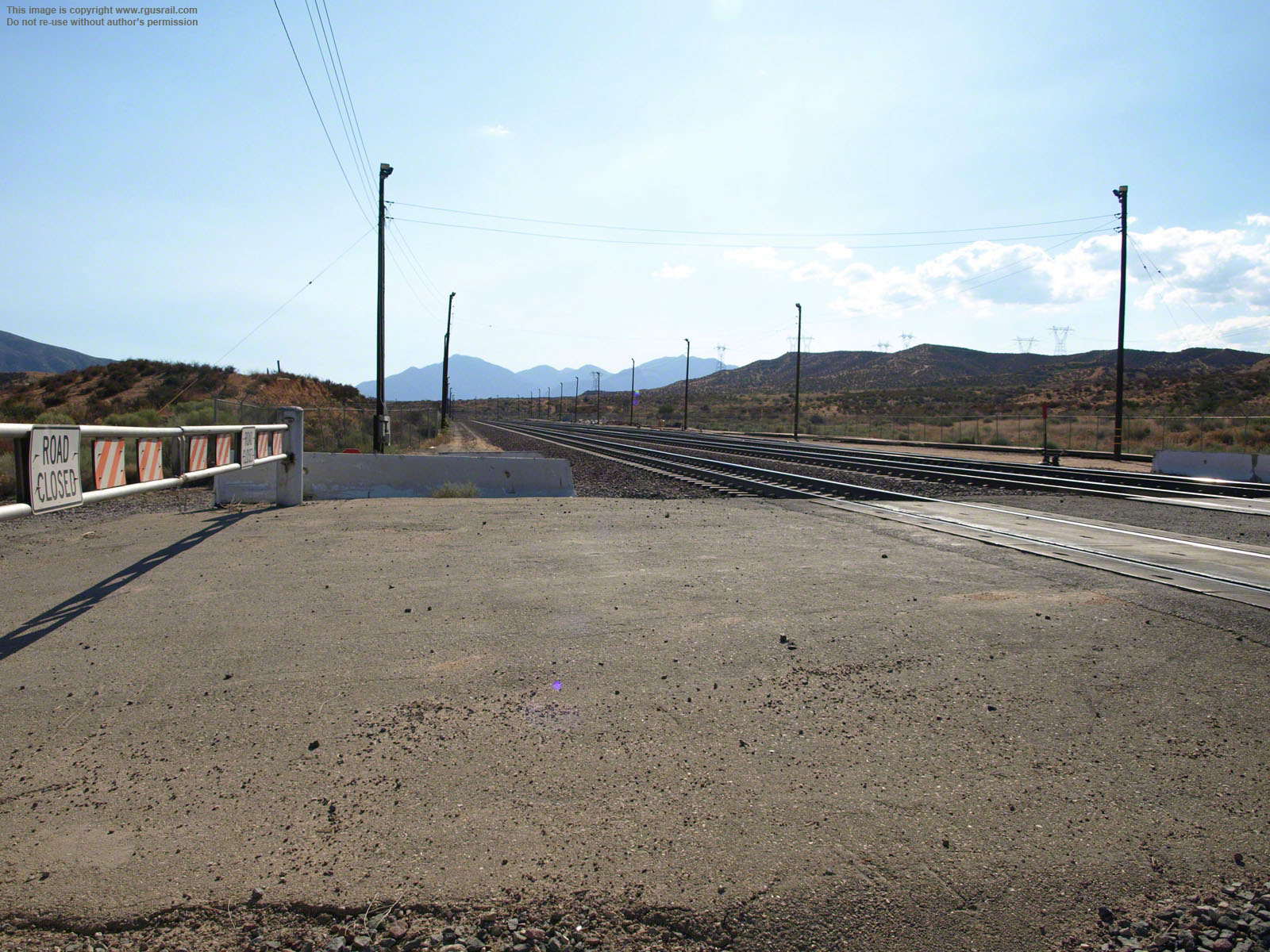
Cajon Pass is broadly understood as the area between Devore and Hesperia, CA, where the Union Pacific and BNSF railroad lines climb from the Los Angeles Basin to Victor Valley and the Mojave plateau between the San Bernardino and San Gabriel Mountains in Southern California. Devore, at the southern end, is about 60 miles from Los Angeles, and it is about 24 miles from Devore to Hesperia. Cajon Pass itself is located at the head of Horsethief Canyon on California State Route 138.
This area is a real railfan's mecca, and the year round California weather means you'll almost always find chasers about. Some go to great lengths to get that perfect shot, and there are consequently tons of sites on the web showing photographs of Cajon, many the result of years of visiting by enthusiasts.
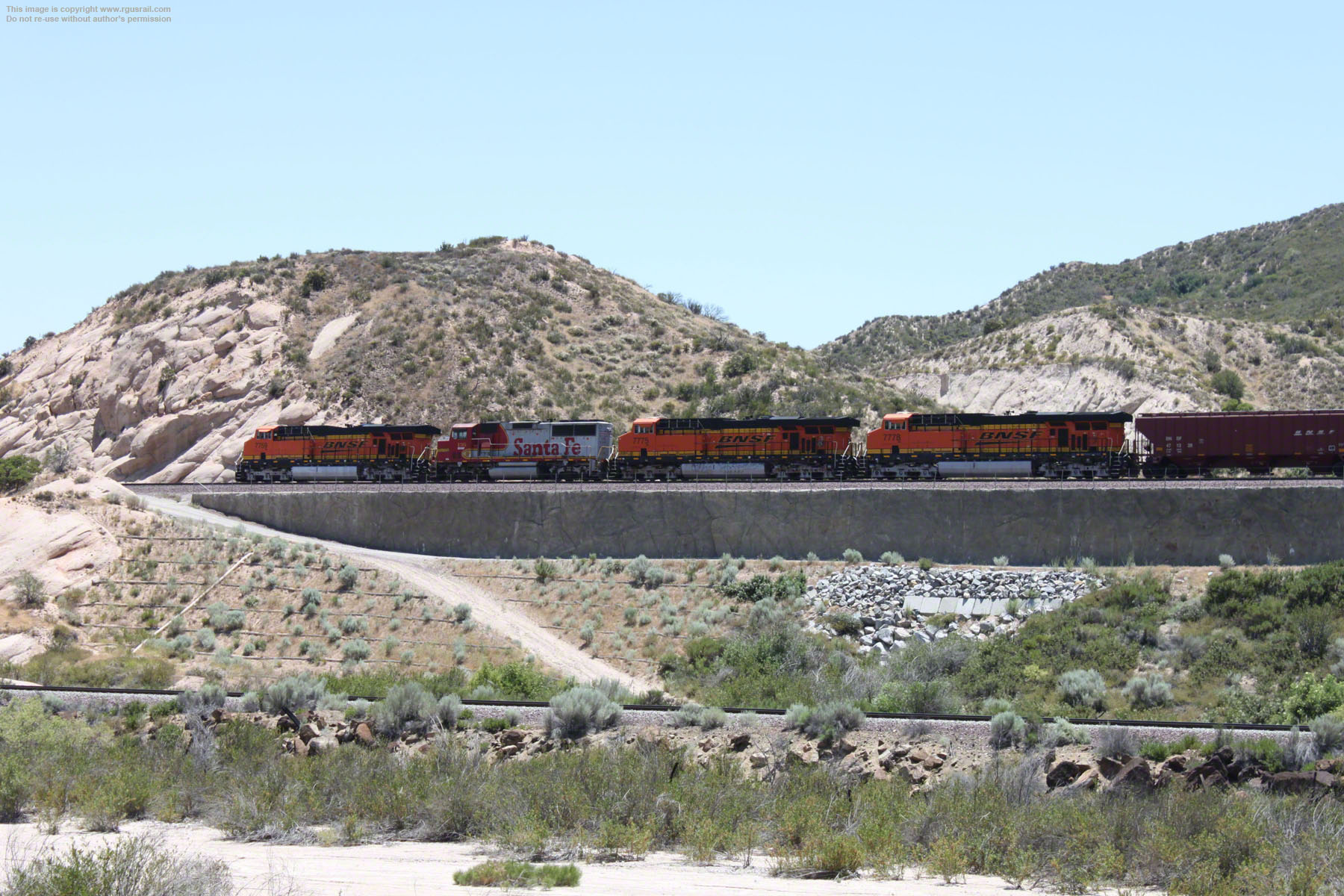
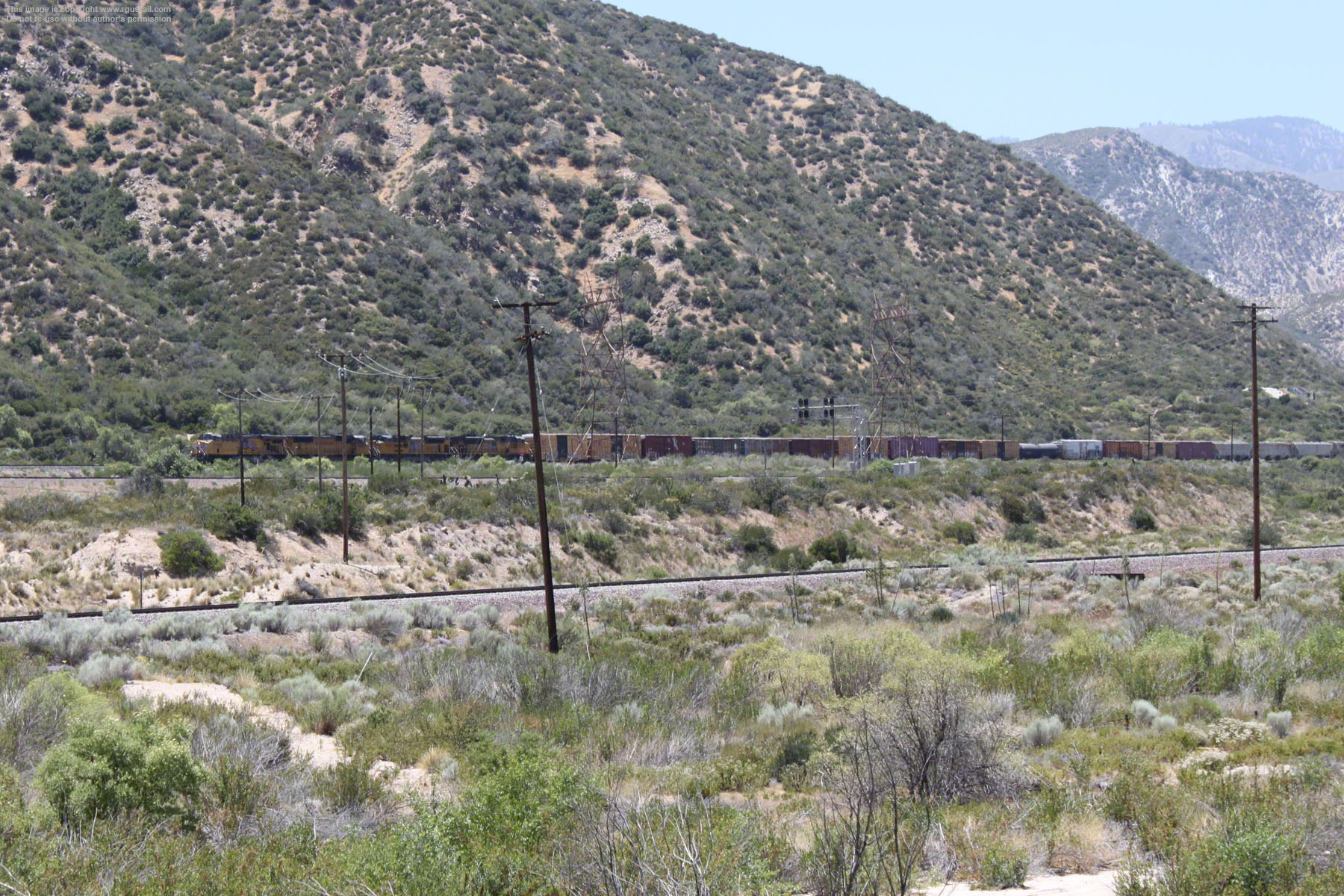
BNSF and the Union Pacific share trackage rights, so you'll see trains hauled by either carrier on the different lines. Once in a while, as I have, you may even see a mixed engine consist. I've visited the location a few times, and the photos on this page are from various visits.



The characteristic blue-gray rock, Pelona schist, which gives this area its name, is evident in all of the views above.




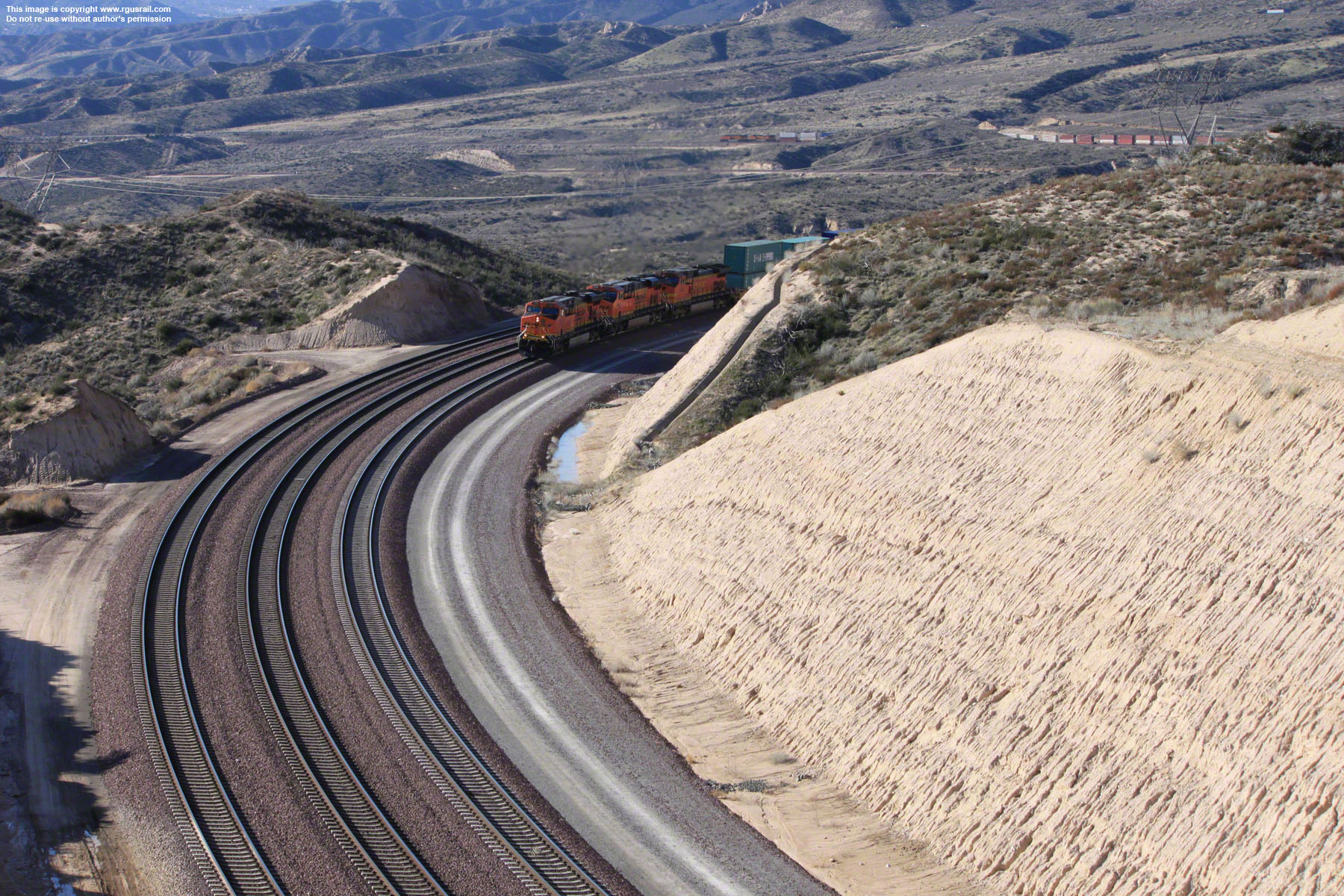
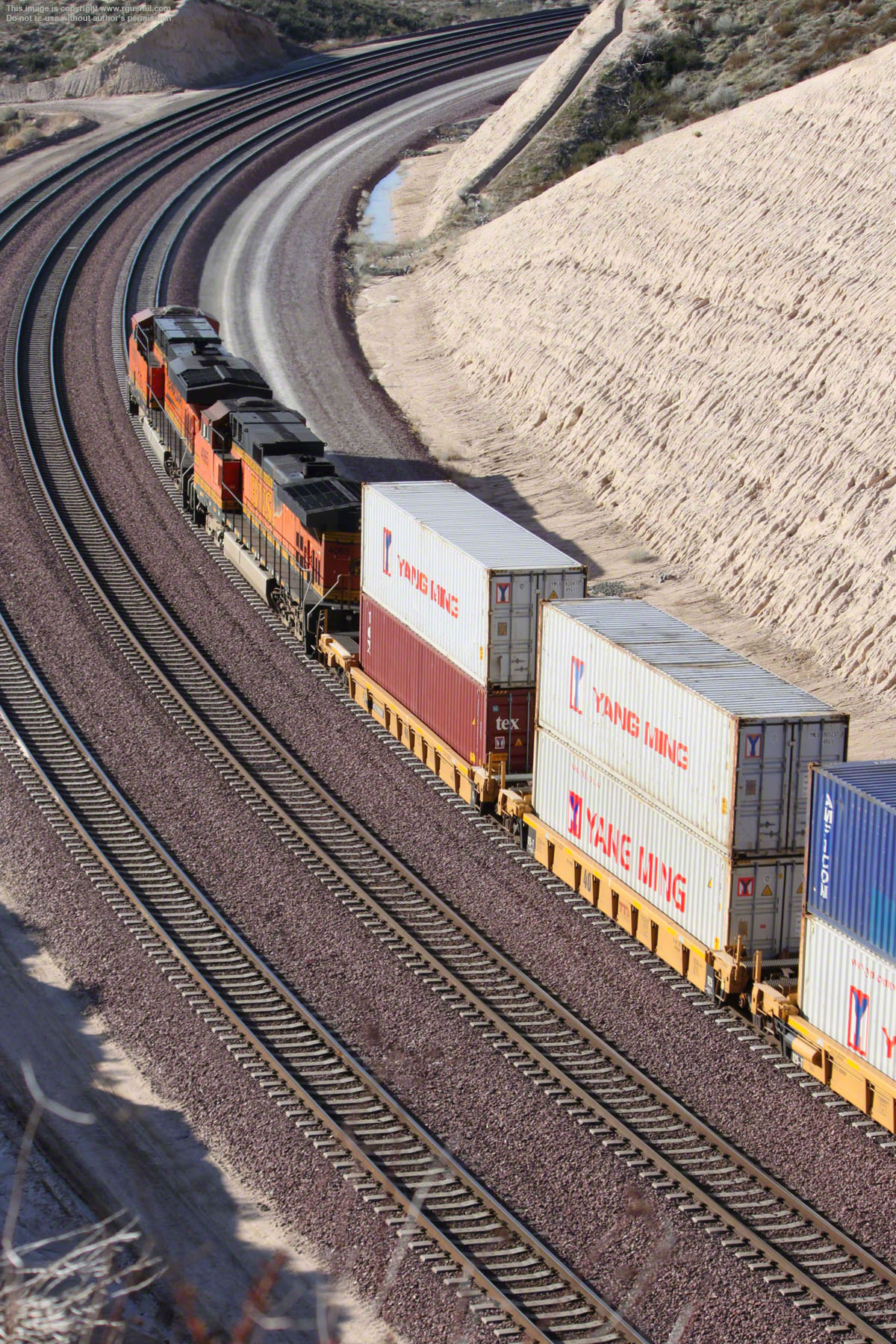
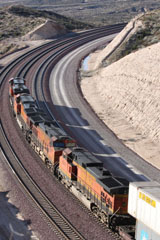
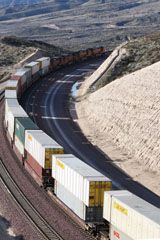
Just south of Cajon Junction, the train is about to enter Sullivan's Curve, the west spur of the BNSF line.
The head end of the train can be seen just left of centre in the top view as it enters the curve. In the bottom view, it is just visible emerging from the curve above the four tractors on the middle right.
These two photographs were taken from Cajon Boulevard just south of Cajon Junction.



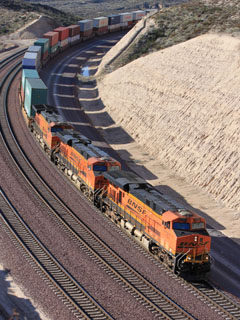
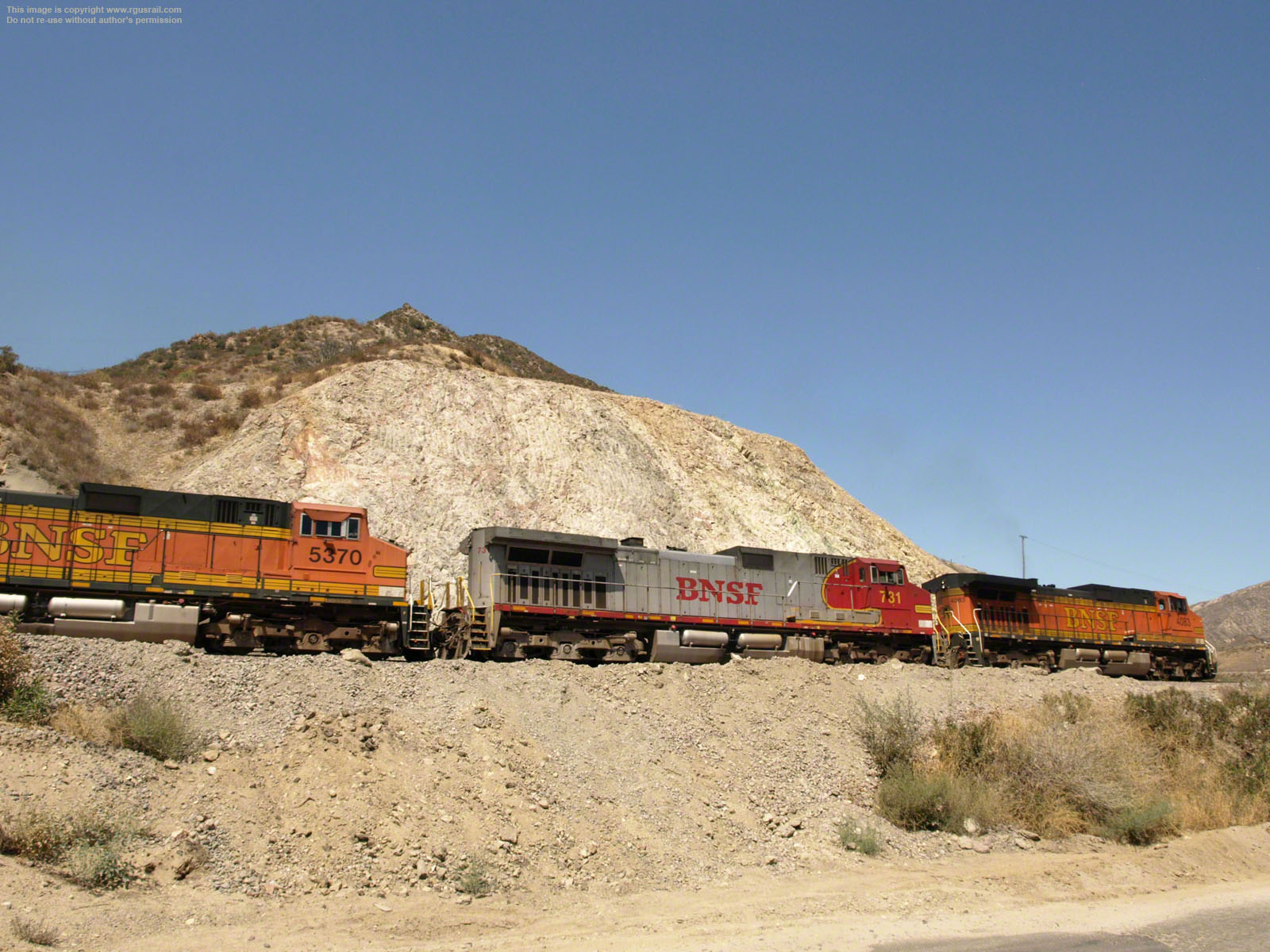
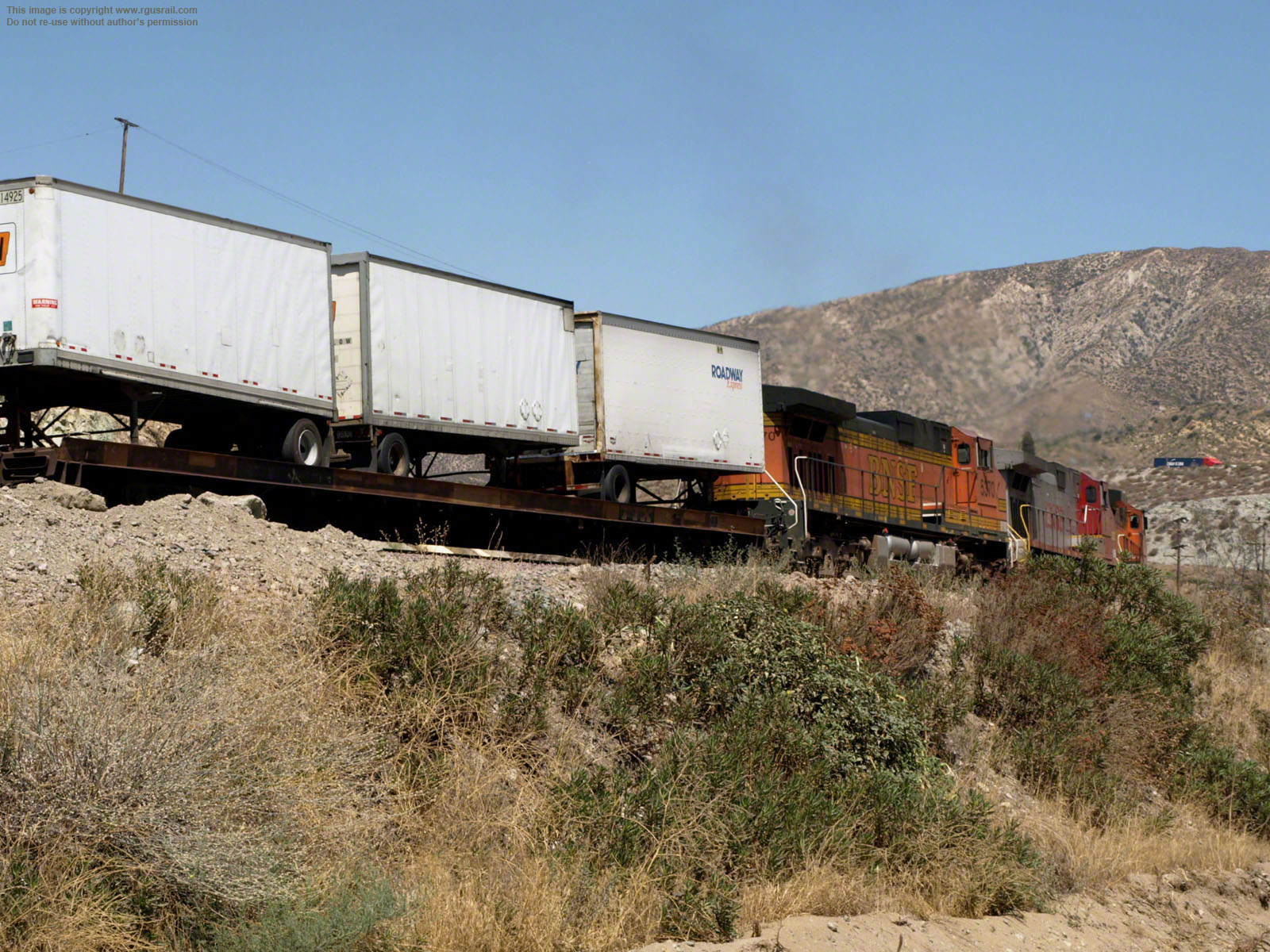
BNSF GE ES44-DC #7787, BNSF GE ES44CE #6600 and BNSF GE C44-9W #4043 about to top the grade to Summit.
BNSF GE C44-9W #4065 and BNSF GE ES44-DC #7229 are just visible at the rear of the train in the upper photo.


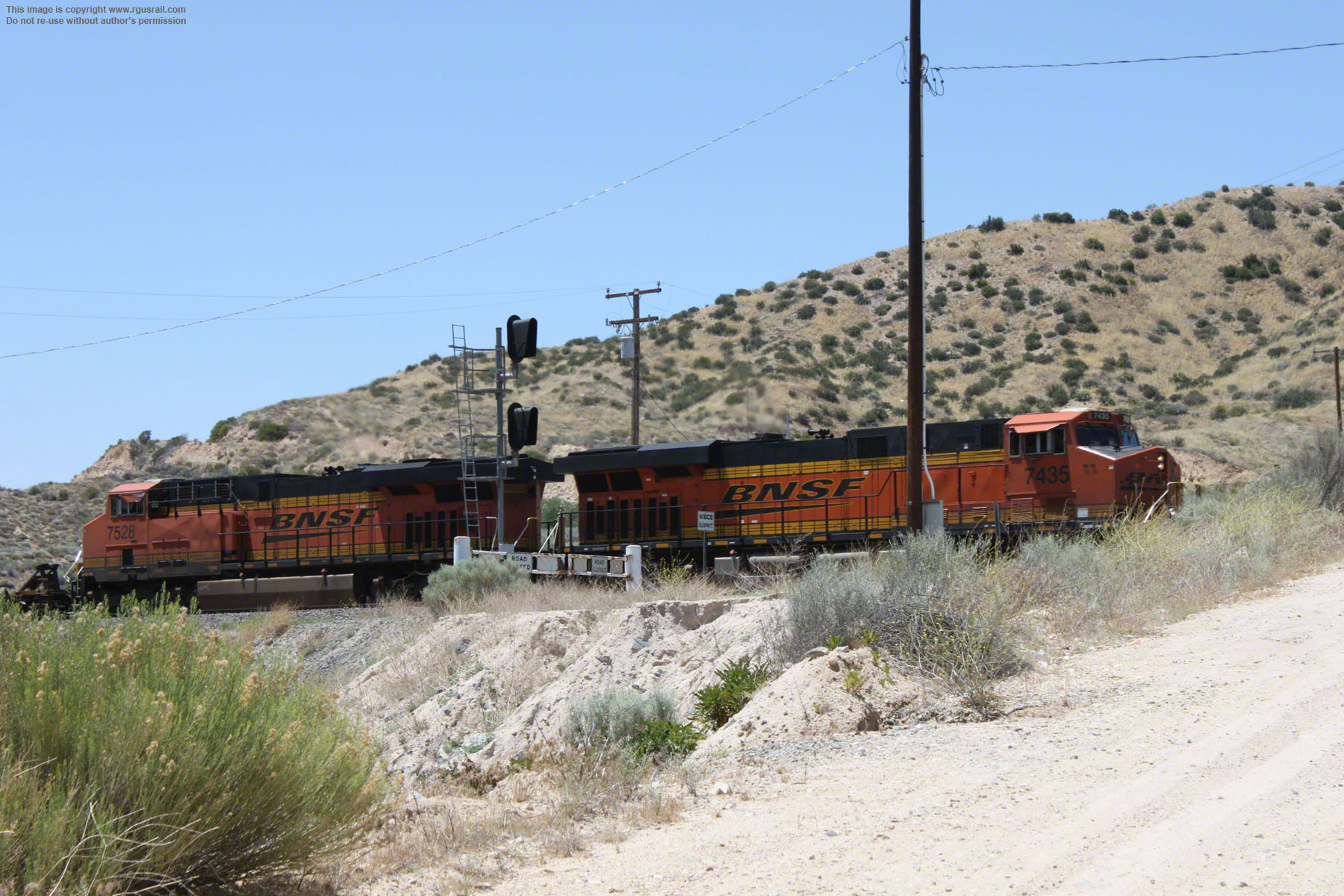
The train pulls through Summit...
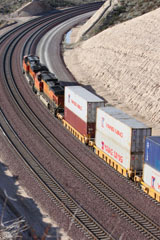
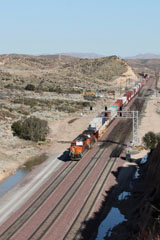
...BNSF #4065 and #7229 at the rear.
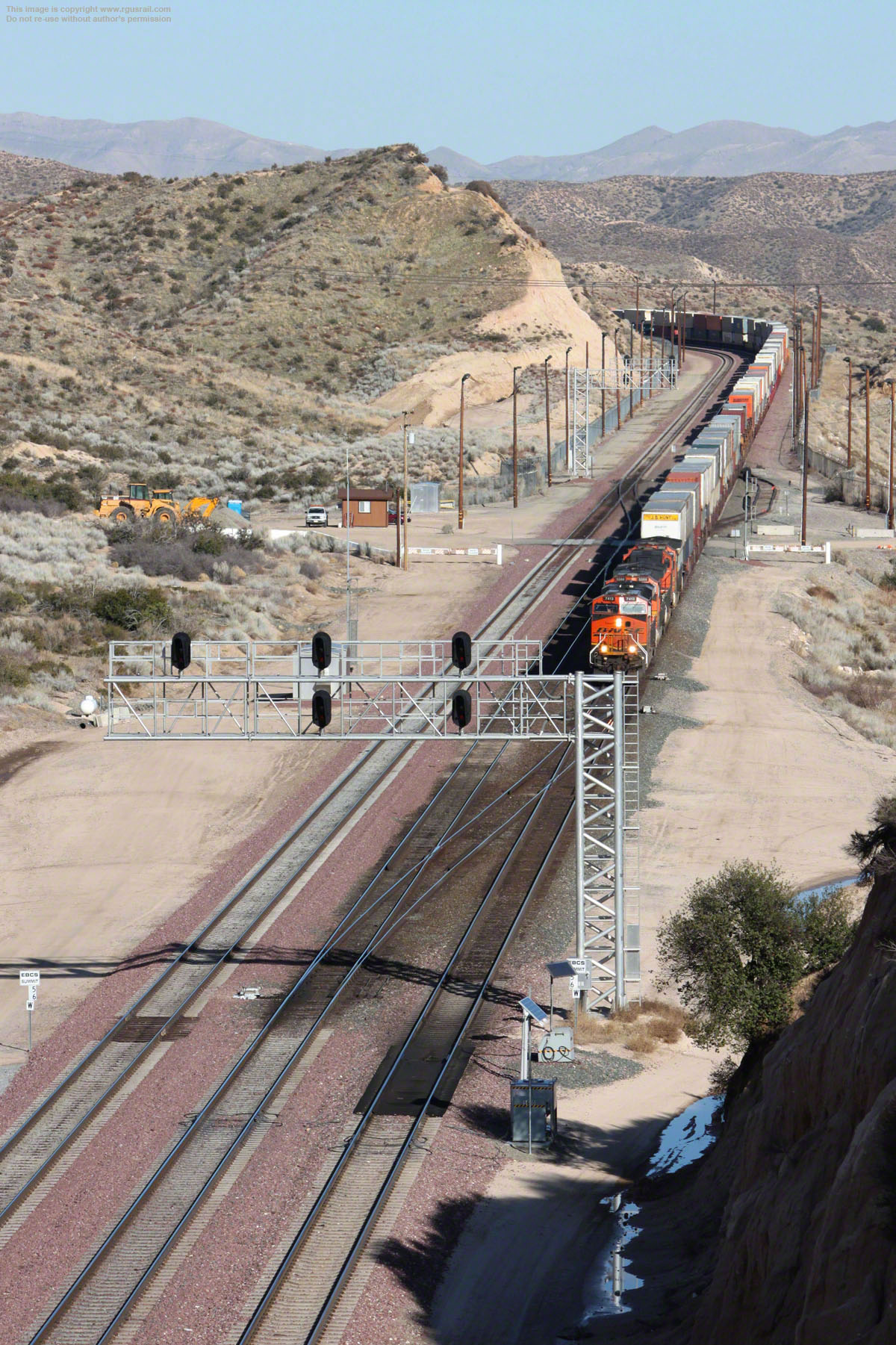
At Summit, a level area has been used to build crossovers, setout tracks and floodlighting to inspect westbound trains before they descend the 3% grade to San Bernardino. These photos were taken just off Forest Route 3N45 overlooking the cut.
Below, BNSF GE ES44DC #7413, BNSF GE ES44-DC #5086, BNSF GE
C44-9W #5067 and BNSF GE C44-9W #5014 cross from track #3 to track #2.
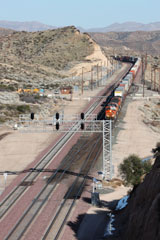
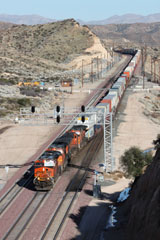
Below, BNSF #7413, #5086, #5067 and #5014 start on the down grade. Because of different grades on the Pass, the train is reverse running on this section.


Cajon Pass was formed by tectonic activity occuring where the San Bernardino and San Gabriel Mountains meet.

The area was part of the Serrano Native American Indian territory. The first Europeans to travel through the pass were deserters from the Spanish army. In 1772, Military Governor Pedro Fages led an expedition through the pass in search of deserters.

In 1848, the US gained possession of California after the
Mexican-American War. By then, Cajon was on a loosely connected route known as the "Old Spanish Trail" carrying pack wagons 1,120 miles between Santa Fe, NM, and Los Angeles, CA.
Also in 1848, a group of discharged Mormon soldiers from the Mexican-American War returned west along the trail to Utah. They took one hundred and thirty-five mules and a single covered wagon, showing that the trail could be used by wheeled traffic.

In 1850, Phineas Banning and W. T. B. Sanford built a wagon road through the west Cajon valley five or six miles to the east of the Old Spanish Trail. It was not as rough, but lengthened the trip by several miles and was described as very steep at the summit.

In 1851, Amasa Lymand and Charles Rich led a band of five hundred Mormon settlers with one hundred and fifty wagons from Salt Lake City, UT, across the Mojave Desert and down through the pass to found the City of San Bernadino.

In 1855, Sanford improved the west Cajon route with a new summit crossing about a mile and a half west of his original road. At 30%, the grades were still steep and the last one hundred and fifty yards were described as "precipitous"!

A toll road was opened through the pass in 1861 under the management of John Brown although the tolls were quite expensive: 25c for a single horse and rider, 50c for a horse and buggy and $1.00 for a wagon and span of horses.

The lease on the turnpike expired on 17th October 1882, at which time the route became a public thoroughfare.

California Southern Railroad, a subsidiary of the Atchison, Topeka & Santa Fe, built the first line through Cajon Pass to connect Barstow and San Diego, CA. It was completed in 1885 with a ruling grade of 3% and is known today as BNSF Main line No.3 or the South Track.

In 1905, the Los Angeles & Salt Lake Railroad began operating over the pass on AT&SF rails via a trackage rights agreement.

In 1912, work started on a second track north of the original AT&SF alignment. The ruling grade of the new track, which was known as the North Track was 2.2%. It is now known as BNSF Main line No.2.
Although two miles longer, the new track was used for eastbound, uphill trains, while downhill trains headed west on the original route. This meant trains had to run "left-handed", with the crews effectively on the "wrong" side of the cab

The road through Cajon Pass was maintained, improved and eventually macadamised by the County of San Bernadino. It was formally adopted as a state highway by the State Highway Commission in 1915.

In 1921, the Union Pacific gained a controlling interest in the Los Angeles & Salt Lake. The LA&SL trackage rights were transferred to the UP, which then gained access through Cajon Pass, and the agreement is still in effect.

In 1926, the road through Cajon Pass became part of the new, two thousand, four hundred and forty-eight mile US Highway 66, from Chicago, IL, to Los Angeles, CA.

In 1953, a new northbound highway was built from Devore parallel to the original road, which became the southbound double lane part of the new Interstate Highway 15 the following year.

In 1967 the Southern Pacific Railroad built a new, single-track line from West Colton to Palmdale, CA, fairly close to the existing AT&SF alignment between Devore and Summit. It was designated the "Palmdale Cutoff" and included two tunnels at Alray.

In 1996, the Union Pacific merged with Southern Pacific. The Palmdale Cutoff was then rolled into the Union Pacific and AT&SF trackage agreement. Currently, both the Union Pacific and BNSF have joint trackage rights throughout the Pass.
In 1996, Burlington Northern and the AT&SF merged to form the Burlington Northern Santa Fe Railway (BNSF). The railroad has over 33,000 route miles in twenty-eight US states, as well as in two Canadian provinces. The Union Pacific has over 38,000 route miles in twenty-three US states.

In 2007-08, the two tunnels on the Palmdale Cutoff were "daylighted" when a third track was laid by BNSF along the route. This increased potential daily capacity to one hundred and fifty trains.

Depending on circumstances, anything between a hundred and a hundred and fifty trains run through Cajon Pass every day. As well as the BNSF and UP freight trains, there are two Amtrak trains: The Southwest Chief eastbound and westbound.